

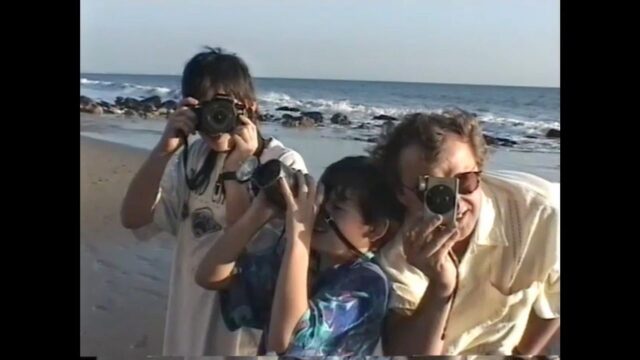
One day a few years ago, filmmaker Marcin Borchardt received a phone call with a proposal. The call came from Andy Chojecki, a Polish producer based in Los Angeles, and Barbara Ławska, a production manager at the Documentary and Feature Film Studio in Warsaw. They asked whether Borchardt would meet and talk about the possibility of making a film telling the story of the Polish cinematographer, Piotr Sobociński (1958-2001), whose credits ranged from Krzysztof Kieslowski’s Three Colours: Red to Robert Benton’s Twilight starring Paul Newman.
Sobociński was a brilliant cameraman, but one who had struggled with the extreme stresses of working within the Hollywood system in the latter part of his career. He died of a heart attack while still in his creative prime.
At first, Borchardt was wary. “I receive quite a lot of calls like that, and in 99 percent of cases nothing really comes from them,” he notes.
In this case, though, Chojecki had been a friend of Sobociński. He also mentioned the “magic words” that there was “a large amount of home movie footage available,” and suggested that this might at least be worth taking a look at.
Soon afterwards Borchardt met Michał and Piotr, Piotr Sobociński’s sons – both now acclaimed cinematographers in their own right. Over the years, the family archives had become scattered among different relatives and stored away in attics, basements and private homes. The sons had gathered everything together and decided to entrust it to Borchardt. This treasure trove forms the basis of Borchardt’s new feature documentary Magic Hour (a world premiere in International Documentary Competition of the 66th Krakow Film Festival).
“I transported the materials to my home in several car trips because it was physically impossible to move everything at once. It was in many different formats – 8mm, 16mm, VHS, various digital video formats, even HDV tapes in both European and American standards, but there were also tens of thousands of photographs, albums, diaries, letters, film awards and all kinds of personal objects and memorabilia,” the director remembers.
During the following months, Borchardt set about digitising the archive. He wanted to understand “what was actually hidden on those tapes and whether there was enough substance there for a feature documentary.” In the end, he discovered he had around 250 hours of footage at his disposal.
Some of the oldest materials were shot by Piotr’s father, Witold Sobociński, on film stock from the late 1940s, 1950s and early 1960s. From the perspective of film history, this was valuable stuff. Witold was a legendary cinematographer who had collaborated with directors from Andrzej Wajda to Jerzy Skolimowski and Roman Polanski.
Other material came from films on which Piotr himself had worked, including those made in Hollywood and those directed by Kieslowski. These were all home movies – recordings of family gatherings, holidays, birthdays and off-duty moments on film sets.
“What struck me most was the evolution that gradually revealed itself over time. The material documents Piotr’s life and career from roughly the late 1980s until his death in 2001. While watching it chronologically, I began to notice a slow erosion, small fractures appearing in his relationships with the people closest to him, and profound changes happening inside him,” Borchardt notes.
Piotr’s growing loneliness became apparent in the footage he shot in all those luxury hotel rooms and apartments where he stayed while working on the big US movies.
“At first, his family accompanies him, but later he is increasingly alone. Since he never really separated himself from the camera, he kept filming his off-set reality, and that reality became empty hotel rooms,” Borchardt observes. “That was perhaps the most unsettling discovery for me. I found countless shots of anonymous hotel interiors and temporary spaces filmed between productions. It was as if the camera had unintentionally captured the psychological cost of that career and that lifestyle.”
Piotr had a relentless work ethic. When one project finished, although he was often exhausted, he would only wait a week or two before embarking on a new and equally ambitious one.
One partial explanation for his behaviour was that he was trying to live up to the reputation of his father. “Witold was an extremely powerful and dominant personality. He was demanding, uncompromising and fully aware of his own artistic stature. Piotr grew up in the shadow of somebody legendary,” the director says of the father-son relationship.
Witold had a different personality to that of his son. Supremely self-confident, he simply wasn’t prey to stress on film sets. “For him, filmmaking was almost a kind of grand adventure or game…everything seemed to come to him naturally and effortlessly.”
By contrast, Piotr was “delicate, highly sensitive, inward-looking, much more of a vulnerable artistic soul.” It was his dream to get to Hollywood but once he arrived there, he was thrown into a working culture that was radically different to what he had become accustomed to in Poland. He was in charge of huge crews of highly talented technicians but the goal was nearly always the same – simply to make movies that would succeed at the box office.
“What Hollywood wanted in the early 1990s was precisely that European artistic stamp. Large American productions were searching for cinematographers who could bring visual depth and emotional ambiguity into highly industrial productions. Piotr represented exactly that,” Borchardt explains why Piotr was so heavily in demand.
“But very quickly he discovered the darker side of that system. In the film he himself says that in Hollywood “you are a screw in the machine, but a golden screw.” You are treated extremely well, you have access to everything, but in exchange you are expected to work with absolute efficiency and speed.”
It sometimes seemed that Piotr’s artistry was counting against him. There would be murmurings that he was too slow or that he thought too deeply about his craft. He was working 20 hour days, pushing himself into a state of “almost permanent stress and overstimulation” but, somehow, it was never enough. The more immersed he became in the filmmaking, the greater gap that opened between him and his family.
“That tension between artistry and efficiency gradually became one of the central tragedies of his life…”
Borchardt clearly has an intense work ethic of his own. He was working on Magic Hour at exactly the same time as another equally ambitious documentary, My Themersons (also selected for Krakow FF, and which portrays the artists Franciszka and Stefan Themerson ).
“To be honest, it was not always a comfortable situation. At times I even felt a little like Piotr Sobociński near the end of my own film,” the director confesses of the juggling entailed in tackling two such projects simultaneously.
No, Borchardt doesn’t have a clear idea of what will happen to Magic Hour after its Krakow premiere or how it will be distributed. “I am simply a professional storyteller. I told this story, and now I want to move on and tell the next one,” he shrugs off the question.
And, yes, he is already cranking up two new (and completely different) films, again working on them side by side. One is a major documentary about Roman Polanski that he is making with ATM Studio and producer Marta Dużbabel, alongside a group of European partners.
The other, entitled Divine_comedy.omnia_corrupta.log., is a found footage essay “about the crisis of Western civilisation, structured around the dramatic architecture and spiritual journey of Dante’s Divine Comedy.” This is being made with producer Maciej Kubicki through Warsaw-based production outfit, Telemark.





