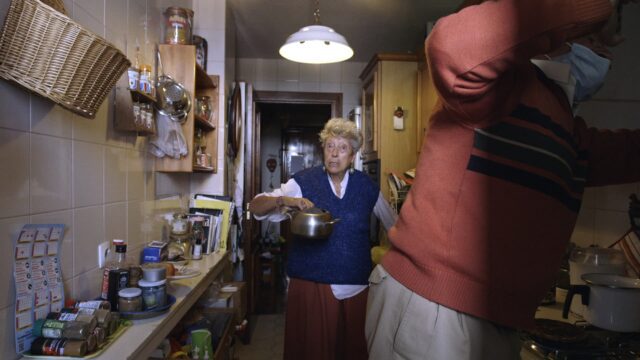
Following the legalization of euthanasia in Spain in 2021, director Guillermo F Florez set about finding potential characters to populate a documentary on the subject.
But when he found 86-year-old Carmen, however, he knew he need look no further. She was a woman who had already made plans to end her life and was more than happy about it. She had lived through the Civil War, was previously a nun, was married then divorced within a very Spanish conservative society, and had taken took several lovers, all the time following her own very unique path.
“She even had a date for it,” says Florez of her desired passing. “But she had no legal ground to request the euthanasia in Spain because she had no particular suffering or terminal disease, aside from her age of course…In this sense I didn’t fully choose the subject, it also chose me. And I found myself embarked in the most unexpected project: a comedy about an old woman planning her suicide.”
“Thanks to Carmen’s personality, it’s mostly a life-affirming story, and a portrait of a Quixotesque woman who suffered the oppression of an extremely conservative society, especially with women,” Florez adds. “The elements were so interesting that I put everything aside and started filming, not knowing where the film would take me.”
“Somewhere in this process, I realized I was doing this project because I am afraid of death, and she was not.”
Florez argues that the social context for the film is particularly important, that of a desire to conclude one’s “biographical” life as much as one’s “biological” life. “Mostly in western countries, some of the elderly population find themselves in this situation, having the possibility to continue their lives thanks to medicine, but with the price of lowering their quality of life. Some people draw their limit here, and some there. It is, at the end of the day, a very personal choice.”
While some countries are seeking to legislate for “completed life euthanasia,” ie when a person wishes to opt for a termination irrespective of their state of health, the law on euthanasia in Spain determines that illness and pain thresholds must be met before termination can be administered. “It’s indeed a very complex and nuanced subject, a dilemma of which the film provides no answers.”
The film is at very advance stage and will be finished by Summer 2024. “Creatively we have worked in two differentiated phases,” Florez explains. “First I filmed with Carmen, mostly alone with her, adapting to her plan and without any funding in place. While this very intimate shooting was happening, I also spent a lot of time watching the material that was being filmed, editing some sample sequences, exploring some of the music lines that we ended up using, and so on.”
“We are not particularly interested in efficiency during the creative process of our films, so we spent a quite lot of time in this first phase. For the creative process, this method of shooting and working with the material as a kind of pre-editing was essential, for both the production itself and for the editing process that came much later,” he adds.
Later the project was selected for international workshops and markets such as IDFA Project Space ‘22, Fipadoc Pitch ‘23, Ventana Cinemad ‘23, EIDF K-Docs Korea ’23, all of which “were extremely helpful on both the creative and business side.” Along with French co-producer Nadège Labé from La Société du Sensible, Florez also managed to raise most of the budget through regional and national funding, as well as the involvement of some broadcasters. “Currently, our goal is to secure the last part of the budget and work on a world premiere and distribution,” he says.
Florez underlines the appeal of his documentary to audiences. “We often mention that comedy is a rare [thing] in documentaries, especially this type of black comedy, so to say. It is not at all a film for old people, or a philosophical-sophisticated film that reflects on life and death. On the contrary, it’s a rather rough, authentic, even beautifully vulgar story with a protagonist who is full of energy and life.”
“Aside of this, there is also the sociological background of euthanasia and the end of life in general. It is a subject that most European countries, where population tends to be older, are facing and will be facing more in the future. It will hopefully be a film that raises a conversation or a debate on this issue,” he signs off.