Doc Salon is back in 2025 with what promises to be a frantic four days of documentary activity at Berlin’s Documentation Centre for Displacement, Expulsion, Reconciliation. The event has a new boss, Dutch distributor, sales agent and producer Esther Bannenberg who, alongside incoming Berlinale Pro chief Tanja Meissner, is determined to make the Berlin experience as impactful as possible for the doccers in attendance, both German and international alike.
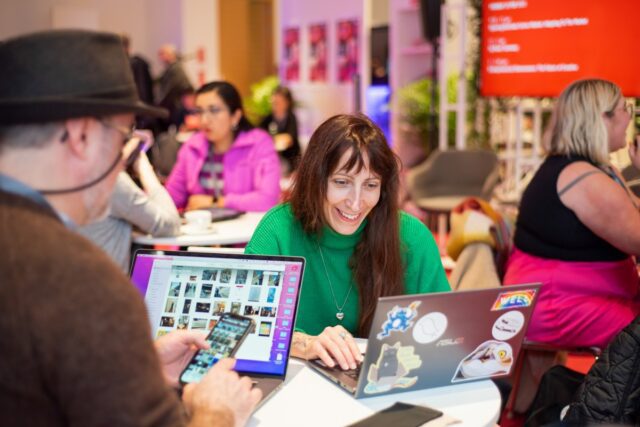
“I realized that there was a missing link because Doc salon had happened until before the pandemic, but then it hadn’t been reinstated after the pandemic,” Meissner tells BDE. “So there was a real gap for these people to meet, to mingle and to network because, as you know, networking is the biggest asset in our industry. It’s really, really important to have a huge address book which you can turn to. So I am putting a lot of effort into developing new networking formats – and a lot of networking formats. First of all for people to meet with each other from different backgrounds, but also peer to peer within their profession because that’s also really important with regards to exchange knowledge.”
“People are going to be able to exchange a lot of their experiences, their worries, their concerns, their challenges, but also their innovations,” adds Bannenberg of her Doc Salon offer. She further underlines how docmakers and producers can also access the Innovation Hub in Gropius Bau, a dedicated space for cutting-edge technologies and AI-based solutions. “There’s a lot happening this year and people are going to be able to make use of that, and I hope it’s going to be inspiring.”
Berlinale Pro’s Meissner further emphasises why a designated doc space is essential at EFM. “I think it’s really necessary for this community, maybe even more so, to be able to mingle and to have a dedicated space because of this power of community building, which I think is really, really essential,” she says. “And also to [develop] the large set of skills that you need to become creative. And when it comes to financing, you also have to have a network. And then we also need to upskill. I mean, everybody in this industry needs to upskill, but the documentary crowd really also needs to upskill with regards to innovative measures, generative AI with regards to animation, which is a lot more in use now in documentary. So we [protect] this space to advocate for documentary cinema.”
Among the events arranged between 14 and 18 February are a series of roundtable interrogations of core issues pertaining to the doc world, and a raft of interviews/panels that serve to indicate the strong links between the Berlinale Pro and the wider festival. These include an interview with the production team behind Timestamp, the only documentary in Berlinale Competition this year, and an examination of the trajectories of two high profile European documentaries of the past year (Dahomey and the Oscar-nominated Soundtrack to a Coup d’Etat). Salma Abdalla, Head of Communication at Austrian Film Institute and former MD of sales powerhouse Autlook, will offer expert analysis on how to strategise for non-fiction awards campaigns.
What’s more, two German-driven (but internationally-oriented) discussions will examine the financing of non-fiction, together with Emanuel Rotstein (Head of Documentaries of ICON DOCS, a brand of Bavaria Fiction), Melanie Andernach (producer Made in Germany) and Sylvia Griss (BR ARTE). Additionally, German Films MD Simone Baumann will explain how to co-produce with Germany – from a non-fiction perspective.
On February 18, for the seventh time, the EFM will present the Archive Market within Café Connect at the Documentation Centre during which representatives of leading international footage libraries will present their archives and invite EFM participants to discover their collections and discuss specific projects.
Bannenberg underlines the sense of camaraderie that exists among the many documentary events within the global calendar. “I think when we have a vibrant film culture in general, and we’re actually increasing the space for everyone,” she stresses of Doc Salon’s contribution. “There’s no intention at all to compete with any of the documentary festivals or markets because they do a fantastic job everywhere…Since we have this enormous number of industry people in Berlin, we can only facilitate and be supportive and help to make exchanges happen.”
What’s more, there is a lot be learned from a Berlin event that is geared towards all genres, Bannenberg adds, and more creative synergies may well develop as a result of cross fertilisation across sectors. “Berlin allows for that with all the industry personnel that is attending.”
Meissner further emphasises the links between her Pro activities and those of the Berlinale as a major public-facing event. “Of course there’s sort of a paper wall between the festival and us, but at the same time there’s a lot of exchange and communication between myself and Tricia (Tuttle, festival director), because she – and I’m very fortunate – is a person that totally understands the market and…understands that we are a festival that is at the same time a business place and a creative place,” she says.
“It’s really this kind of synergy that makes the Berlinale what it is. And that’s also why it is so interdependent and strong, she adds. “Each side is as strong as the other. And so we have a lot of exchange with regards to how we want to strengthen the industry through our offerings, through our programs and what we can do to support them.”
After Doc Salon, Meissner and Bannenberg will take stock of 2025 before planning for the future. “We are a service platform at the end of the day,” says Meissner. “I mean, we’re not substituting ourselves for what sales agents do, what producers do in the market – we are enhancing and facilitating what their work is about. So there will be a lot of feedback discussions that we’re going to have and also to see how we can develop our platform within the future. I think I have ideas and Esther has them too, but we really need to also double check if we’re going in the right direction.”
“I am ambitious. Tanja’s ambitious,” Bannenberg agrees. “And in a way we have to be smart about it and [make sure] that what we do is not happening at all the documentary festivals and markets, but really create our own event, use our own strengths and be smart about it – and then we will see what happens.”
DocSalon is supported by the FilmFernsehFonds Bayern (FFF Bayern).