He is the German army officer who intervened to help Polish pianist Władysław Szpilman survive the Holocaust (a story told in Roman Polanski’s film The Pianist). He is reckoned to have saved the lives of around 60 other Poles and Jews during the latter part of the Second World War.
Nonetheless, Wilm Hosenfeld, formerly head teacher at a school in the small German town of Thalau, had become a Nazi officer by choice. In the 1930s, he had been enthusiastic about Hitler.
Bad Nazi, Good Nazi, the new film from Chanoch Ze’evi (director of Hitler’s Children), is a world premiere in the DOK.deutsch section of DOK.fest Munich. In the documentary, the Israeli director travels to Thalau. Locals there have long proposed putting up a memorial to Hosenfeld but some within the community remain bitterly opposed to the idea.
“In general, I am looking for a new point of view to tell the story of the Holocaust,” Ze’evi explains what took him to a small town in Germany. “If we want to reach especially the youngsters, it is important to look after thought-provoking stories.”
After the success of Hitler’s Children (2011), his film about the offspring of prominent Nazis, the director had seen an article in UK newspaper The Daily Mail which reported on new research about Hosenfeld and the number of lives he had saved during the Second World War. Ze’evi was a big admirer of Polanski’s film and wondered if there might be a documentary to be made about the Nazi officer. He contacted Hermann Vinke, the author who had uncovered the new details about Hosenfeld’s wartime heroism.
Ze’evi travelled to Berlin to meet Vinke. That is when he first heard about the dispute over the proposed memorial in Thalau. “As a filmmaker, I felt that was win/win.” He could make a film about Hosenfeld’s life but one which would have a strong contemporary angle thanks to the ongoing controversy.
“I must admit, I was very happy to hear that there is a struggle in the village.”
The director discovered that Polanski’s The Pianist had never been screened in Thalau. That gave him the idea of showing it there for the first time. Vinke contacted Hosenfeld’s family, including his daughter who lives in Munich, on the filmmaker’s behalf. They said they would be happy to meet him.
Opinion about Hosenfeld in Thalau is sharply divided. The locals hail his heroism but several worry that erecting a memorial to a Nazi officer could send the wrong signal to visitors.
Ask Ze’evi how he himself feels about the subject of his film and he strikes a largely admiring note.
“For me, the Hosenfeld story raises an important question – what makes a person keep his morality in such a dark moment in history. It’s not just about Wilm Hosenfeld. It’s about all the others. If he knew [about the Holocaust], and he was just an officer for culture and sport, not high ranked, if he knew what they were doing, what about all the others?”
From 1942 onwards, the German officer recorded his disgusted observations about the ongoing genocide in his diaries. He was taking a big risk. If the Gestapo had seen what he was writing, he and his family would have been in extreme danger. As the documentary reveals, he smuggled out his diaries in laundry packages.
“Yes, he was a Nazi but after he realised he was taking part in a crime, he changed his way and he documented what they (the Nazis) were doing for the next generation,” the director notes. “Also, he saved lives.”
The new principal of the school where Hosenfeld was once head teacher wants to use his story to educate her pupils.
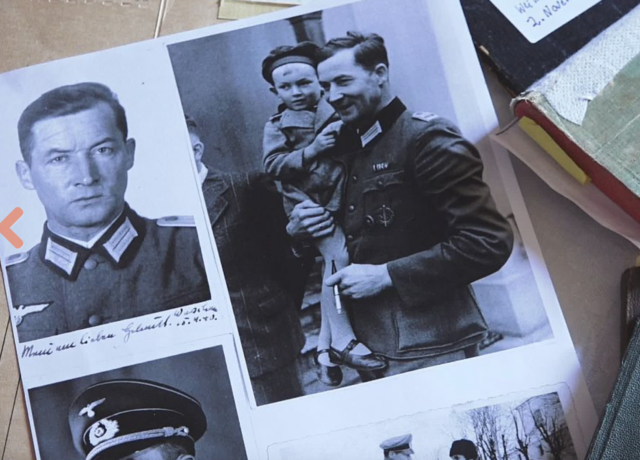
By chance, the director was there with his camera on the day when Hosenfeld’s daughter brought photographs of her father to the school. The principal was willing to hang one up in the classroom but saw that most of the images showed Hosenfeld in uniform, with the Nazi insignia clearly visible. She made it clear it would be impossible for the school to accept such pictures. “You and me know that today in Germany it’s very sensitive to show a Swastika or to show a Nazi symbol,” Ze’evi observes of the incident. “As a director, I felt it was telling the whole story in one piece.”
The daughter’s visit came on the day of the public screening of The Pianist. The film was projected on the wall of the school – the building where Hosenfeld had lived and worked all those years before.
“It was a very emotional moment for me. I was very moved the first time I saw The Pianist when I was a young man in Tel Aviv,” the director remembers. “This time – Thalau – it was the second time that I had been very, very emotional during the screening, It’s true that I am the filmmaker and that I had to be focused on the shots and to be near the director of the photography, but I was very moved and emotional.” He talks of looking “into the eyes of the Germans watching the film,” and seeing that they were equally stirred by it.
Bad Nazi, Good Nazi exposes disturbing and sometimes contradictory attitudes among modern-day Germans toward their wartime history. Those who are opposed to the memorial to Hosenfeld aren’t necessarily motivated by dismay and disgust at the soldier’s Nazi past. “Not just in Thalau but in Germany in general, sometimes they don’t want to touch something because it will force them to ask questions about their family,” the director reflects.
Hosenfeld, though, remains an inspiring example. He may have been a Nazi at the beginning but when he witnessed the Hitler regime’s genocidal wrongdoing at first hand, he acted.
In his films on the Holocaust, Ze’evi has four main goals. One is raising awareness of what happened. “If we want to keep the memory alive, we need two think why…I am looking for new angles.” Another goal is making the Holocaust story “relevant today.” The third goal is to create a tool against Holocaust denial. The fourth is to show that individuals like Hosenfeld can make a difference.
The director talks of using his films “to deliver an optimistic message. In all the sadness and darkness of the Holocaust stories, there is a bit of light…it seems that evil does not pass genetically. You need to choose to be evil. This is the main important message. You need to choose to be the bad guy. You could also choose to be the good guy.”
International sales on Bad Nazi, Good Nazi are handled by Autentic GmbH.