

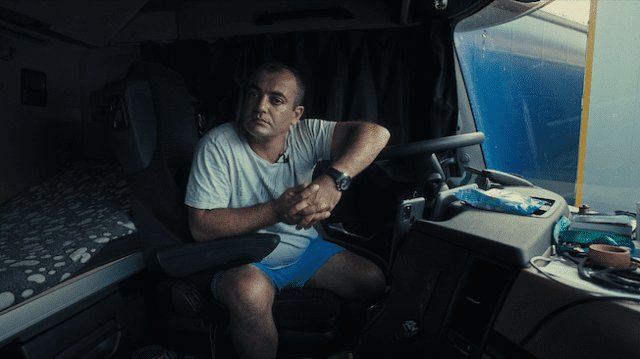
Young German director Felix Länge was researching “the value of work in our society” when he came across stories about lorry drivers going on strike in Germany. Many of them were Georgian or from other parts of Eastern Europe. Their action had been prompted by anger at allegedly unpaid wages from Mazur Group, a Polish company. Länge went to investigate – and what he found inspired his documentary Driving Europe (screening this week in DOK.fest Munich, and also his graduation film from HFF Munich).
Over 300,000 drivers from these countries work in the EU – and they are being viciously exploited. The film begins in very poignant fashion with footage of a young boy, Zuka, talking about how much he misses his father, Alekio, a driver who always seems to be away on long distance trips.
During his research, Länge had gone to the rest area where the men on strike had parked their HGVs. “It was night. I had a car, a Volvo, and it gave me the opportunity to sleep… Then, the first evening I was there, I talked to an Uzbeki driver. He was really nice. We smoked a cigarette and he was talking to [another driver] about the whole problem. The next day, he realised I was still there. The difference between me and all of the other media was that I arrived there, and I didn’t leave…”
For around five weeks, Länge stuck around to chronicle the dispute. At first, the drivers were wary of him. They knew that the Polish boss that they were in dispute with had sent spies to infiltrate the strike. “But then suddenly I met this very close group of 10 Georgians and they took me in…”
Eventually, these Georgians began to treat Länge almost as if he was a family member. During this period, morale was low but the drivers were doing everything they could to keep their spirits up. “I had bad moments [too] sometimes…and they supported me throughout the work on the film.”
Early on, Länge was there on this own. “As soon as you have a team, topics might not be so personal anymore,” he explains why he was working and travelling light. “But then afterwards, when I was coming back after the strike, I had contact with a production company [Bardamu Film GmbH] and they said let’s do this, but we have to make it bigger.”
Funding came through and the project grew a little bigger. Länge had the opportunity to go to Georgia and to meet some of the drivers’ families including Zuka, the soccer-crazy kid yearning for his dad.
In the end, the director shot over 120 hours of material. He had to winnow down this to feature-length.
The documentary shows certain logistics companies treating the drivers very badly. Länge points out, however, that it’s not “just their fault” that the drivers are in such a precarious situation. “It’s a systemic problem. Sometimes big companies just lose track of their products because the system is so complicated. This is also what we tried to put in the film,” he says. “There are many companies in Germany that are really trying to keep their work values up, but they can’t compete with the other companies who are not fair with their employees.”
You don’t need to look hard for reasons why drivers need to be paid properly. Their livelihood is at stake, their families depend on them and it’s illegal to exploit them. Another key issue is safety. If the drivers are exhausted and in a poor mental condition, the risk of accidents increases very sharply. Länge himself witnessed situations when drivers were so exhausted they came close to falling asleep on the road.
On a formal level, this was a challenging documentary to make. The director and his cinematographer, Matthias Kofahl, had to work out how to shoot inside the cramped interiors of the lorries where the drivers work, live and sleep. They would sometimes connect cameras to the windows. For some of the shooting, they would be sitting in separate car, following the trucks.
“I like this way of doing documentaries, being inside what is happening,” Länge explains why he wanted to get so close to his subjects.
This is a very masculine subculture. Almost all the drivers are male. They’re very loyal to one another. The trucks they drive are juggernauts that are so big that they need huge amounts of space to park. That means the drivers will often end up spending nights a long way from shops or conveniences.
No, they won’t be coming in convoy to the Munich premiere. The main protagonists remain frantically busy making trips all over Europe – but some have seen the film already.
On one level, the strike was a success. The drivers were given a lot of media attention and eventually received some money. However, the back wages didn’t come from the rogue companies who had been refusing to honour their commitments. “The wrong companies paid. They hadn’t really done something wrong but still they paid for it. That is why the film doesn’t really have a happy end so far…”
Sobering text at the end of the movie reveals that, as of last summer, Aleko was still driving trucks – and continuing to be “cheated out of his wages.” Multiple German and foreign logistics companies still violate the “supply chain act” that has been put in place to protect drivers – and not a single fine has yet been imposed.
“This is just one industry among many others,” the director continues. Workers’ rights are being eroded everywhere.”
Nonetheless, Länge believes the film shows “the power of connecting and fighting for your rights. This is really a positive in my opinion. But it’s also a huge system you are working against.”
As a graduation film, Driving Europe has received top grades. “This is a good way to start. To be honest, I am not sure how my life will look like trying to do these films. It pays off in an emotional way but not in a financial way. I don’t do it for the money as you can imagine…”





