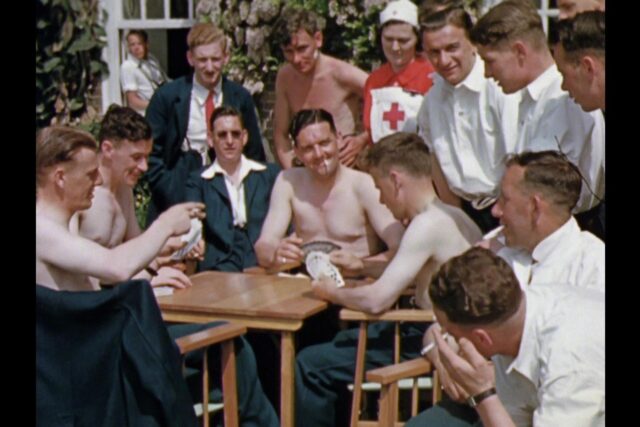
IWM film still MGH 3773 © IWM
The UK-based Imperial War Museums will be on the front line during DOK Leipzig’s Archive Market, representing a collection with 25,000 hours of moving images.
“I am particularly looking forward to meeting some of our European customers but also reaching out to some new customers,” says Fiona Kelly, Film Curator at IWM. In Leipzig, she’ll be showing off the IWM’s film site which allows clients to select clips and download them in HD in “the same day.”
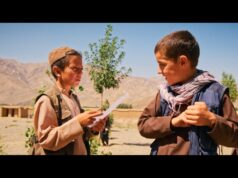
Kelly is also keen to talk up the breadth of the collection held by what is the UK’s oldest film archive (founded in 1917). “I think people often think of us as just First and Second World War but we have the NATO film collection, for example, and the United Nations TV collection as well and a lot more recent contemporary conflicts as well.”
IWM is the official repository for the Ministry of Defence. “They send us their films and photographs.” The archives have plenty of material too relating to the Falklands War and the Troubles in Northern Ireland.
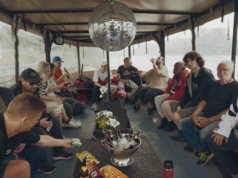
The organisation’s remit is to collect material from conflicts in which British and Commonwealth troops have been involved, but there is a wealth of footage in the archives that has little to do with the battle field. The collection holds ”fantastic scenes” of everyday life.
“Sometimes, people think of us as a military collection but really our collection reflects life in the 20th and early 21st century,” Kelly observes.
The archive is just as likely to supply footage for documentaries about sport or immigration or family life as for films exploring what happened during the battle of the Somme or at Belsen concentration camp. “It’s not just the tanks, the planes and the cars. It might be the role of women or all sorts of other things….We’re trying to get people to think of us a resource for social and cultural history as well as military history.”
For example, if you want to find images of the late Queen Elizabeth II in uniform as a young princess, IWM is the place to come. For obvious reasons, such material was heavily sought after during the Queen’s Platinum Jubilee and at the time of her death last month.
One of the NATO films, High Journey, which features evocative photography of European countries shot from low flying aircraft, is narrated by Orson Welles.
Like many other archives, IWM was exceptionally busy during the pandemic. “Even when we were working from home, we were able to maintain a service and to supply digital material. Also, in that period [during COVID], there were a lot of documentaries being made drawing parallels with the Second World War and coping with food rationing and queueing etc. There was quite a demand for that type of material. The 75th anniversary of VE Day coincided with that period as well. That was a particularly busy period.”
Kelly calculates that IWM’s customers are 50% from the UK and 50% from the rest of the world. “We’ve always had a very international reach.”
IWM has been involved in some special, high profile recent projects. For example, it supplied the footage used in Peter Jackson’s remarkable First World War documentary They Shall Not Grow Old. Grim material from its archives was included in Andre Singer’s 2014 documentary Night Will Fall, telling the story behind the 1945 British government documentary dealing with the liberation of the Nazi concentration camps at the end of the Second World War.
&nbs
p;
However, as Kelly points out, material from the archive also turns up in less likely places, for example in episodes of TV’s All Creatures Great And Small (about a Yorkshire vet) and period medical drama.
IWM has a close working relationship with the British Film Institute’s National Archive. The two organisations collaborate frequently on everything from DVD releases to research projects. As Kelly points out, the Imperial War Museum has been around for longer than the BFI.
The UK has its own chequered imperial past. Archivists are as sensitive as possible in the way they address this. “A lot of our material was filmed or photographed by British cameramen. Certainly, as regards catalogue, that is something we are constantly look at it. If captions contain language which would now be deemed as offensive, we are very aware of this.”
Yes, the streamers have turned into important new customers. They’ve been making their own historical documentaries in increasing numbers. “We’re able to help them dig out different stories and perhaps lesser seen material.” Meanwhile, dramatic films, for example Terence Davies’ recent feature Benediction, have used archival material held by IWM.
The archivists will try to cater for filmmakers working on lower budgets. It has a rate for projects that will be seen at film festivals but won’t receive major mainstream distribution. “We discuss each request on a case by case basis.”
Kelly and her colleagues continually make discoveries. “We do know what we’ve got but you do sometimes look at films and perhaps notice something you haven’t noticed before. You are able to bring a different interpretation to it, with more historical knowledge. It is always exciting looking out for new things.”
Kelly herself was drawn to work at the Imperial War Museums by a passion for history and a passion for film. “They coalesced beautifully,” she says of a job she has now done for 15 years without her enthusiasm wavering in the slightest.