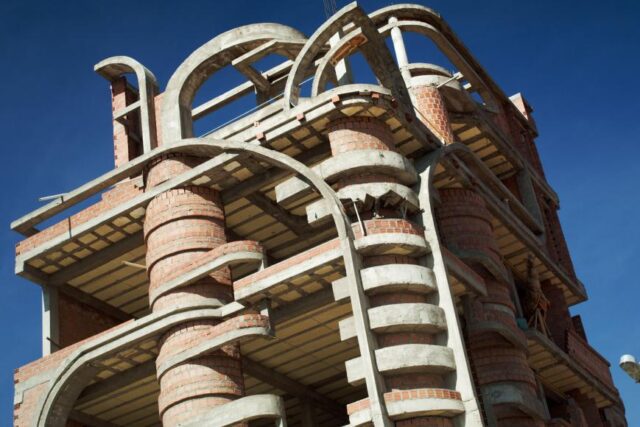
The title Slaughterhouses of Modernity (or Schlachthäuser der Moderne, the original title of this architectural critique by German director Heinz Emigholz that premiered at the New York Film Festival earlier this month) is, in itself, one that is somewhat multi-layered.
First, there are the literal modernist slaughterhouses designed by architect Francisco Salamone (1897-1959) in the 1930s, spread across the pampas around Buenos Aires. Some are still functioning, others abandoned, but all have seen better days. There is something surreal about seeing these former symbols of progress now lying lost in the middle of nowhere, and seemingly lost in time. “[F]unctionalism turned to the absurd”, as the voice-over says.
Then there is the connection between modernist architecture and Auschwitz, made in the introductory remarks. A subject that recurs later, when the actor Stefan Kolosko paraphrases Jorge Luis Borges’ 1946 short story ‘Deutsches Requiem,’ in which a fictional Nazi concentration camp commandant reasons that he himself had to make the greatest sacrifice of all, by renouncing his own compassion. (He paraphrases because the “******* widow” didn’t give him the rights to the text, he complains – with the expletive bleeped out.)
And finally there are the places where, as Emigholz puts it, modernism itself is slaughtered. The example being the ludicrous rebuilding of the Berliner Schloss, a baroque building in central Berlin, demolished after World War II by the GDR regime to be replaced by their modernist Palast der Republik, seat of the East German parliament, which was itself torn down after reunification, against the wishes of most East Germans, to be replaced again by the Schloss (with three sides meticulously reconstructed and one side a concrete facade, as a post-modern reminder of its warped origins).
“One of the most disgusting buildings in the world,” as far as this documentary is concerned. The official excuse that excess asbestos meant renovation was impossible is refuted by architect Arno Brandlhuber, the spokesperson for this episode, who points to the similarly asbestos-contaminated International Congress Centrum in West Berlin, which was declared a monument and duly restored.
Slaughterhouses of Modernity contains four such episodes, which act as chapters. First, there are Francisco Salamone’s works in Argentina, featuring not only slaughterhouses, but also municipal buildings and some amazing proto-Brutalist cemeteries. Then the Borges episode, presented by Kolosko in a diving suit at the eerily resurfaced ruins of the ghost town of Villa Epecuén, built in the 1920s and flooded in 1985 after the ill-conceived dams broke. Then the Schloss and then, as a final chapter and counterpoint, the triumphant modern buildings by self-taught Bolivian architect Freddy Mamani Sylvestre (1971), full of rounded shapes, striking patterns and bold colours.
What if we gave the Schloss to the Bolivians as a warning against “toxic European culture,” and let Mamani build a replacement in Berlin, Emigholz suggests. Wouldn’t that be an improvement?
There are many ideas, concepts and -isms here, including capitalism and postmodernism, none of which are fully explored. One could certainly argue a connection between modernism and Auschwitz, but then architecture would not be the central issue – there is nothing specifically modernist about the architecture of the concentration camps. Or the Gulag, for that matter. It is true that modernist architecture flourished during the early years of Mussolini’s regime, but ultimately he, Hitler, Stalin and most other dictators preferred versions of Neoclassicism (with some modernist touches). Indeed, the Nazis actively persecuted the Bauhaus.
Also, the Palast der Republik wasn’t destroyed because it was modernist (the look-alike Kulturpalast in Dresden is still standing), but because it symbolised the GDR regime. Brandlhuber’s counterexample, the West-German modernist Congress Center which got renovated, proves just that. Moreover, the genocidal imperialist Kaiser Wilhelm II, who introduced chemical warfare, built concentration camps and said he wanted to eradicate the European Jews, could justifiably be called the “Ur-Nazi”, as Kolosko does here, but as far as I know, a modernist he was not.
However, I must stress that Emigholz’ texts are short and polemical, and leave a lot of room for interpretation. There are long stretches, minutes at a time, without any voice-over or other explanation, where we are just looking at the architecture. But this is my first Emigholz documentary (of the dozens he made) and I understand that, usually, there is no commentary at all. Just static images of architecture. So I’m not complaining – and I suppose Slaughterhouses of Modernity would be a good starting point for other newcomers to Emigholz’ oeuvre as well. And it seems fair to assume that Emigholz is putting these architectural stories out there, each fascinating in its own right, and partially contextualising them, to challenge us to form our own ideas.
I must say there is a meditative quality to the systematic, analytical way Emigholz films architecture. His camera is always stationary and the editing follows a steady rhythm, with image and sound cut concurrently. The effect is similar to an old-fashioned slideshow, except for some movements of birds and trees and the like. Usually, the first shot is how the modernist (if you like: fascist) architecture was meant to be photographed: symmetrical, imposing, in full view. Then, Emigholz takes different angles, including Dutch ones, close-ups, which often show wear and tear of the buildings, and shots from behind trees and bushes, as if nature will end up devouring these symbols of industrial progress (as has already happened with Villa Epecuén). It is, you might say, a kind of deconstruction of their architectural effect. Cutting them up in pieces, hiding them behind bushes. The Dutch angles are especially effective. The aura of these buildings, with their straight lines and high towers, cannot withstand tilting – as Mark Cousins recently remarked in his documentary on the rise of Mussolini, March on Rome (2022). Doing so immediately undermines any totalitarian pretensions.
Now, Cousins never stops talking in his documentaries, so you always know exactly what he wants to tell you, scene by scene. Emigholz’ polemical style leaves much more to our intellectual imagination – often in a stimulating way.
So let me tell you what I made of it. The main evil force here, it seems to me, is (neo)colonial imperialism – modernism being little more than the taste du jour of a certain historical time period (and one, I admit, I quite like, which might diminish my willingness to see it as inherently fascist or totalitarian). Imperialism allowed Salamone to impose his Western ideas about architecture on colonial territories. And the decision by the reunified German government (in which Wessies outnumbered Ossies) to destroy the symbol of East German power, but guard the symbols of Western, could also be called ‘imperial’, perhaps even ‘colonial’. Of course, from imperialism to fascism and Auschwitz is only a small step, with or without modernism.
Emigholz makes a good point, when he talks about Western colonialists’ lack of regard for Indigenous culture (which led to centuries of imported Western architecture in the Americas, Africa and Asia – with modernism only coming at the tail end of it). And indeed it would be wonderful to see works by Freddy Mamani (who is not free of Western influences, but adds Indigenous Bolivian influences to his designs with irresistible effect) being built in the capitals of Europe – not just to add some colour, but to reverse the imperialist tide of history.
DOK Leipzig also world premieres two other documentaries by Heinz Emigholz in the Camera Lucida section, which further explore specific elements of Slaughterhouses of Modernity. Salamone, Pampa on the works of architect Francisco Salamone and Mamani in El Alto on Freddy Mamani’s Neo-Andean architecture.
Germany, 2022, 80 minutes
Director: Heinz Emigholz
Production: Filmgalerie 451
Producers: Frieder Schlaich, Irene von Alberti
International sales: Frieder Schlaich
Script: Heinz Emigholz
Cinematography: Till Beckmann, Heinz Emigholz
Editing: Heinz Emigholz, Till Beckmann
Sound design: Christian Obermaier, Jochen Jezussek
Sound: Esteban Bellotto, Rainer Gerlach, Christian Obermaier, Jochen Jezussek
Music: Kiev Stingl
With: Stefan Kolosko, Arno Brandlhuber