

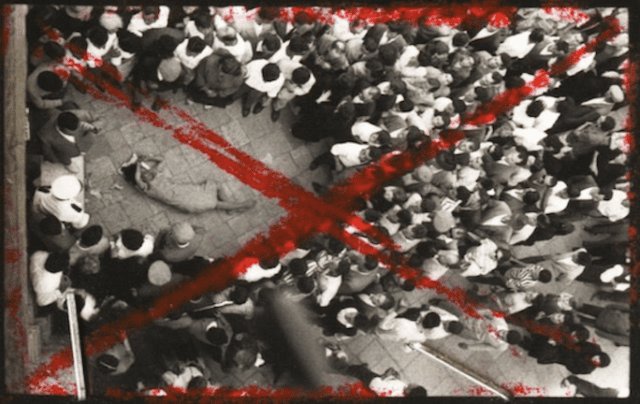
In their new documentary Tarantism Revisited (premiering in German competition at DOK Leipzig) filmmaking team Anja Dreschke and Michaela Schäuble explore the mysterious cult of ‘Tarantism’ in southern Italy. Local myth had it that when women there were bitten by a tarantula, the only way to get rid of the poison seeping through their system was to dance out the toxin in a mad frenzy. In other words, this is an exorcism by music and movement.
“Both Anja and I are trained as visual anthropologists and as filmmakers. When I teach visual anthropology, I always tell my students, “don’t make a film for the sake of making a film. Only make a film if you can find out something using film as a research tool that you couldn’t have found out otherwise,” Schäuble explains her attitude toward using documentary alongside more traditional academic research.
She and Dreschke follow the advice in the new film and have assembled some truly startling archive material while shooting their own original footage too.
They two filmmakers share a fascination with “re-enactments and spirit possession and states of trance.”
“Anja and I have known each other for a very long time, long before we started working on this film together,” Schäuble explains the collaboration. “We both came across the archival films and were fascinated by them.”
Schäuble points out that visual records have an impact that written descriptions of Tarantism don’t. “We were really trying to show how the choreographies, the dances, the frenzies that are seen in the archival material, are used as a template for the re-enactments of Tarantism today. We have also written about that but to really see these women climb the altars, the way they scream, the way they also interact with one another…those moments can best be shown in the filmic medium.”
The footage here is often very visceral and even shocking – women who appear to be possessed dancing in manic fashion, writhing around on the ground, or men and women crowding into churches and trying to climb up altars in their fervent worship of St Paul.
“At some point, this was sanctioned and almost labelled as an exorcism,” the director says of the wild behaviour within sacred religious spaces. “Church officials seemed to give a tacit approval to the dancers,” Schäuble notes.
The church’s explanation for the phenomenon was that the dances were cathartic – a way of expelling sin – and should therefore be tolerated.
Many of the women who were considered “cantata” remained unmarried or had abusive relationships, or had suffered trauma and grief. “It is clearly related to extremely restrictive gender roles,” the director reflects on a sickness which seemed primarily to affect those already regarded as outsiders. “They were very often people who did not comply with strict gender norms and expectations.”
One focus of the documentary is the relationship between Italian anthropologist Annabella Rossi (1933-1984) and Michela Margiotta, a poorly educated, epileptic but highly intelligent and articulate peasant woman who had become a ‘tarantata.’ The two women corresponded at length (there were 65 letters between them).
“I came across the letters during a fellowship I did in Bologna. I realised they were very unique…when Anja and I started to work on the film, we knew right away that the letters would be important. We had them translated into German by a writer because we also knew there was a very strong literary quality to them. They were very forceful. Unfortunately, a lot of that gets lost in the English translation.”
In the letters, Margiotta acknowledges she had little formal schooling. She doesn’t use punctuation but instead writes in a stream of consciousness. The director talks of the “old fashioned way she expresses things and of the immediacy of her emotions and anger.”
Dreschke and Schäuble are considering having the letters translated into English by a professional writer who’ll be able to capture their full force and lyricism.
Schäuble is based in Bern while Dreschke is in Cologne. As they worked on the documentary, they sent project files back and forth. They also went on several field trips together to southern Italy.
“It’s almost a 10-year project. I went first in 2014. In 2016, Anja accompanied me for the first time. From then on, this was a joint project. We went basically every summer, or every other summer.”
They generally travelled to southern Italy in time for the Feast of St Paul which takes place in late July. They met local people and deepened their knowledge of Tarantism. Their film strives to move beyond the usual clichés about ‘mad women’ dancing.
“It’s a re-evaluation of something that has been conceptualised as backward, and as maybe primitive, as something with a lot of potential and power,” Schäuble states. “It’s a form of finding pride in something that has been stigmatised for a long time.”
This, then, is far more than just a film just about dance. “It [Tarantism] is a vessel for a lot of things that are then acted out. There is certainly a very subversive element to it…it is definitely an outlet for marginalised populations. In this case, it’s mainly women, poor women [dancing]…a lot of frustrations are acted out, but it is also a form of agency and empowerment. It can be very politically charged as well.”
Tarantism Revisited is premiering in Leipzig. There are plans now to set up an accompanying website which will contain extra research materials dealing with subjects covered in the documentary.
Tarantism Revisited was produced through EMB Ethnographic Medlab Bern and Petit à Petit in Cologne. It received financing from the Swiss National Science Foundation, Schweizrischer Nationalfonds Film and Film- und Medienstiftung NRW, among other backers.





