On 29 October, Jihlava’s Industry Hub hosted the session “Czech Joy in the Spotlight.” The showcase, backed by Creative Europe, the City of Jihlava, the Visegrad Fund, the Czech Ministry of Culture, the Czech Film Center, and the Region of Vysočina, was hosted by Czech Television Deputy Editor-in-Chief Diana Tabakov. During the one-hour session, nine non-fiction productions with Czech involvement were presented to the industry audience in attendance.
Czech Joy is the competition section for the best Czech documentary, celebrating “diversity of themes and cinematic expression.”
The first doc was Martin Páv and Nicolas Kourek’s Dajori (world premiere), produced by Jan Bodnár (How I Became a Partisan, The World According to My Dad) and Jarmila Poláková. “Dajori tells three years of Maria Hučková, an indomitable Romani woman, and her nephew Samuel, who is coming of age during this film,” said the team. The woman lives with her husband in Varnsdorf. After her younger sister Iveta ends up on the streets with her nine children, she decides to take her own fate and theirs firmly into her own hands and attempts to break out of the vicious cycle of poverty that characterises their hometown.
“We found out about Maria and her relatives in winter 2021, during the debate about the housing crisis and Romani people living in that region of the Czech Republic. Soon, we became very close to each other, and we realised we had the opportunity to create a strong relationship, which we believe will be visible on screen,” the directors added. Páv and Kourek worked with a skeleton crew so that “the protagonists could forget about their presence.”
“It [is] different from other films about Romani people. These either deal with fascination with poverty or tell of exceptional heroes. Our film is about a normal family, with their ups and downs, childhood and adolescence, and the role that creativity plays in our lives,” they summed up.
The second project, Alice Růžičková’s Jungle/Placht (world premiere), was produced by Jitka Kotrlová of Frame Films. It zooms in on famed Czech painter and artist Otto Placht, whose creative and private life is divided between Prague and Peru, where he draws inspiration from the depths of the Amazon rainforest, ayahuasca, and the local people.
Placht moved to the Latin American countries in the 1980s. The director first met him when she was looking for “authentic experiences of living among the Indigenous tribes.” Back then, Otto was living with his wife Monika and two children in Peru. “I shot a one-hour doc on 16mm, following his family and artistic life. […] The film also sees him preparing the herbal drug known as ayahuasca. After a long time, I decided to embark on the making of a feature to see how Otto has moved on humanly, artistically, and ecologically. It’s not just a portrait of the famous painter but also of the Amazon jungle’s despair.” The team is seeking sales agents and festivals.
Third in line was Fakir (Czech premiere), a co-production between the Czech Republic, Slovakia, and Poland, led by Michal Sikora, directed by Roman Ďuriš, and sold by Film New Europe. Ďuriš met his protagonist, Dalibor, in 2020 when his circus came to his hometown. “He was sitting in a very small caravan, eating a modest meal with his rabbit and guinea pig. Loneliness was the first word that came to mind, and I felt the need to tell it.”
In the doc, the young Romani man returns home after two years in prison, only to be confronted with a family crisis. To shield his younger brother, Kevin, from their abusive and alcoholic father who readily resorts to violence, he dedicates all his energy to assisting his mother in a custody battle for Kevin. To manage the traumas of his past and the struggles of his present, Dalibor finds refuge in the enchanting world of a travelling circus.
“He’s an unlikely hero, full of contradictions, who tries to save himself and his brother. He wants to end the cycle of generational abuse and trauma,” the docmaker added. The pic premiered at Munich’s Dok.fest and was screened at both Jihlava and Millennium Docs Against Gravity. The project is still looking for festivals and distributors.
Next, veteran Peter Kerekes went on stage to present his latest outing, titled Wishing on a Star (Czech premiere), which premiered at Venice this summer. A co-production between the Czech Republic, Italy, Slovakia, Austria, Croatia, and Taiwan, the doc is an “astral comedy” revolving around Luciana, a bizarre astrologer who also acts as a psychotherapist and personal coach.
“I admit this is a film I never wanted to make. I kept on refusing [the producers’] offers for three years. I thought astrology wasn’t my topic. Then I met Luciana. She’s such an interesting person, a strong character, and I ultimately decided to make the film. We follow five of her clients and see how their lives and destinies have changed after having travelled to different places for their birthdays.” The long-gestated project entered production in 2017 and wrapped this year. France’s Films Boutique is selling it worldwide and seeking more festivals.
Producer Michal Sikora also produced the fifth project, Lidia Duda’s Forest (Czech premiere), a Polish-Czech co-production. He presented it on stage with Polish producer Weronika Adamowska. The film, which premiered at Thessaloniki in March (where it scooped the Silver Alexander), follows Asia, Marek, and their three children, who find refuge in an old house near Poland’s Bialowieza Forest, living harmoniously with nature. But soon, their cameras capture not only wildlife but also desperate refugees seeking safety. Committed to protecting life, they feel compelled to help, risking the sanctuary they’ve built.
Rise and Shine is selling the doc worldwide. On stage, Sikora and Adamowska highlighted the timeliness and relatability of the subject, adding that an impact campaign aimed at changing Polish and EU legislation is attached. This includes screenings at the Bundestag and the EU Parliament. The pic recently travelled to Shanghai and will head to DOC NYC in two weeks. Other festival selections include Krakow, Munich Dok.fest, Makedox, and Astra.
Coming up next was Zuzana Piussi’s Scent Evidence (world premiere). The Czech-Slovak doc, produced by Vít Janeček and lensed by the director herself, examines the scent trail, an evidentiary method originating in the USSR and later used by East German police, which became common in Czech judicial practices from the 1980s onward. The pic questions this method’s validity, following those seeking retrials for unjust convictions and shedding light on potential flaws in Central European justice systems.
On stage, Janeček revealed: “We finished the film two weeks ago, and we were hardly thinking whether to confirm it for Jihlava, but we still had many reasons to release it right away.” He then showed the audience the official poster of the film, drawn by cartoonist Marian Kamensky. “We asked him to watch the film and make it for us, and that’s what he did,” the producer said, adding that the whole project took three years and focuses particularly on five stories. An impact campaign involving prominent MPs and senators is also in the works.
The seventh project was World Between Us (world premiere) by Student Academy Award winner Marie Dvořáková, who was accompanied on stage by producer Pavel Berčík of Evolution Films. The Czech-Slovak pic, made in co-operation with the Slovak Audiovisual Fund, the Czech Film Centre, and HBO, centres on Marie Tomanová, a photographer who moves to the US as an au pair and ends up shooting for brands like Nike and magazines like Vogue, gaining more recognition abroad than in her native Czech Republic. Her growth and self-discovery in New York were supported by her partner, art historian Thomas Beachdel. The director, also based in the US, captured Tomanová’s turbulent journey for five years, exploring the themes of the American dream, identity, and home.
“The story of Marie mirrors those of thousands of artists coming to New York, hoping for their big break. Today, it’s a special day, as we’re world-premiering the film here at Jihlava. We’re looking for more international festivals for next year,” the team said, billing their work as a “feel-good film” for those “who love happy endings.”
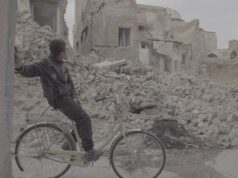
Later, producer and sound designer Václav Flegl pitched Benjamin Tuček and David Čálek’s War Correspondent (Czech premiere), co-produced by the Czech Republic, Slovakia, and Ukraine. The doc follows Czech journalist Martin Dorazín as he reports from war-torn Ukraine, joining volunteers to deliver aid to civilians in shelled towns. It highlights the challenges of his work and the personal stories of Ukrainians enduring the war, underscoring the absurdity of conflict and the essential need for empathy.
“War Correspondent isn’t just a film but also an educational programme developed with our colleagues and distributed in schools. We’re providing dedicated material and a shorter version of the film. Advocacy of public service is the main theme, and the film is for all those who are interested in finding out what’s happening now in the world,” Flegl stated, adding that the team is looking for “partners on the same wavelength.”
The last project of the session was Eva Križková’s Birdhill (Czech premiere), accompanied on stage by producer Silvia Panáková. The Czech-Slovak doc takes a closer look at Vtáčnik, once a peaceful, vineyard-covered hill near Bratislava, now transformed by property development. Told from both human and bird’s-eye perspectives, the film contrasts economic interests and visions for life with the director’s memories of her tranquil childhood. The project entails an impact campaign revolving around urban development and biodiversity and has received the support of the Czech and Slovak public broadcasters. The team is looking for additional festivals and sales agents.