

“The very beginnings of the project was basically me fighting with my father about politics,” Karoline Rößler says of her feature documentary, Intersection – It’s Political (premiering in DOK Leipzig German Competition). When she was an undergraduate on a cultural studies degree and becoming involved in student activism, her father, an engineer, would tell her that her “feminism was too harsh” and that “normal” people wouldn’t be able to follow it.
Their disagreements inspired the short film, Dear Dad (2021) based on emails and phone calls, Instagram posts and newspaper articles, and exploring their clash in views.
“He’s an old leftist. That’s why I was surprised when he would disagree with me on so many things. I tried to explain things to him and that’s when I realised explanations were not enough.”
For Intersection, the director has devised her own computer game which is “easy and fun to play” but that also reveals the levels of discrimination that certain players face. It’a a game designed to be unfair. If you don’t fit in, you don’t get the same chances – that’s the underlying message. Players are treated differently depending on their colour or their shape.
No, Rößler doesn’t come from a gaming background. “But thankfully in Berlin, there is a really big gaming scene. They’re surprisingly welcoming. I just went to a few networking events and said, ‘ok, I’m a filmmaker and I wanted to develop this game. Who wants to help me?’”
There wasn’t a shortage of volunteers. Her key collaborators were game developer Fredrik Freund, and game art and animation specialist Mascha Ermakova.
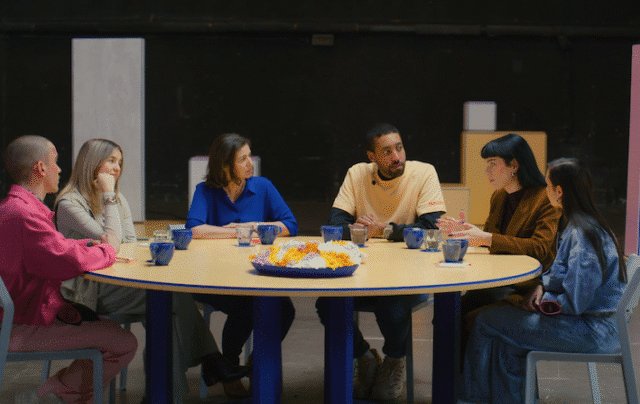
In the documentary, six protagonists who’ve faced discrimination because of their sexuality, ethnicity or disability, are interviewed individually and take part in a round-table discussion. The subjects include journalist and moderator Maria Popov, who sees the world “through a migrant’s experience” and as “a not-knowingly queer girl”; actress and musician Phenix Kühnert, who is a trans woman; German-Turkish journalist Hatice Akyün; queer author and content creator, Ole Liebl; feminist content creator Matilda Jelitto, who specialises in German rap and who has a disability; and Dominik Djialeu, a non-white podcaster and party organiser.
“I actually knew them from afar…I used to follow a lot of them on social media. I know their content quite well. I just researched a lot of people who felt were like-minded about the topics I want to stand for, and that I wanted this film to speak about. I met them – and thankfully they said yes,” Rößler explains how she recruited the subjects.
This is a student production. Rößler made it as part of her MFSA at Filmuniversität Babelsberg KONRAD WOLF. It was shot over a period of around a week at Studio Babelsberg. Funding came from the Medienboard Berlin-Brandenburg. She did the interviews first and then moved on to film the round-table discussion.
“It was kind of a workshop format. I had a rough idea of what I wanted to discuss and I used the game as a starting point to open up conversation. Then I just tried to be very open to what the protagonists wanted to say,” Rößler explains.
The six subjects spent time in the make-up room playing the game and getting to know one another before their joint discussion. “Then we just jumped into it…”
There was a sense of relief among participants that they were all with kindred spirits, and that the round -able hadn’t been set up as a debate against people who held very different views. That meant they all relaxed and, Rößler suggests, spoke openly and without pressure.
“They felt they could be more vulnerable in what they share, and the way they speak about things if you don’t have someone [opposing you] who is denying your entire existence, or is just saying you are too sensitive when you speak of your own experiences with discrimination.”
Nonetheless, Rößler couldn’t help but notice that all the protagonists spoke about how tired they feel, and how difficult it is to keep on speaking out, as “right wing voices get stronger and stronger,” and as it becomes harder and harder to “advocate for basic human decency and moral values.”
She wanted the film to end on a positive note but admits “it was hard to get there.”
However, she was encouraged by the way her protagonists accepted each other’s views. “You see that there are different opinions and that just because you roughly identify coming from a similar political world view, you don’t have to agree on everything. I think that is something really important that the film also wants to picture. That is something that can bring us forward, if you have this common respect for everyone and at least try to see where the other person is coming from.”
Her now own father has softened his stance. He likes the game and has seen a rough cut of the film. “I felt like something changed. He speaks differently now…I think he can relate to things more. He saw that, yes, [in the game] it really did suck to be a yellow circle and not to get through anywhere. “
He also understands concerns that Rößler raises, such as women’s safety, far better than when he was dismissing her as being out of touch.
When it came to the editing, the director says it was “a blessing and a curse to have so much material.” The film is just under 90 minutes long in its final cut, but she had eight to10 hours of the round table and 12 to 14 hours of the interviews. This material was shot with multiple cameras (including some handheld footage intended to provide some more “dynamic” moments.)
“Whenever you have an interview film, it’s quite a challenge not to be overwhelmed with all the talking and information you get,” Rößler notes. That’s why there are continual cut-aways to animated footage from the computer game.
The director hopes the computer game will now have its own life alongside the film and will be used as “a tool to empower progressive voices.” (It will be released on the day of the premiere and can be downloaded on smartphones).
“We have very good support for our impact campaign from the Good Media Network,” Rößler explains.
Rößler and her team are hoping for further exposure at international festivals and are also planning a festival tour in Germany.
“It was my graduation project from my masters degree on directing,” the director explains. Now, she is looking to try different formats, possibly even to make fiction, but also has a job coming up as a production manager on one of her fellow student’s projects.





