

Filmmaker Betina Kuntzsch grew up close to the Prenzlauer Berg Park in East Berlin. Back then, the Wall was yet to fall and her part of town was grey, grim and polluted. Now, as the filmmaker reflects ruefully, the area has come up so much in the world that she can no longer afford to live there.
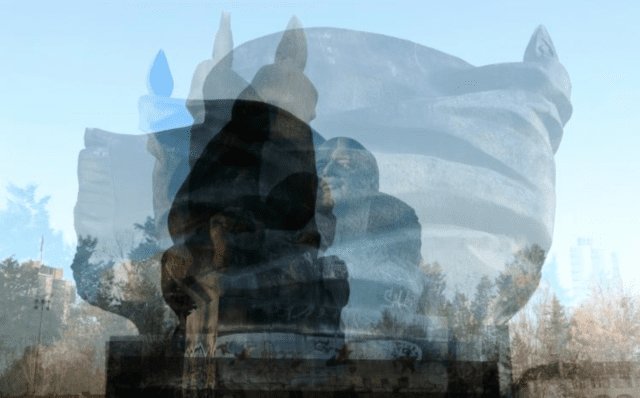
One landmark from her childhood still remains – and looks as if it may never be moved. This is the gigantic bronze statue of Communist leader Ernst Thälmann, who died in Buchenwald. Installed in the mid-1980s, it an anachronism, one of the few visible legacies of the old East Germany, too cumbersome and heavy to dismantle but now a site of considerable historical fascination – and a listed building.
This memorial is the inspiration behind Kuntzsch’s new film Kopf Faust Fahne – Perspektiven auf das Thälmanndenkmal(which screened in the German competition at DOK Leipzig).
“I have a deep connection to the territory and I hated the monument from the beginning,” Kuntzsch says. “It is so ugly!”
The director has an excellent visual record of her GDR childhood. Her father was a very keen photographer. “I grew up in Prenzlauer Berg and my father always took photographs of us,” she remembers. When she grew older herself, she started to take her own pictures. She was there to record the demolition of the old gas works buildings in the early 1980s. A children’s playground was created on the site. No-one seemed to realise at the time how toxic the land had become.
As she worked on the documentary, Kuntzsch assembled other materials such as drawings and old footage. She also conducted interviews with other residents from the area and spoke with old schoolfriends. The film also uses voices-overs and animation.
The GDR leaders used to tell their citizens that they were living in a country that was “better” than a democracy where everyone could make their own choices. That wasn’t the truth at all. There was no consultation when the Government began demolishing old buildings. “We all protested but it wasn’t heard. It didn’t count,” the filmmaker recalls.
The locals were disappointed and angry. They felt a strong attachment to the area in spite of the pollution and dirtiness.
“Today, it’s like a foreign city,” Kuntzsch reflects on how Prenzlauer Berg has been transformed over the last three decades. The area is now vibrant and colourful. “When I grew up, everything was grey.”
Those who had spent their childhoods there used to joke that they had lived in a black and white world. There were still scars from the war but the locals also felt that the GDR “created ruins without weapons because they didn’t renovate.”
The documentary unfolds in chapters, each with a different perspective on the subject. It has sections on growing up in Prenzlauer Berg, on the activities of school kids, who were part of the Ernst Thälmann corps of young pioneers, and on how the monument to Thälmann came to be built and unveiled.
One part of the film, Irma’s Teddy, provides an imagined biography of Thälmann’s daughter Irma. “She was maybe a kind person but she didn’t receive a lot of education,” Kuntzsch says of a woman who shared her father’s political fervour but led a difficult life. When Irma stood in a local election in post-reunification Berlin in 1994, she received fewer than 300 votes. Her life was defined by a father she didn’t really know. His real family, it often seemed, was the Communist party. Throughout her childhood, he was often away from home on party business. She would attend his rallies. Even when she didn’t understand what he was talking about, she could always see the crowd responding to his tub-thumping oratory. Then, in the 30s, he was arrested by the Nazis and spent years in prison before finally being shot in 1944.
No, Kuntzsch never met Irma. “But my friend and colleague (Christina Schmidt), who did research [for the film] got her red neckerchief.”
Having screened at DOK Leipzig, Kopf Faust Fahne is due to show at the short film festival Interfilm Berlin. Visitors to Prenzlauer Berg will also have the chance to watch the documentary at the site of the Thälmann memorial itself. Kuntzsch is planning to put up five concrete pedestals, each with a QR code. Passers-by can sit on these pedestals, scan the code and access the film that way.
Yes, after all these years, Kuntzsch still hates the monument as much as ever. “But maybe I am a little more quiet, a little more relaxed about it,” she says.
And would Kuntzsch miss it if it wasn’t there? “I think it is a great possibility to discuss – to listen to stories and to tell stories,” the director says of the civic service that the monument now at least plays in stirring up debate about everything from the history of the GDR to town planning.





