Impact came to Berlin October 15 with the Good Media Pitch during which docmakers met non-profit organizations, foundations, civil society organisations, research institutes, policymakers, brands, and media representatives to address “today’s most pressing social and environmental challenges.” Six Impact campaigns were pitched on projects a diverse series of subjects. Each project was either completed or in late post-production.
“It’s more than just collaboration—it’s a dynamic platform for the creation of powerful, purpose-driven partnerships that have the potential to bring about real change,” Good Media Pitch organisers write of their event. The producers/makers behind each film/project spoke to Business Doc Europe about the Impact campaigns they will mount for their vital documentaries.
OFFSIDE—EICHI AND THE FC PIO BY LORAINE BLUMENTHAL
Loraine Blumenthal’s documentary underlines that there are things in life even more important than football, and that the beautiful game itself can be a conduit for change.
Thomas ‘Eichi’ Eichstätt coaches the FC Pio football team in the small town of Torgelow in eastern Germany. Many of the young players have fled their home countries and are struggling to find a job, acceptance and their past. Eichi is a father figure for many of them, but he also looks back on a dark time as a right-wing extremist. It is “a documentary film about what it means to build bridges and find a new place in life.”
“I found out about Thomas Eichstätt and his football training programme for refugees in a newspaper article. I was even more surprised to read about his right-wing radical past,” Blumenthal tells BDE. “As a documentary filmmaker, I was immediately interested in his unusual biography. I also wanted to find out more about the refugees and their living conditions on site. I myself grew up in the 1990s as a young girl in Mecklenburg-Vorpommern not far from Torgelow, where I got to know the region and its challenges in terms of unemployment, alcoholism and xenophobia. I wanted to know how people with a migration background live there today. At a time when right-wing politics and right-wing extremism are gaining ground, it was important for me to make a film that takes a look at what rapprochement can look like.”
The film is at late edit stage and will be ready for delivery early 2025. Impact wasn’t foremost in Blumenthal’s mind when she embarked on the film, but in recent times as the far right has become more dominant in German politics, she realised that she could “make a difference with the film.”
Her goals are to:
- put on 50 film screenings throughout rural Germany, starting in Mecklenburg-Vorpommern.
- help Thomas Eichstädt to safeguard his job so that he can continue training the refugee team.
- organize regional workshops on racism and how to address it for youth club staff and football trainers in Mecklenburg-Vorpommern.
- draw attention to the importance of volunteer football trainers and help to establish (financial) structures to enable their work.
“I want to use our local impact goals as a blue print for our national goals,” Blumenthal underlines to BDE. “The idea is to develop the national strategy at the same time but with a bit of a time-delay when turning to actions. Once we have a workflow in place for our local goals, we can easily implement our ideas and learnings on a national level and convince more organisations and allies to work with us on our strategies. The same goes for an international level. With a successful national impact campaign and the structure laid out, we would like to explore the international terrain.”
THE FAMILY APPROACH BY DANIEL ABMA
The Family Approach offers intimate insights into the everyday lives of youth workers over the course of a year, revealing the superpowers it takes to raise the child in their care.
“In 2017, our director Daniel Abma became aware of the enormous lack of youth workers in Germany. His first visit to the residential group in the house “by the lake” was in 2018. Over five years, he built up a strong relationship with the people on site and was able to accompany them with the camera for over a year – a special place, that is usually inaccessible to outsiders,” explains producer Lisa Nawrocki to BDE of her completed film which will world-premiere in Competition at DOK Leipzig at the end of October 2025.
“Over 200,000 children and young people only in Germany live in residential care or foster families, accompanied by youth workers and caregivers every day – so there is a high demand for skilled professionals,” she continues. “With The Family Approach, we wanted to contribute positively and constructively to the public perception of child and youth services from the beginning of making the documentary. At the latest when you become a parent yourself, you realise the responsibility that these people actually bear.”
Nawrocki lists her impact goals:
- strengthen the visibility and appreciation for caregivers in child and youth welfare services through 20+ screenings for decision-makers.
- counteract stigmatisation and empowering children who grow up outside their parental home to find their own agency and equal opportunities.
- discuss the role of the (nuclear) family in society through an educational program.
- use the film to generate enthusiasm for caregiving and increase applicants for apprenticeships and job offers.
- emphasise the necessity of residential child and youth care services as essential to training and apprenticeships.
“Fortunately, the child and youth welfare sector are very well organised and there is already an existing network,” Nawrocki continues. “We feel a great openness from NGOs and institutional representatives, because the lack of visibility of the profession has always been an issue (e.g. compared to daycare educators). We initially focus on the German-speaking territory. We started our Impact strategy with two brain trust days with representatives of specialized institutions within the field. Our [findings are] that the number of children remains high over the years and that the children in residential homes have become younger. Therefore, there is a high demand for educators for intensive therapeutic residential homes in Germany.”
“On the other hand, children who grow up in residential homes are often stigmatized. The term ‘careleaver’ was created to counteract this. They need to be visible in our society, gaining the same changes and perspectives for the future. This is where we can create an impact together with NGOs through institutional and hopefully parliamentary screenings as well.”
IN OUR BACKYARDS (W/T) BY JUAN FRANCISCO DONOSO AND ALINE JUÁREZ
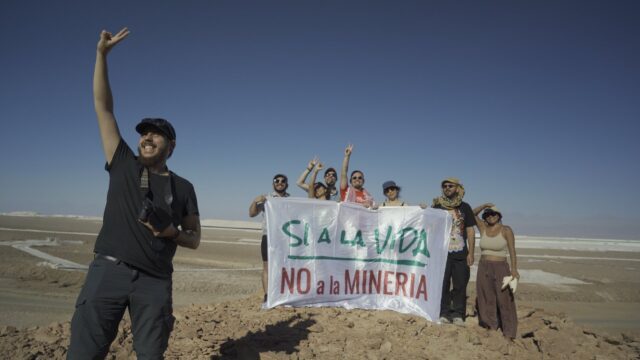
In Our Backyards (working title) follows an indigenous radio journalist, a rural beekeeper, an academic activist, and a Hollywood actress as they unite to defend their territories in Chile and Serbia from lithium mining, reads the synopsis of Donoso and Juárez’s new doc, whose Impact campaign was pitched 15 October at Dokumentale. Through their stories, the documentary “exposes the greenwashing of big corporations and highlights how these distant ecosystems—through their organizing methods, food systems, religious practices, and traditional dances—are bound together under the umbrella of environmental justice.”
“The communities themselves asked us to make this film (currently in post-production) and from the beginning we saw the potential impact of this as a driving force,” director Donoso tells BDE. “We first connected with two of the protagonists in 2020 while working on an educational project in Chile’s sacrifice zones. We were struck by their passion to show that the desert is not a barren, lifeless place to be exploited by lithium mining companies, but rather a vibrant ecosystem, deeply intertwined with the lives and culture of the people inhabiting the region. In 2021, another protagonist shared how her community in Belén had successfully halted a Rio Tinto mining project, and how this local struggle had connected with communities in Serbia facing the same corporation through a network called “Yes to life, No to Mining.”
“The impact was clear from the start, especially given that we live in Germany, where the car industry and lithium demand play significant roles,” says Donoso who underlies his and partner Juárez’s credentials in delivering both the film and its associated Impact campaign.
“We both have the sensitivity of auteur cinema, which allows us to approach the story with a deep artistic and emotional understanding, while also having extensive experience in climate communication. This makes us an ideal and compelling duo to tell the powerful experiences of communities confronting the exploitation of their land, striving to share these stories not only for awareness but also for tangible Impact and action.”
Impact goals
- Train 400+ educators and environmental enthusiasts in conservation and electromobility.
- Unite 30+ civil society organizations to address community perspectives on transportation, energy, and conservation.
- Host 20+ discussions and film screenings across Germany to promote critical views on green technology.
- Hold 10 screening events at political institutions to raise awareness of sacrifice zones.
“The impact of this film is deeply personal for the team, as it not only tells the story of communities fighting against lithium mining but also reflects our own commitment to environmental justice,” say Donoso and Juárez. “The people working in the documentary either come from Chile or who have grown up in mining towns in the desert or in the cities where the mining companies headquarters and seat of government are located.”
We want the film to be a toolkit for real change, starting with local screenings and discussions in mining towns, sacrifice zones, and community events like fairs, climate camps, and cultural festivals. These screenings will provide spaces for dialogue, where people can share their struggles, build solidarity, and strengthen their resistance to ‘green extractivism.’”
“ Personally, we’ll act as media advocates, using our platform to raise awareness of the Right to Say No to Mining and fight against environmental injustices. For us, this is more than just a film—it’s part of a larger campaign to stand up to extractivism and promote a fair future to everyone in the context of some many crises.”
PITCH: THE CHILDREN OF KORTAL BY JULIA CHARAKTER
The feature doc The Children of Korntal is currently on release in German cinemas. Korntal is a small town in south Germany, and the scene of the most terrifying sex abuse scandal within the Protestant Church in Germany. In the film 150 former children of an orphanage of the Pietist brotherhood come forward and tell the horrors of their childhood. The pastor is encouraging forgiveness, many people in the parish feel that it’s time to put the matter to rest – but the former child victims are fighting for recognition and dignity…
Director Charakter started to investigate the subject of institutionalised sexual abuse in 2017 for the short film Without Mercy. Such was the enormity of the response they decided to make a feature-length documentary film about it. Her research brought her to Korntal, where the massive abuse scandal had taken place. “When we started to work on the film in 2019, we were shocked about the unheard and ignored voices of the survivors, which the little Pietist community tried to ignore, still the survivors fought to be heard,” the director tells BDE. “That is why we felt the need to make this film. One line at the beginning – and the reason to make the film – was ‘Survivors of sexual abuse have voices. They just need to be heard.’ So our main motivation for the documentary film was to make the survivors be heard and tell their stories to a broader public.”
Impact goals
- Put on 50+ film screenings to raise awareness of the issue of abuse and discuss how to support survivors of sexualized violence.
- Organize a special film screening in Korntal, facilitated by a trauma specialist, to initiate a dialogue between survivors and the citizens of Korntal.
- Hold screenings for decision- and policymakers in order to reform investigations into sexual abuse cases in accordance with transparent, independent guidelines.
- Generate 100,000 signatures for a petition run by Tour 41 to challenge the statute of limitations for sexualized violence and generate public pressure to prevent the closure of the Fonds sexueller Missbrauch (German Sexual Abuse Fund; FSM).
- If we can dream big here: collaborate with the #ChildAbuseIsTorture campaign, which aims to abolish the twenty-year statute of limitations on child abuse internationally, advocating for changes in human rights legislation to ensure justice for survivors at the ICJ.
“After the [current] screenings we have often discussions with the survivors, experts and also church representatives. The press were on our side and we had some quite good reviews in the newspapers, social media and TV,” Charakter says of the ongoing campaign.
What the film team didn’t expect was that the wider Protestant Church in Germany would be so supportive of the doc. “They are sharing the announcements of the film stops and they are even thinking about using the movie for their “abuse prevention trainings” and they are planning to screen it next year at their annual Church Congress.”
However, the Pietist brotherhood in Korntal remain critical of the film. “They present themselves as the victim, disrespecting the rights and the traumas of the survivors,” says Charakter. “But there’s a lot of movement in the small community and we still have the goal to make a special screening in this little town where it all took place. Unfortunately, there is no cinema and we are looking for a creative solution.”
“In the international context it’s not only important to strengthen the rights of the survivors, but also change the law regarding the 20-year statute of limitations for sexual abuse, because in the most cases the survivors cannot talk about it after 20 or 30 years. To change the awareness of the subject and really to change the international law our movie would need legal support and support of experts in the field of human rights [legislation].”
THE ICE BUILDERS BY FRANCESCO CLERICI, TOMMASO BARBARO
In their short film. directors Francesco Clerici and Tommaso Barbaro provide an urgent portrait of the people within the Himalayan Zanskar valley and their struggle to survive extreme living conditions aggravated by climate change. Now the filmmakers are seeking funds to extend the short documentary to feature-length.
For producer Fabio Saitto this is a first delve into the business and processes of Impact.
“I learned about the Ice Stupas and the reality of the villages in the Himalayas by chance, through friends who introduced me to Andrea Zatta, fresh from a trip to Ladakh where he was trying to help the local villages build artificial glaciers,” Saitto tells BDE. “This theme immediately fascinated me, touching on issues dear to me such as the defence of mountain ecosystems and indigenous traditions to combat climate change. I felt that this story needed to be told, not only to raise awareness in our community but also to raise awareness of a positive example of struggle for land conservation. Even though I didn’t yet know the world of Impact producing, I unconsciously already had a dissemination path in mind that reflected those same principles. From the beginning, the idea of the documentary had an educational purpose and a desire to try to bring about change.”
Saitto lists his Impact goals:
- Reach 100,000+ people through a targeted campaign addressing climate change in vulnerable areas like the Himalayas.
- Encourage 100 communities globally to adopt similar initiatives within three years by sharing success stories and resources.
- Inspire 50+ policymakers to integrate indigenous knowledge into climate strategies through workshops and case studies in two years.
- Secure $500,000 in funding over three years for sustainable water solutions for communities reliant on glacial water.
- Advocate for three new policies in five years to reduce pollution and support climate-adaptation projects like ice stupas.
“Yes, we are trying to organize local screenings in various countries thanks to the support of mountain-related associations, such as the Alpine Clubs. Furthermore, we would like to involve universities and NGOs to promote screenings together with conferences, in which to discuss the situation of mountain ecosystems and the challenges due to climate change,” Saitto underlines. “For example, in Milan we organized a screening during Green Week at the Museum of Science and Technology, with a debate between professors and researchers on the topic of mountains and climate migration. We aim to replicate these initiatives in other countries, integrating the documentary into an academic debate to reflect on the challenges that mountain communities face.”
SISTERQUEENS BY CLARA STELLA HÜNEKE
In Sisterqueens, director Clara Stella Hüneke follows Jamila (9), Rachel (11), and Faseeha (12) from the eponymous rap troupe over a period of four transformative years, as they challenge societal norms, confront biases, and battle gender expectations. ‘The inseparable best friends, who live in the heart of Berlin, raise poignant questions about the complexities of self-determination, identity, and the pursuit of equality,” the synopsis reads. Faseeha confronts the limits of artistic expression, Rachel ponders what self-empowerment means to her, and Jamila questions the role of the police. Amid their contemplative reflections, the three girls craft rap verses that “skilfully disrupt conventions, redefining feminism one verse at a time.”
“In my work I deal with microcosms in which feminist utopias are (partly) lived. That’s why I was very curious to understand how a girls’ centre with a focus on self-determination works,” director Hüneke tells BDE. “When meeting the 3 main protagonists of Sisterqueens I was sure of making the film.”
“I speak as an artist at all times and women and queer rights are the core of it,” Hüneke adds. “I don’t think there is such a thing as apolitical art. We work with empathy, humour and open questions within the film as well as with the network around the film. We make films to drive social change.”
Hüneke’s impact goals
- Have three politicians commit to putting funding for adolescent cultural institutions (back) on the agenda.
- Use our social media channel to create a platform for young girls, women, and FLINTA (female, lesbian, inter, non-binary, trans and agender) communities to empower each other and drive local change on a societal as well as political level.
- Put on 5+ special film screenings to obtain support and provide maintenance for social youth institutions that encourage critical thinking and self-determination.
To achieve these, Hüneke wants to:
- organize a funding and impact cinema tour with 100 screenings;
- launch creative writing empowerment workshops to accompany the cinema tour
- develop a toolkit for our empowerment workshops and DIY screenings
- find partners who can mobilize, co-create, and/or fund transgenerational screenings and workshops with us, such as NGOs, foundations, and educational institutions, as well as creatives, musicians, artists, or simply rap fans and feminists.
The role of a separate and independent Impact producer is essential, Hüneke underlines. “I have worked around Impact campaigns before. What I learned is that an empathetic filmmaker has very precise expertise as well as is very involved on the subject after a long period of filming – which is good and bad. I think it’s therefore important to have Impact producers who can co-create with the existing networks and the driven filmmaker.”
Speaking to Dokumentale before the festival, the filmmaker talked of the youth work undertaken at the Mädea intercultural girls’ centre and in the Sisterqueens rap project.
“Here, very young girls learn about sisterhood and political participation, and can explore their artistic talents. The film gives great insights into what is possible in anti-discrimination initiatives that provide young people with access to education opportunities tailored to their own realities free of charge. Many of these youth programmes are currently experiencing cuts and being downsized nationwide. I hope the film can counteract this state of affairs.”