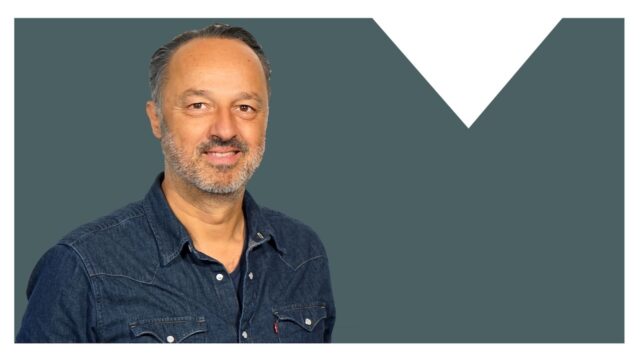
At MIA 2024, Head of Doc & Factual, Marco Spagnoli, welcomed Manuel Catteau, President and Producer of Paris-based ZED, to the stage. The conversation focused on the evolution of contemporary non-fiction storytelling and ZED’s rich slate of projects. The talk took place at Cinema Barberini on Day One of the Rome-based industry event.
“For me, producing and selling has always been the same job,” Catteau began. “Step by step, I built a large production company with a vast catalogue, and our business model remains unique.”
“By producing films, you don’t make a lot of money, but by distributing them, you can. Working on both production and distribution allowed me to balance my cash flow and made my business sustainable. That’s why I’m here today.”
Spagnoli asked Catteau why he chose to work in non-fiction instead of drama or animation. “It was completely random, I’ve got to say. When I started, I was living in Milan and serving in the military. My girlfriend worked in the media industry and went to Cannes. I tagged along and managed to get into the Palais [des Festivals]. I was fascinated by the market. Months later, I decided to enter the media industry and got my first job in a production company, working as a salesman,” he revealed. “[Working in] non-fiction happened purely by chance, but I grew to love it and have stuck with it.”
Spagnoli later hinted at the idea that “all documentaries are original IPs, in a broader sense.” Catteau agreed: “Each documentary is a prototype, with its own model and ‘chemistry.’ You can’t replicate the formula of one film or another. We work in an industry built on prototypes, which doesn’t make life easy.”
“We live in countries with very rich histories, we have an educated audience, and we benefit from strong public broadcasters. These factors help us find stories—what you call ‘IPs.’ We’re lucky because the IPs for documentaries aren’t as fiercely contested as those for fiction. In fiction, everyone wants to hold onto IPs, and production companies struggle to retain them. In non-fiction, this is easier because most documentaries don’t air in prime time or generate massive profits, so the stakes are lower and there are fewer conflicts.”
“We’re now specialising in projects that can sell internationally,” said Catteau, before presenting his latest slate of productions. “We know that quality history, nature, or science documentaries have a long shelf life, from 5 to 10 years. You don’t earn a fortune, but the income is steady.”
The first project he introduced was the 2×50-minute series Destination Moon: The New Space Age, produced by ZED with One Way Films and NHK for France Télévisions, ZDF Terra X, SVT, PTS, RTS, and SBS. Combining archive footage, impressive CGI, and contributions from experts involved in this colossal mission, the film details the history of the Moon’s conquest, from the Apollo missions to the latest milestones of the Artemis programme. The project, budgeted at €1.2 million and set to air during prime time to coincide with the Artemis 2 launch, includes a VR experience and a full-dome film.
Next, Catteau presented Terra Futura, an ambitious 2×45-minute series and 90-minute feature film produced by ZED and SAM Content for France Télévisions and Screen Australia. The documentary explores how the Earth will look 250 million years from now, after humanity has gone extinct and other species have survived and evolved. “It’s a futuristic journey to a time when conditions will be too harsh for us, but life will continue to exist. It’s about the resilience of [other] forms of life,” explained Catteau. Delivery is scheduled for the end of next year.
Other series presented by Catteau included WW2: The Sound and the Fury (4×52 minutes, for which ZED is the distributor, with delivery slated for 2026), Ancient Megacities 2 (3×52 minutes, also set for release in 2026), William the Conqueror and the Mystery of the La Mora Ship (2×52 minutes, set for 2027), and Caligula: The Hidden Treasures (2×52 minutes). The latter, produced by Alma Productions for Histoire TV and distributed by ZED, is now in development and is set for release at the end of next year. It focuses on the controversial, extravagant Roman emperor. New archaeological findings—particularly the floating palaces discovered beneath Lake Nemi—will allow viewers to reassess his legacy. Catteau is currently seeking additional partners, “ideally an Italian co-producer and broadcaster.”
“It ticks all the boxes. We’ve got the bad guy, a contemporary investigation shedding light on history, and so on… Once completed, it will travel well, and we expect to sell it in over 40 countries. That’s the kind of story we’re looking for,” said Catteau.
Towards the end of the discussion, Catteau maintained a positive outlook on the future of factual content. “Non-fiction is a fragile economy but a solid business. It will never die because our clients are public broadcasters, and they’ll never disappear. They may transform or change their model, but they remain a matter of cultural sovereignty.”
“The challenge is that this market is constantly evolving, but public broadcasters are going digital. They want their programmes to be available anytime, anywhere, so they’re developing their own platforms. This isn’t just changing business models but also the way we tell stories—non-linear programming opens up new ways of storytelling. The non-fiction business is probably the richest genre when compared to fiction and animation. It’s constantly evolving, but it will always be around.”
On the future of theatrical documentaries, Catteau was more sceptical. “I think it’s very complicated. I’ve seen a lot of films fail. I’ve experienced it myself—you release a film in a week that’s packed with other releases, and it’s difficult to keep it in cinemas. But with IMAX or planetariums, that’s a different story. It’s a growing business. I can’t say it will be profitable in the near future, but it’s young, dynamic, and has international appeal. With technology advancing, I see it as a new market closely tied to what we do.”
Streamers, on the other hand, are not particularly reliable. “At first, they were very creative and looked for niches… But now, if you look at their content, it’s all very mainstream. […] I rely much more on public broadcasters. They are our main partners when it comes to creation. The problem with streamers is they have too much data, and creatively, they rely on it too heavily.”