

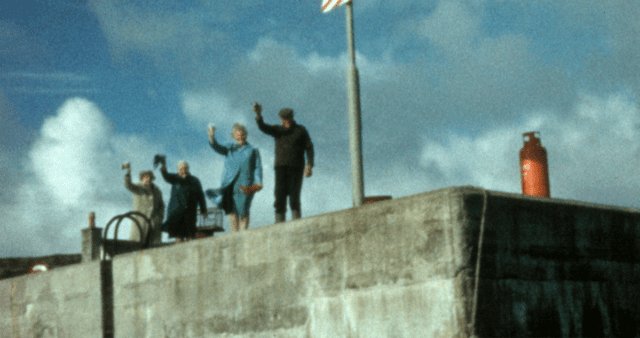
“Dùthchas” is a word in Gaelic which evokes very strong feelings. It means heredity or the place of one’s birth and it provides the title for the new, archive-based documentary premiering at the Edinburgh International Film Festival and across Scotland on August 20.
The film is largely based around remarkable 8mm footage shot by Bill and Ann Scott, a couple from Cheshire who visited the Hebridean island Berneray every summer in the 1960s and 1970s. Bill, an architect by trade, was a keen and talented amateur cameraman who loved to record his trips to the Hebrides.
Ann Scott was a cousin (in law) of Gloria, an Australian district nurse who ended up living on Berneray – and is one of the main interviewees in the new documentary. Gloria had married the islander Donald “Splash” MacKillop, a local character famous for having taught Prince Charles about crofting when the royal visited Berneray in the late 1980s.
After the Scotts died, their home movies were donated to Gloria and Splash. There were over five hours of material, most of it chronicling life on the island. Splash died in 2009. Gloria, who hadn’t done anything with the old films, found the footage in her attic and wondered what to do with it.
“She got in touch because she knew we were interested in archive film,” recalls the North Uist-based McKinnon, an arts manager and filmmaker who is director of UistFilm and works closely with the Taigh Chearsabhagh Museum and Arts Centre in Lochmaddy. MacKinnon co-directed the documentary alongside Kirsty MacDonald, a North Uist native fluent in Gaelic and who has extensive experience researching and presenting archaeology and arts productions for BBC Alba.
The first step was to set up a crowdfunding campaign to get the Scott material digitised in 4K resolution. “We were just blown away when we eventually saw it,” MacKinnon remembers.
The footage was remarkable and often very haunting. When the Scotts left the island on a small boat at the end of each holiday, they would always film their departure. They captured on camera the faces of the islanders waving at them as their boat disappeared into the distance.
“It just struck me what a fantastic metaphor this was for the loss – and the leaving which is continual,” the director recalls.
The Scotts had caught on camera the faces of relatives whom some present-day islanders had never met or only remembered as old folk. Gloria was startled to see footage of her own wedding for the very first time.
MacKinnon and MacDonald realised they had something very special which would work as a fully-fledged feature film. They received support from BBC Alba and Screen Scotland. They were also helped by John Archer of Glasgow-based Hopscotch Films.
Alongside the old 8mm footage, the documentary includes interviews with many residents of Berneray, old and young, with most speaking in Gaelic. Some talk about the old way of life on the Hebrides, before the arrival of TVs and telephones. They evoke an idyllic time when ceilidhs (lively celebrations that generally involve a lot of dancing and alcohol) would be held at every opportunity and communities were very tight knit. The islanders may have had to work hard to stay alive but they were happy with their way of life.
That is one side of the story. The other is that this was a patriarchal society which had some very strict social rules. (No-one was allowed to work on the Sabbath). There were very few opportunities, especially for women, to find jobs.
“If they [women] didn’t want to marry a crofter or fisherman, there was nothing for them,” MacKinnon describes the plight of the young islanders in this period. It was a terrible wrench for them to have to leave. Their departures tore away at the social f
abric of Berneray.
Interviewees remember that during their childhoods, they would “get the belt” if they had the temerity to speak Gaelic, which was their mother tongue. They were being forced to speak English instead. From the age of 12, they would have to travel to secondary schools on other islands. They would often be boarding away from home for months at a time, only coming back during the school holidays. The women, meanwhile, would find husbands on the mainland, stay there and bring up non-Gaelic speaking families.
The filmmakers don’t feel they are romanticising the islanders’ lives. “Life was hard in some ways. But I think also there were idyllic aspects to it. I think people do have a nostalgia for that. I think they recognise at the same time that change is a constant and that in so many ways life is much better now on Berneray…[but] I think there is still a sense of regret and grieving for the culture and the language that has been lost to such a large extent.”
Gaelic is back on the syllabus today. The cultural imperialism that characterised the education system in the 70s has largely been reversed.
MacKinnon has direct experience of the exile and sense of loss that the documentary foregrounds. His great-great grandparents migrated from the islands. “Gaelic was lost in my family four or five generations ago.” He moved to the Hebrides just over 20 years ago to make his first feature film and immediately felt he was back where he belonged. He married a local girl and, as he puts it, “has never really left.”
Dùthchas is having a special screening on Berneray just in advance of the Edinburgh International Film Festival premiere. The film will also screen in 12 regional cinemas at the same time it is shown in Edinburgh. It will tour in the “Screen Machine,” a mobile cinema which will show the film “everywhere in Scotland where there isn’t a regular cinema within 50 miles…in many ways, that is our audience for the film, people living in these communities.”
The film will then be screened over the Christmas period on BBC Alba. In the meantime, the filmmakers are also looking to show the film further afield and “hit the European festivals.”
MacKinnon is handling the distribution himself at the moment but is looking for a sales agent to help with the international campaign.





