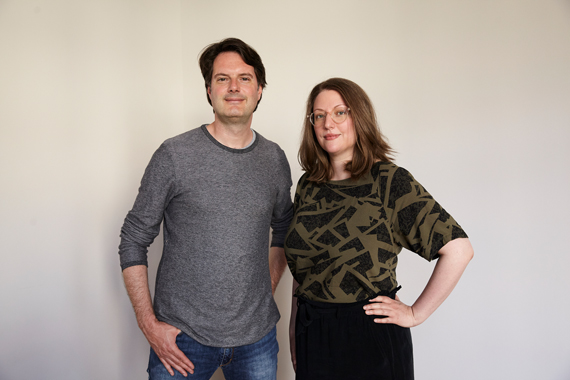
It was only by chance that Georg Gruber noticed that his Berlin-based film sales company, founded in 2003, is celebrating its 20th anniversary. No big events are planned but he gives his word that when the company turns 25, there will be a party. “It’s so funny, we kind of realised in January, oh, Jesus Christ, 20 years! It really took my surprise a bit,” he says of his dawning realisation that his company has now been in existence for two decades.
Gruber is at the Berlinale this week with several feature documentaries either in official selection or screening in the European Film Market. Lea Najjar’s Kash Kash, an enrapturing film about several characters living in very tough circumstances in Beirut, but keeping their hopes alive by breeding pigeons, is in Perspective Deutsches Kino. He also has other titles which have travelled widely on the festival circuit this year, among them Pepe Danquart’s Daniel Richter (an intimate portrait of one of German’s most important contemporary artists), as well as films about culture and architecture.
MAGNETFILMS tends to represent around 12 new films a year. Gruber has plenty of culinary docs, among them She-Chef. “We just do them because we like food and eating. It’s really a bit more of a personal passion.”
“Then we try to get a couple of thematic documentaries, Gruber says, citing films like The Milk System and Alcohol – The Magic Potion and the upcoming Just Move! In 2016, 4 million people worldwide died as a result of lack of motion. This new doc argues that, as Gruber puts it, “we need to get up off our asses.”
Gruber first started licensing movies when he was at Film Academy Baden-Württemberg. He had been involved in the 2001 short animated film Rocks, which was nominated for an Oscar.
“That was the trigger point. I thought, ah, I’ve got a film people do want to have. That’s when I started selling the films basically I had been producing. When I left film school, I had to decide whether to keep on doing that or not, and that’s when I founded MAGNETFILM.”
During his film school years, Gruber had done an internship with Beta Cinema, working under Andreas Rothbauer. “That was during the insolvency of the Kirch Group so it was a bit [of a] strange internship because the company was falling apart,” Gruber remembers. “Beta Cinema was the safe island.” This was where Gruber had his first taste of sales – and discovered he liked it.
However, after he left film school, Gruber also held down “a regular job” with a finance company. “I was working for a private equity film fund.” (He did the film sales in his spare time). Among the films he worked on was Marcus H. Rosenmüller’s 2011 hit, Sommer In Orange (My Life in Orange).
Around 2012/13, his job with the film fund ended. “”I had the luxury that I didn’t have to choose whatever was available. I could take a bit of a time.” He realised that he “enjoyed selling more than producing” and decided to plunge into it full-time.
“What I like is that it’s a lot faster. You don’t have to work four or five years to get the film done,” Gruber reflects. “From a business point of view, it definitely makes more sense selling stuff than producing. And I like the international nature of the business.”
In the early years, MAGNETFILM was devoted to short films but gradually expanded to cover feature documentaries.
“It was clear to me that short films only was a bit too niche,” Gruber notes. “Of course, it is a privileged thing to do [to sell shorts] but at some point, it became too much of a routine.”
Gruber had always been a fan of documentaries. “I just like to watch them and I do like the people making documentaries. It’s a bit less ego [than in the fiction world] and it’s a bit less money.”
The company has always been kept deliberately small, with a staff of only two or three (including his colleague Frauke Knappke). “Small but distinctive…” he says. “Even as a super small unit, you nevertheless have the chance to get really good films. The idea was that we stayed small, flexible and fast. Being so small means we have the luxury of basically taking the films we want to take. There was not the financial pressure on each film that it had to perform because we had to feed 120 people or more.”
One of Magnet’s first docs to have a big pull in the market was Farida Pacha’s My Name Is Salt (2013), about Indian families trying to extract salt from the earth. This won the IDFA Award for First Appearance.
The company quickly established a strong reputation in the doc arena. “At the beginning, you have to start from scratch and take the films that you get offered,” Gruber remembers. Now, though, the filmmakers often come to him.
“The good thing was that I had already a short film catalogue on the side which brings in a steady revenue stream. Let’s say the infrastructure was there already…” Gruber says of the move into the doc business. He built up his network of contacts at doc events like Sheffield Meet Market and IDFA.
Gruber tries to mix and match between different kinds of titles. “We do films we believe in but it’s every subject, topic and genre. It could be first-time filmmakers, it could be experienced directors. In the end, it is about the film.”