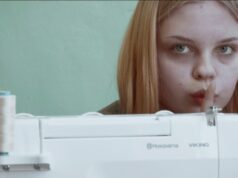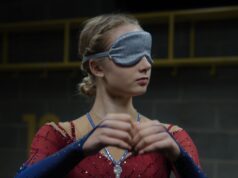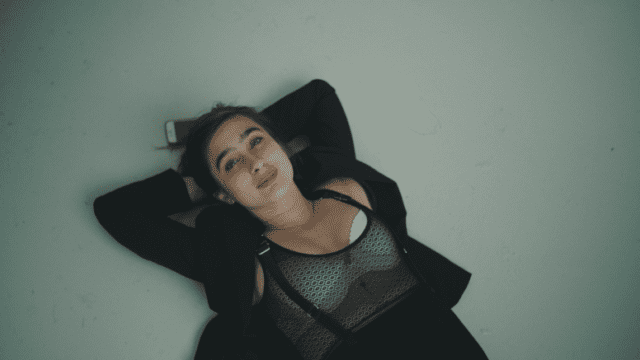
Why twice? Why isn’t the documentary simply called ‘Apolonia’? As the title appears on screen, the second ‘Apolonia’ is in all caps – Apolonia, APOLONIA. As if she’s being called, with the voice getting louder. Panicking perhaps, fearing her lost. Or seeing her approaching a cliff. Apolonia! Or maybe cheering her on, as she is being hauled onto the stage as a star.
All these things are true. All these things happen. And all these things take time.
So that might be another reason why her name is repeated: because the documentary doesn’t portray her at just one of those moments in her life, but follows her longitudinally. Filmmaker Lea Glob, who has had a camera in her hand for as long as she can remember, started filming Apolonia Sokol, the young bohemian Parisian painter, in 2009 for a Danish film school assignment. And she kept at it – the documentary ends in 2021, but it feels as if she’ll never stop. To paraphrase the traditional German fairy-tale ending: And if they haven’t died, they’re still filming even today.
Because that’s what happens in longitudinal documentaries: people die, people are born. That is also what happens in Apolonia, Apolonia. But that wasn’t necessarily the documentary maker’s intention. Lea Glob was simply mesmerised by Apolonia, an endlessly charismatic and interesting subject. As Lea describes her in the accompanying press kit: “From sexuality, to grief, to love, to sex, to ambition, to doubt, to suicide, to religion – she was challenging everything.”
Meanwhile, Apolonia seems fully herself in front of Lea’s camera, not a muscle in her face betraying any discomfort. As if the camera is simply part of life. At one point she leaves the room saying: “Bye Lea. Bye camera.” As if both are her friends. Maybe because Apolonia had been used to being in front of a camera her whole life – and even before (her parents filmed not only her birth, but also her conception, a short clip of which is included in this film).
Lea must have had an enormous amount of material to choose from. Of course, this film, as it is, could never have been scripted beforehand – it’s all editing. The story appears, it is discovered, not planned. And I must admit that it took me awhile to get into it, to discover it for myself. Apolonia is never less than engaging, but as a film, for a while it seemed too private. A friend filming a friend. Who lived in a very cool old Paris theatre created by her parents, full of artists and activists, but still… And Lea’s film style, observant, respectful, calm, did not immediately draw me in either. There remained a certain distance, mirrored in the wistful soundtrack and retrospective voice-over.
But then the magic started to happen. Time. Because before you know it, you’ve been to Denmark (where Lea is from and Apolonia lived for a while), to Paris (where the battle to preserve the theatre is ultimately lost), to New York (where Apolonia tries to kickstart her career), with historical detours through Belarus and Poland (where Apolonia’s family is from) and Ukraine – from where Apolonia’s soulmate, Femen co-founder Oksana Shachko, originates, fleeing to Paris, still weakened by the two broken arms she suffered for her activism. These are people who, like so many of their generation, do not just live in Denmark, or France, or Ukraine. They live in Europe – with certain parts of the US as a dependency.
And then slowly, Apolonia’s attempts to make it as a painter, coalesce into a cautionary tale which transcends her individual career. Because what Faustian bargain do you have to make to be able to live off your art? Apolonia is pressured, by both the prestigious Beaux-Arts de Paris academy and disruptive American art patron Stefan Simchowitz, for reasons which are perhaps less personally malevolent than systemically repressive, to sacrifice quality for quantity, to produce, to conform. And it’s not only the art world which is to blame – Apolonia herself genuinely seems to want to be big, to break out, to be famous. Which is understandable, given that she had almost nothing left after her theatre closed down. But still painful to watch.
And then another, even more overarching theme appears in the narrative. The struggle against the patriarchy. It’s what Oksana and Femen are fighting against, with great personal sacrifice. But it becomes increasingly clear that this is what Apolonia is fighting against as well. Almost all of the people we see critiquing her work are men. Some of those critics seem more helpful than others – but even then, they remain skewed in their representation. “I wonder if they would’ve said so to a male painter?” muses Lea from behind the camera, when Apolonia receives some particularly harsh feedback.
The patriarchy is also connected to Apolonia’s and Oksana’s decision not to have children. “The problem for me is that if I want to paint, it won’t be possible,” Apolonia concedes, and however unfair that might be – there are plenty of male painters who were never bothered by the kids they left behind here and there – in the world as it is today, she might very well be right. “No families, no babies. Art and creation,” says Oksana, with a sad smile, “It’s the only way to survive in this patriarchal world.”
When she is in the US, producing paintings faster than she ever did before, Simchowitz (who at the time was dubbed ‘The Art World’s Patron Satan’ in a piece by The New York Times) has her – like so many up-and-coming, potentially investable young artists – on a leash. It’s grating how he talks to her as he takes pictures: stand here, move over there, and so on. As a commodity. “I’m an industrial product now”, Apolonia laughs, “I’m not going to be cool anymore for any of my friends.” Later, a man she is taking photos of nervously warns “take care”, when he hears she is having tea with Simchowitz and Harvey Weinstein. It’s only a short while before #MeToo appeared on the scene.
But there is a fairy-tale ending to all of this. During the photo shoot, as Simchowitz is bossing her around, Apolonia at one point says: I want to have my nude picture taken with that giant inflatable butt plug! Simchowitz protests that the terrain is public property – he seems to fear commercial repercussions for doing anything too subversive, possibly illegal. But Apolonia breaks free: she says “Fuck America”, strips down, asks Lea, who is filming everything, to take a picture of her and poses proudly. This time it’s not the powerful rich guy, but her female friend who takes the picture Apolonia wants taken of herself, on her own terms. That is the moment, according to Lea, that “Apolonia, instead of selling her soul, used her body as defence. And set herself free.”
Apolonia leaves the US. Later, her first solo exhibition is organised by a female gallery owner of her own generation. “They find that my paintings make an impact!”, she almost giggles, reading reviews. And her paintings, including one in which a woman is sitting on a horse, armoured, trampling the bloody remains of naked men underfoot, do indeed.
This is also the time Lea realises she has not just filmed a portrait of a friend, or an art scene, or even a time period. By keeping at it, year after year, “I had a camera aimed at life itself.” And precisely that is the magic of the longitudinal documentary. At the end, one simply wishes that Apolonia, Apolonia would continue.
Denmark, Poland, France, 2022, 116 minutes
Director Lea Glob
Production Danish Documentary Production
Producer Sidsel Lønvig Siersted
International sales CAT&Docs
Script Lea Glob
Cinematography Lea Glob
Editing Andreas Bøggild Monies, Thor Ochsner
Sound design Anna Żarnecka-Wójcik
Music Jonas Struck
With Apolonia Sokol, Lea Glob, Oksana Shachko