

The thousand-mile quest (maybe more) undertaken by the eponymous hero of Sam Now is one born of necessity. One day, when Sam Harkness was barely in his teens, his mother Jois packed her bags, stepped onto on a train and disappeared through a “portal.”
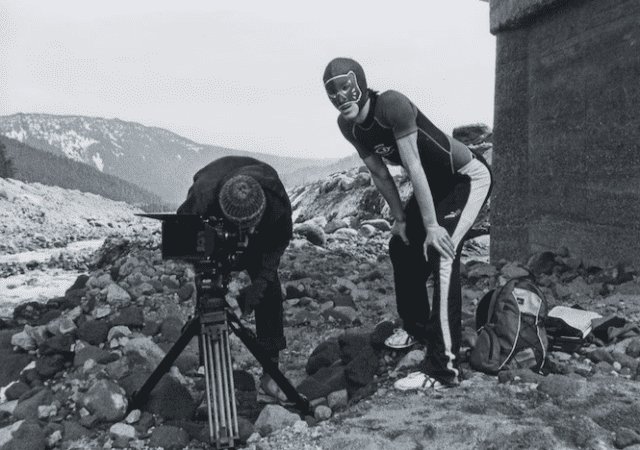
Back in the early years of the new millennium, Portland-based Sam and filmmaker Reed Harkness (a half-sibling and seven years Sam’s elder) were inseparable as latter-day Lumière brothers, inventing and (re)discovering filmic processes on their Super 8 cameras. Sam even had an onscreen alter ego, the Blue Panther, who developed out of the series of films (Sam 1, 2, 3 and 4) that the pair made together.
As is explained in Sam Now, it was these films that provided the key to unlocking the mystery of Jois’s disappearance, when the half-brothers set out to make an altogether more serious addition to the series, The Blue Panther Finds His Mom, which propelled them on their thousand-mile odyssey that eventually ended in Oregon.
The adventure may sound light in tone but it was undertaken against a background of devastation and confusion within the family. Nobody knew why Jois had left, especially as in archive she looked happy, at least in the way people do in family footage. But Sam’s brother Jared took it particularly hard and he “shut down,” we are told in the film. Despite being a family of “educators,” as director Reed Harkness explains to Business Doc Europe, nobody was equipped to deal with the disappearance. An aunt tells how it Jois’s departure was “pure and simple abandonment.”
It is no spoiler to say that Sam and Reed succeed in finding Jois, who is both surprised and delighted to see them, but shows no regrets as to her behaviour, and the rest of Harkness’s admirably non-judgmental film details the lives of the family members as they come to terms with her (part) re-immersion into their lives.
What is clear that all of the family, especially the kids, were profoundly changed, both emotionally and psychologically, by that acute point of singularity when their mother left, and while they have grown into impressive adults, a difficult legacy remains. For a long time Sam felt “emotionally crippled.” He was someone who could shut out emotions, which he describes as both “a strength and a weakness,” but subsequent relationships suffered. Jared has thrived as a café owner, but he is nevertheless haunted by continuous introspection. And yes, a coda sequence goes some way to explaining Jois’s own emotional development as an adopted child (half Japanese/half American) within what appeared to have been an austere US household where she remembers “no love” and always having to “stand in the corner.”
Producer/editor Jason Reid grew up around the corner from the Harkness family, and from an early age would play with Reed who was separated in age by just one day. “I grew up with kind of a front row seat to the Harkness family, and I knew all the characters; Sam, Jared, Jois and Randy [father]. So as the editor of the project [he came onboard in 2015], I was able to know who all the characters were and understand the family dynamics in a way that probably most producers and editors wouldn’t, just because I have that personal connection to Reed and his family.”
The Harkness family may be one with love at its root, but it is not without its complications and dichotomies.
“They’re all educators and they’ve all learned a way to present in front of a classroom and keep their cool,” director Reed explains of the unnervingly calm sense of distance shown by the older Harknesses both after Jois’s disappearance and re-emergence, an aloofness that the director responds to with exasperation at one point onscreen. “We’re all very close-knit and gather regularly. So there’s a lot of space for being near, being connected, joking and talking – but not necessarily a lot of space for how we share pain with each other. And I think that this is the thing that I get at in the film as I start to take on all of these responsibilities of helping my brothers find their mom. It really starts to weigh on me and I start to realize that, man, where’s the room for recognizing complex feelings in my family?”
“As we’ve shown this to audiences, a lot of people recognize the suppression and the sort of family dynamics where people just don’t want to talk about uncomfortable things a lot of the time,” Harkness adds. “And I see that’s where stagnation or pain happens in family. Families carry on secrets that are hurtful and not just secrets, but they don’t address things and in not addressing them that creates patterns that can be generational.”
The film is bursting at the seams with film references and influences. Harkness cites the autobiographical works of revered America documentary make Ross McElwee, as well as François Truffaut, whose 400 Blows inspired the “coming of age concept” of the early Sam series. He also offers a grateful nod to Michael Apted’s seminal Up series, which has revisited characters every seven years since childhood. When Harkness heard about Richard Linklater’s Oscar-winning fiction feature Boyhood, which was shot over 12 years while following the same characters, he was fearful that his idea had been taken, but was relieved to see that Linklater’s take on the story was significantly different. But that didn’t stop Harkness from giving a nod to Linklater’s Slackers in Sam Now’s vibrant final sequence that involves a ritual sacrifice which brings the 25-year story to an end.
“For Sam, it was a huge relief to get to an end point. I think that he really started to feel like not having an end to this film was becoming something that was too much for him. And I respected that too and wanted to wrap it up in a timely way.”
Sam Now world-premiered at Hot Docs 2022 and had its European premiere at the Zurich Film Festival where it won the Documentary Prize. It has subsequently screened at over 50 festivals, garnering 15 awards. The film has been screening on PBS Independent Lens since May 2023 and is currently streaming on the Criterion Channel.
After 25 years of filming and editing, and over a year of plaudits from public and critics alike, how does Harkness reflect on telling his family’s immensely personal and at times very difficult story?
He explains how, back in 2005, an article was published in Oregon about his documenting the story of Jois’s disappearance. She saw the article, at which point she felt intensely uncomfortable with the process, so he stopped filming.
“Then I came back to her years later and said, I want to continue making this film. And she said, I want you to know that it makes me uncomfortable that you are doing this story, yet at the same time I support you and think you should make the film,” Harkness continues emotionally.
“This is where we get into really deep personal ethics. Am I willing to make my stepmother uncomfortable for my own art? Am I willing to make my other family members uncomfortable for my own art project? And I think what I came back with was, it does feel right to me to tell this story and to speak my mind. It felt like a really difficult letter to somebody when you’re saying things that are hard to say,” he says.
“But ultimately it’s a love letter. It’s a letter saying, I love you. I recognize there’s some shit going on, but I love you. So that’s kind of the gist of this project,” Harkness signs off in tears. “Yeah, man, it still gets me.”





