Lucy Kerr’s arthouse triptych documentary, selected for FID’s Flash Competition plays both as a riveting piece of storytelling and a cri du coeur for safe practices within the movie stunt industry. The director straps up with Business Doc Europe.
The evolution of Lucy Kerr’s arthouse triptych Crashing Waves is, in some ways, as intriguing as the resulting film.
“I had been making a conceptual exhibition, based on some research I had done about translations of women’s mystic writings in the Middle Ages, hagiography of saints and how they’re kind of often depicted violently,” she points out. “And while I was working on that project, I made this contemporary analogy to stunts and their repetitive re-enactments of death in the film industry and in Hollywood.”
“So I was interested in this gap between the lived experience of creating a representation and the representation itself,” she adds.
This inevitably leads to a critique of the stunt sector and an appraisal of its operatives and their relative value within a food chain that sees stars earning their millions at the top while their stunt doppelgangers risk lives and limbs at the bottom, quite often for SAG wages.
The situation is even worse for women who are asked to perform stunts in in appropriate dress. “They’re often playing these sexualized roles where they’re wearing high heels and having to roll down the stairs wearing little padding. The way all these elements affected one another really interested me,” says director Kerr.
The first part of the triptych offers the nerve-jangling testimony of an über dangerous stunt during which a car was supposed to flip off a road at pace into the sea forty feet below. Not only does the story indicate how poorly the production was prepared the stunt, but also the sense of pressure felt by the teller of the tale, Jess Harbeck, to perform it.
“It felt like a rite of passage stunt. Like if you do this, you’re going to be taken seriously for these things,” Harbeck says in the film. “I felt like it would make me be seen as a certain type of brave, that would help keep up the image of me as a tough, strong go-getter stunt person. Looking back now, I feel like asking questions and caring about your own safety is actually way more impressive, and also taking care of yourself and the people around you. It means you give a shit. It doesn’t mean you’re afraid or not valuable. You’re actually very valuable because you want to make sure that everything will be okay.”
She adds: “So because of that, I wish I had thought so much more about it because I was like, oh fuck, I need to this thing…”
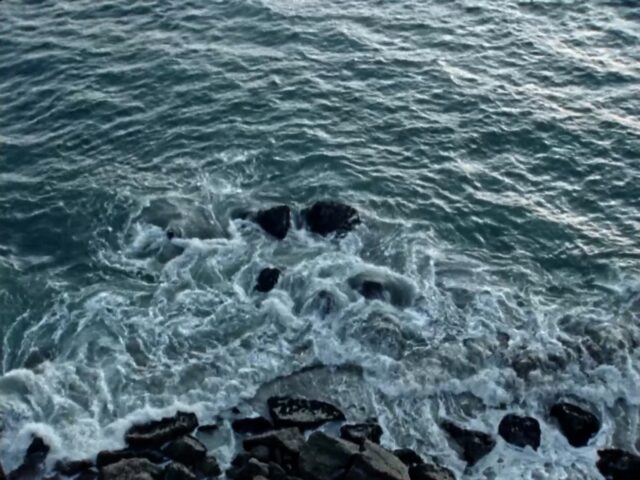
As we hear her testimony we also see, from high above, dark and violent crashing waves towards which we are inexorably falling, until we are engulfed in silence.
The third part of the triptych shows grainy and discombobulating footage of stunt activity performed by Kelli Scarangello for The Exorcist TV series who floats through the air, attached to a harness, bloodied and crashing into doors and walls.
The film was originally set to be longer and with more stories but Kerr figured that the tale of the car careering into the sea drove home the point satisfactorily. “What I thought was so powerful, it’s like the ethics of care,” says the director. “So the reason I chose that minimal structure is because I just wanted to kind of find a way to make that the most important element…It was difficult at the time to strip so much away…but I think that’s how the story gets told with the most a powerful kind of tension.”
Such was the effect of the car experience on stunt person Harbeck, she now dedicates her time to safety practice within the sector. “Those three performers, Jess, Court [who was integral to the production, but whom we don’t see on screen] and Kelli are all queer women in the film and stunt industry, which is actually quite rare [as] it’s quite a masculine man’s world…so it has been hard actually for Jess to become a stunt coordinator in charge of safety. But I think it is really important to have more women in that position.”
In the film, Harbeck further describes the inherent sense of psychological imperative and despair once you arrive on set, when there is no turning back.
“I guess we have this ability to override the part of your brain that’s screaming at you – don’t do it!” she explains. “Pretending to be someone else’s body is cool, because you put your body through the trauma as someone else… So that’s sort of how you talk yourself out of saying ‘no’. You try to tell yourself it’s not real. Bailing out of that car at 20 miles per hour, or you’re being hit, or you’re falling 40 feet. All that shit is happening to you, but you’re like almost convincing yourself that it’s not, because it’s for a scene.”