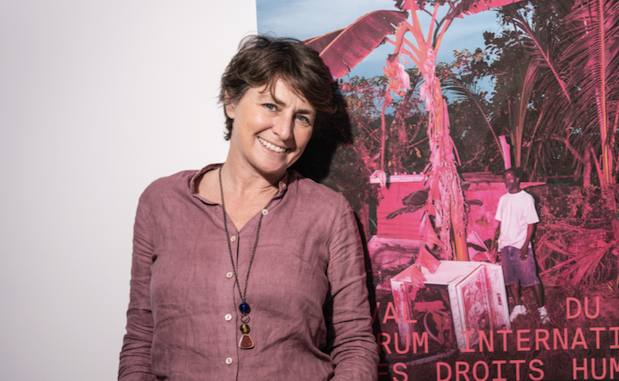
FIFDH, which runs March 8-17, is first and foremost a film festival, co-director Laura Longobardi stresses, with competitions, sidebars, an Industry programme and a thorough line-up of debates, Q&As, talks and keynotes.
But its setting is crucial – Geneva is arguably the global capital of Human Rights – and at the heart of all festival and industry deliberations is the question of how to help define a better future by harnessing the power of cinema and the influential voices seeking to effect fundamental change for good across the planet.
As Longobardi underlined when the programme was announced in February, FIFDH will “set the stage for meaningful dialogue while leveraging the transformative power of cinematography to portray the lived experiences of individuals who embody human rights, and showcase their commitment in dynamic and palpable manner — all in service of a collective future.”
The film programme isn’t vast, numbering approximately 40 films, comprising both docs and fiction. But there are two competition sections, a Creative Doc competition of ten important works, and a Focus Competition of 11 films that includes two documentary world premieres.
The first of these is Askold Kurov and Anonymous 1’s Of Caravan and the Dogs which, filmed over the course of a pivotal year before and after the invasion of Ukraine, “paints a portrait of the last defenders (journalists and activists) of democracy in Russia and offers a glimpse of hope for a different future.” The post-film discussion will invite essential contribution from, among others, director Kurov; Nobel Peace Prize laureate Dmitry Muratov (co-founder, publisher and former editor-in-chief of Novaya Gazeta) and Mariana Katzarova, UN Special Rapporteur on the situation of human rights in the Russian Federation.
The other world premiere is An Unfinished Journey by Aeyliya Husain and Amie Williams in which four Afghan women leaders – past parliamentarians, ministers, and journalists – are forced to flee the country after the Taliban takeover in 2021. “No longer in positions of influence, they are forced to reinvent themselves to continue the fight for a free and just Afghanistan,” the synopsis reads. The post-screening debate (part of the festival’s inaugural Spotlight programme) will include not only the filmmakers but Afghan activist and former minister Nargis Nehan, and Pooja Patel, Deputy Executive Director of ISHR (International Service for Human Rights).
“The campaign to recognize gender apartheid [in Afghanistan] can be made stronger by this presence in Geneva,” underlines FIFDH co-director Longobardi.
“We have an additional 10 documentaries that are there to illustrate themes that we want to tackle during the festival,” Longobardi adds, citing the likes of Out of Competition titles Food, Inc. 2 by Robert Kenner and Melissa Robledo; BROKEN – A Palestinian Journey Through International Law by Mohammed Alatar, and Queendom by Agniia Galdanova. “These are really high-level discussions where we bring experts, we bring in Civil Society, we bring in journalists and activists so we can really dig much deeper into the place, or the situation, or the theme that was been raised by the films.”
Longobardi further describes the festival audience, “as very representative of the diversity that is Geneva…because it is a very international city. Half of the people who live here don’t have Swiss origin. And a lot of these people are already working in the international organizations, the NGOs. So they are already in a way committed on their daily basis with their job in the protection of human rights. And there is also a lot of diaspora. So we have a lot of audiences that come because we are talking [for example] about Iran or because we are talking about Belarus.”
What’s more the festival is timed to coincide with the Human Rights Council of the United Nations, so there are many government, NGO and Civil Society representatives who come to Geneva to present the situation of human rights in their specific countries.
Core to FIFDH is the industry programme Impact Days, at the heart of which is the presentation 16 impact campaigns to an audience of changemakers, philanthropists and other accredited professionals. “You go around the world in three hours. I mean, 16 projects in three hours is a lot. It’s very rich, it’s very dense,” says Longobardi of a selection that can bolster the specific international campaigns of most activists in the room. What’s more, the festival is this year publishing a very practical catalogue of 75 films previously presented at FIFDH. “[These are] really matched on a case by case basis to our network of NGOs and philanthropists so that they really have a good base to look into films that can be used for what they need.”
“Sometimes it’s very hard to see, because we know that the films that we are presenting are not about good news all the time, [with] violations and pain and suffering and hard stuff,” she adds. “But at the same time, there is always a part of hope. Very often at the centre of these films, there are people who are working to make things better.”
The FIFDH professional programme will open March 11 with a keynote by Sandra Whipham of BFI Doc Society, titled ‘Love and Rockets: towards the independent and democratic future we all need and deserve.’
“The keynote for me is really always a moment of dreaming big and [having] a vision. Why are we here? What are we doing together?” says Longobardi. “Doc Society has always been at the forefront of Impact, supporting independent storytelling and independent documentaries. And so in this moment of crisis, in which the world is falling apart, in which violence is really beyond imagination and also beyond [that which] we thought would protect us from violence, which is international justice and international law, we wanted to hear from some of the leaders of this field.”
“What is the role of films? Is there still a role, now that violence is speaking, now that the climate is falling apart, now that democracy is shaky around the world? Is there still a place for films, for cultural events like a film festival? How can we participate in finding solutions and going forward?” Longobardi asks.
Impact Days will also seek to measure the impact of Impact itself, in relation to Lisa Gerig’s highly lauded documentary The Hearing which was presented at FIFDH 2023. Khadidja Benouataf, Founder and President of Impact Social Club will ask the film’s audience to answer questions online before the screening and then again after the post-screening debate. The goal is to analyse if there has been any change in the audience’s perception of asylum procedures in Switzerland, the subject of the film. Benouataf’s subsequent keynote will reveal the collected data and the interpretation that can be taken from it as an example of a “straightforward way” to measure impact.
“I think it’s important that we ask ourselves as a festival, how can we make a difference?” stresses Longobardi. “Also that we identify the means and tools that can help us understand, are we really making a difference? And is it short-term or is it a long-term difference?”