

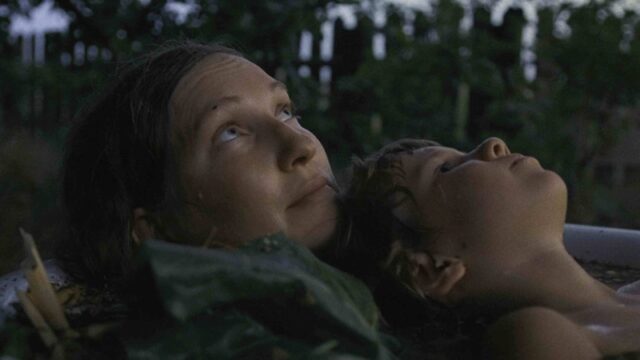
Polish director Lidia Duda’s Forest (premiering in Feature Length International Competition at Thessaloniki and sold by Rise and Shine) is certainly not the typical documentary about the refugee crisis. Early on, it plays more like a lyrical film about the wonders of childhood in the wilds. Asia and Marek and their three young kids live in a fairytale-like cottage in the woods. They seem blissfully happy in nature. They play, work, look after the animals and marvel at the beauty of their surroundings in a forest on Poland’s eastern border.
“I was interested in the humanitarian crisis on the eastern border of Poland already for a long while,” Duda explains what sparked the project. “At a certain moment, I felt I should make a film about it. But, from the beginning, I wanted to make the film from the perspective of people who actually lived there and in whose lives this humanitarian crisis erupted.”
The director points out that the inhabitants of the forest see the situation in a very different way to the human rights organisations and volunteers who make fleeting visits to the area. They’re confronted with a terrible dilemma: should they help the people in need (and thereby risk breaking the law) or should they stay aloof?
Duda set out in the early scenes to emphasise the majesty of the settings. “We see a family that is so close to one another. They have a beautiful bond. We see the beauty of nature that surrounds them, this charming area.”
When she first visited the forest, Duda felt she would love to live here too, in this “private paradise.”
However, the longer she spent there, the more she realised that “this world is poisoned. It’s during the nights that you start to discover there is a crisis going on. The refugees are hidden in the shelter of the night. We hear their voices coming from the woods. We have this glimpse of a feeling that we can only get at night.”
Duda contrasts the beauty of the day and the threatening atmosphere after dark. “The only glimpses of the crisis that we get [during the day] are the tracks of the refugees left in the woods, the sleeping bags, their fireplaces, the pieces of clothes that they’ve been wearing. But we don’t actually see them.”
When she first met the family, Duda was surprised by the “great sadness” she saw in the face and eyes of Asia, the mother. She realised that this woman who seemed to be leading the ideal life had already been through a great trauma. She then found out that the family had been helping the refugees for a long time – but that this was causing increasing tension and worry.
“The hardest part for me was to witness the children, how they [were] slowly losing their childhood, how I could observe how they are deprived of the things they deserve as children.”
When the kids start to play, even their games with Lego refer to the refugees.
“This was the moment when I realised that politics sucks everyone in. It doesn’t ask about your age. It has an impact on you irrespective of whether you are a child or an adult.”
Duda had an excellent relationship with the three kids. They were the same age as her grandchildren and she treated them in the same way as the adults, without condescension. They both trusted her and teased here.
“I have experience of working with child protagonists and I know the most important thing is to treat them as partners. Maybe they’re a little shorter than us but they are still human beings. I talked to them and explained to them why I wanted to make the film and that I couldn’t make it without them.”
Duda’s fellow Polish filmmaker Agnieszka Holland recently made Green Border, a dramatic film on the same subject. Duda acknowledges there was a period when several Polish directors were discussing among themselves how best to react to the humanitarian crisis in the forests happening in their midst.
“When the crisis on the eastern border started, we were actually discussing that we, as the Polish film industry, should document it and that we should chronicle what was happening. But as I am a documentary filmmaker, I started to make my own film. Agnieszka started to make hers. We haven’t been in touch. When I make a film, I don’t watch films of others that touch on similar subjects because I am afraid that I might subconsciously follow someone else’s road.”
Duda was determined to tell her story in her own way. She tells how she wrote a student thesis on the Flemish artist Hieronymus Bosch and she still speaks of the influence of art on her filmmaking.
“I was not blessed with a talent to paint but I was always drawn to the visuals. I always dreamt of becoming a cinematographer and being able to capture the world in the [camera] frame. It was coincidence that I made my way into film. I make what I love and I do what I love because I am actually addicted to telling human stories,” Duda reflects on her preoccupations as a filmmaker. “I’ve always been interested in art and painting. With age, I have the urge to make the images in my films more meaningful.”
One idea she takes from Bosch is to focus on “stories that are seemingly hidden and in the background.”
Duda is as meticulous with her sound editing as with the visual side of her filmmaking. “The sound of nature, the sound of the forest…we were very much focused on capturing the real sounds. Some animals make sounds at night, some during the day. We wanted to keep this. We also wanted to make viewers feel the silence which is amazing in the space of the forest. The forest is a place where you can actually feel the silence spatially.”
The director was determined not to reveal the identities of those hiding in the forest and so disguised their voices. She talks of creating a soundscape which reflected her own inner fears.
“When you don’t see what is next to you, when you just hear the sounds, it is really scary,” Duda reflects on that age-old fear of being alone in the woods. “It is very dangerous and really tricky. You can lose your orientation and get lost – and you might not get out of there!”





