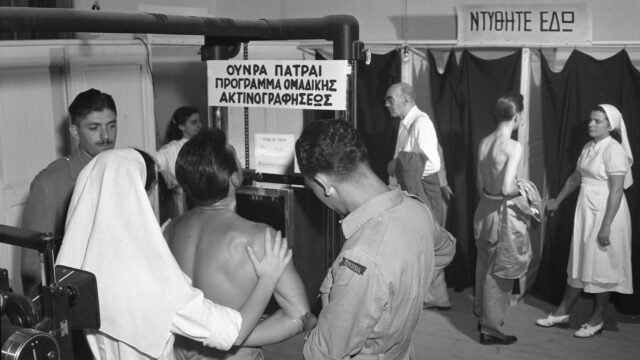
An accidental discovery in the Athens-based Sotiria hospital reveals a collective trauma about hundreds of patients who died of tuberculosis between 1945 and 1975. They were buried unnamed in mass graves on the hospital grounds.
In Unclaimed, which world premieres in Thessaloniki, Greek docmaker Marianna Economou uncovers this controversial story and tries to reconstruct the patients’ identities by looking at their correspondence and personal belongings.
Economou started working on the project three years ago. “This film is based on pure chance. I heard about the story by chance, it was totally by chance that this archive material was found, and it was totally by chance that it was saved. After they found it, they were ready to throw it away again,” the director tells BDE.
“I felt I had to tell this story, there was no [other] way. These people were coming out of ‘oblivion’ after 80 years telling me, ‘here we are, make a film about our lives.’ I got engaged from the very start. I saw some of their letters and packages and I felt very involved.”
From the very beginning, Economou aimed to “make a documentary with these people as the protagonists…I wasn’t interested in making a film about tuberculosis, historical events [in Greece] or the history of the hospital. All of that is in the background and told indirectly through these protagonists.”
The hardest part of making this film was therefore “to bring the protagonists to life through the archive material” with “no voice over” and “without somebody presenting them,” Economou stresses.
Zooming in on the development phase, Economou explains how she didn’t attend any labs, workshops or markets. “It was Covid time. The conditions under which we made this film were incredibly difficult. [It was hard] even to get access to the hospital, because that was the main Covid clinic in Athens.”
“Luckily, during Covid the Ministry of Culture and the Greek Film Centre launched a programme to support filmmakers by giving very small grants. I applied for it, I got the money and I used it to start filming. Then I got some more support from ERT, the Greek broadcaster. But I couldn’t actually pitch it, or travel anywhere. It’s a very low-budget production,” she adds.
Economou manages to strike the balance between uncovering these forgotten pieces of microhistory and keeping the viewers hooked without falling into any rhetorical or melodramatic trappings: “I really didn’t want to make a melodrama. I wanted to hear their voices and to get as much as possible into their psychology, [catching their understanding] of the time and the disease, but also [to empathise] with their relatives, who came from different parts of Greece and were equally isolated, living in remote villages or far away islands. It was impossible for them to visit [their relatives] so they were equally cut off.”
Moreover, Economou’s efforts focused on putting a spotlight on the protagonists’ social stigma and poverty, as well as on their experience of being secluded for 7-8 months or, in some other cases, even for several years.
With Unclaimed, Economou was taking on a new challenge. “For me it was the first time making this type of film. I’ve never used archive materials before. All my previous documentaries are character-driven. So it’s been a very big challenge – tackling this material without falling into the trap of making an informative documentary, while telling a ‘human story’ with historical elements.”
“That’s one of the reasons why the editing process took a very long time. The second reason is that it was incredibly hard to choose the stories to tell. One story was better than the other. It was so difficult to pick which one to tell,” Economou says, adding that her team discovered 350 packages belonging to 350 separate people who died on the hospital’s premises.
The production phase was a race against time, she adds. “We were granted permission to shoot there only for 10 days. We opened about 30 packages, so we were filming, filming and filming, trying to collect enough material.”
Fascinatingly, the film’s composer Vaggelis Fambas wrote the final track based on musical notation found in one of the packages. “I really wanted the ending credits to be a continuation of the music that the person didn’t manage to complete. It was like having two musicians together – the one who started and the other one who completed [the work].”
Speaking about the post-production process, the helmer reveals that she has been working with two editors. With the first, both director and editor felt so immersed in the stories to the point where they couldn’t feel “distant enough.” The contributions made by the second editor helped Economou to structure the work in its current form.
On the topic of dealing with the relatives of those who passed away in Sotiria, Economou tells us: “Everything happened as it is seen in the film. We started analysing the material, and we tried to get in touch [with some of them.] It was very hard – most of these people died in the 1960s or even before that. Eventually we found three [relatives]. What interested me was [to discover] their reactions…For the first time after so many years they discover the truth.”
“It was all about the different reactions [prompted by] this past coming and finding you,” she sums up.
The making of Unclaimed has left a mark on Economou as a documentarian and as a human being: “For sure, this film has touched me very deeply. For three years, it’s been like being engaged in a constant dialogue with these dead people. It was part of my everyday life. Probably, that’s why the editing took so long.”
“How can somebody disappear?” she muses. “How can somebody who was once alive be totally forgotten? That really shocked me. Many are unnamed; nobody knows where they are buried. It’s as if they never existed.”