

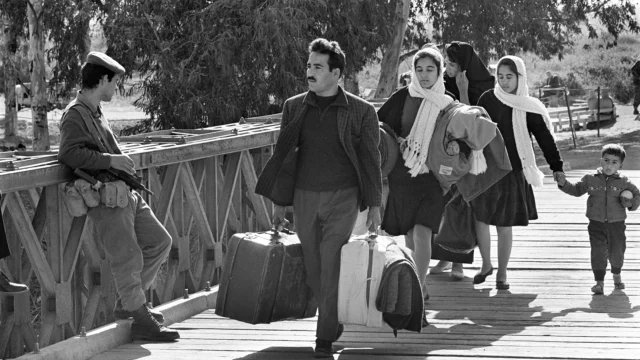
The title sums it up. UNRWA – 75 Years of an Interim History (screening in competition in FIFDH Geneva) is about the agency formed in 1949 by the UN General Assembly to prevent starvation and distress among Palestinian refugees. Few expected the “United Nations Relief and Works Agency for Palestinian Refugees” still to be in existence so many decades later.
The agency has been heavily attacked in recent months over its alleged links to Palestinian militant groups. The most damaging charge is that some of its employees took part in the October 7 2023 Hamas attack on Israel. However, as Lyana Saleh and Nicolas Wadimoff show in their new documentary, the story of UNRWA is far more complex than most of its critics realise.
The filmmakers met for the first time in Ramallah three years ago during the Palestine Cinema Days. Saleh, a Palestinian journalist and filmmaker based in Paris, had been doing some of the programming for the festival. Wadimoff, a veteran Swiss documentary maker, was a guest. They met again at the Cannes Festival.
Both realised they had friends in common in Palestine. “We are part of the same intellectual, emotional and artistic family in Palestine. That made things easier I think,” Wadimoff suggests of why they found it so easy to work together.
The Swiss filmmaker made a short documentary last year, 30 Days To Save UNRWA, which looked directly at the organisation’s financial crisis in the face of accusations made against it by the Israeli government. Philippe Lazzarini, Commissioner General of UNRWA, is Swiss, and Wadimoff had made contact with him and his staff.
“This project actually pushed Nicolas to think about a bigger documentary where actually we take our time to think and unfold the story of this agency. He suggested to me to get on board,” Saleh explains.
The two directors describe the experience of making the film as a journey of discovery.
Through the earlier project, Wadimoff had met several people from UNRWA’s archive and communications departments. They told him that the organisation kept huge amounts of archival material that had rarely, if ever, been seen before. He was allowed to take whatever he needed. This ended up forming the backbone of the documentary.
“I discovered that they had wonderful, incredible material shot in 16mm black and white.”
There were no strings attached to using the material. UNRWA gave the directors complete freedom and didn’t ask for any sort of editorial control. “It was a huge pleasure to work with this material,” Wadimoff appreciates.
The directors were also able to strike a similar deal with Swiss public broadcaster RTS (one of the co-producers of the documentary). Some of Switzerland’s best-known film directors including Alain Tanner and Claude Goretta had filmed material in Palestinian refugee camps – and they had access to this too.
Other footage comes from Wadimoff’s earlier films shot in Palestine.
Editing turned out to be a painstaking process. “I wouldn’t say it was straightforward,” says Saleh. “It was lots of talking, lots of watching, lots of constructing and deconstructing. It was not an easy journey…”
The filmmakers point out that the accusations against UNRWA started well before the 7th October attack on Israel.
“For us, the main issue was to tell how, for the last 75 years, UNRWA history has always been related to Palestine history…it is not possible to separate Palestine history from UNRWA history,” Wadimoff states. “If you see the Palestinian history from 1948 till now, then you can see UNRWA history. Watching and digging into UNRWA history tells you always about Palestinian history and about the connection between Palestinian history and the international world.”
UNRWA, the Swiss director adds, is “the revealing factor about the hypocrisy of the international community, the incapacity of the international community to find a solution to the Palestinian issue.”
He believes that the international community has continually tried to sweep the crisis in Palestine “under the carpet.” Unprepared to intervene directly itself, it has instead relied on UNRWA to keep the society going.
The agency is huge. It employs more than 30,000 Palestinians overall – and 13,000 in Gaza itself. The population there depends on it for aid and services.
“It is obvious that among all the UNRWA employees, some of them are connected or belonging or in touch with Hamas,” Wadimoff notes. “The problem is not this. The problem is the fact that UNRWA is doing the job that nobody else wants to do.”
The agency is taking on basic humanitarian work that many feel should be the responsibility of the Israeli government – and yet Israel is its fiercest critic.
UNRWA is supposed to be neutral but it is dealing with a Palestinian population that regards the “right of return” as fundamental.
“So UNRWA, they are supposed to satisfy Israelis, Palestinians, extreme Palestinians as well, [and] the international community – and it is impossible,” Wadimoff sums up the daunting challenges facing the agency in the face of so many competing agendas. “It’s a slalom between all those dangers. They try to do their best but whatever they do, they will not satisfy everybody because this is an impossible mission.”
In Geneva on Thursday, the screening of the film will be followed by a debate titled ‘Is Humanitarian Law dead?’ Major figures like Lazzarini, the agency’s boss, Palestinian scholar and politician Hanan Ashrawi, and Jean-Daniel Ruch, former Swiss Ambassador to Israel, will be participating.
“We hope that this film circulates in festivals. Also, it has its place in academic circuits in Europe and the States,” co-director Saleh says. “In this world that we are all discovering with the Trump administration and what is happening in Ukraine, I think we need to ask questions about humanitarian law, international law and the role of the UN itself.”
She hopes that the film will also be a “tool” for understanding [that] away from polarisation and accusations… this agency [UNRWA] has done a remarkable job.”
UNRWA, she adds, is “not only employees and paperwork. It is real people doing real jobs.”
“If you have an injection at an UNRWA hospital, it is [with] an UNRWA needle,” Wadimoff emphasises how deeply involved the agency is at every layer of Palestinian society. “They do everything from A to Z.”
His co-director has a final observation. “We are talking about life and death. The way we speak about UNRWA has to be more responsible,” Saleh insists.





