

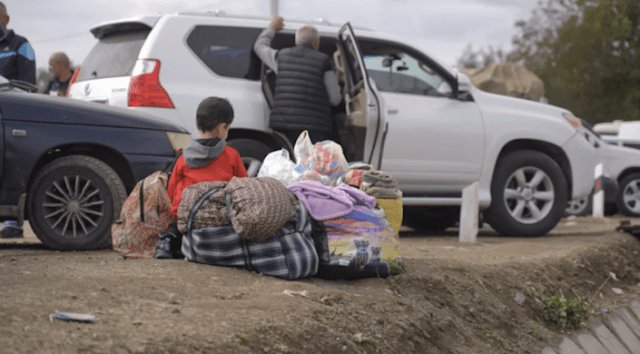
“When it comes to war crimes and the suffering they inflict, no conflict should be overlooked,” Armenian producer Mariam Davtyan (Bars Media) told BDE during the 7th FIFDH Impact Days. “In Front of Us, directed by Inna Sahakyan, amplifies the voices of those affected by the Nagorno-Karabakh (Artsakh) war and following ethnic cleansing of the Armenian population—not just victims, but individuals who have endured and survived war crimes—alongside our protagonists, who work tirelessly to bring justice to those who have suffered as a result of these grave violations.”
The film’s synopsis is, in itself, harrowing to read. A California judge is compelled to act after witnessing the harrowing war crimes committed during Azerbaijan’s brutal conquest of Nagorno-Karabakh and its occupation of Armenia’s border regions, the filmmakers stress. For survivors, she has become their last, best hope for justice. Her journey intertwines with Lala, an Armenian schoolteacher whose sister’s horrific killing and mutilation by Azerbaijani soldiers was spread online in a grotesque act of triumph. Once voiceless, Lala has risen as a powerful advocate for victims. In Front of Us paints a deeply moving portrait of two women’s fight for accountability in a conflict the world has chosen to ignore, revealing both the strength and limits of international law.
“This film is not about the past—it’s about ongoing crimes and injustice,” Davtyan continues. “Right now, a Nobel-nominated Armenian humanitarian Ruben Vardanyan is in critical condition in an Azerbaijani jail, on hunger strike to expose the hostage crisis. As the geopolitical situation worsens and Armenophobic rhetoric rises, a new war is close to breaking out in sovereign Armenia, parts of which are already under occupation. In Front of Us is a call to action—urging society, policymakers, and governments to act before another tragedy unfolds.”
The Armenian/English-language film, set in Armenia, the Netherlands and the US, is in production with a. mooted delivery date of December 2026.
“Our impact strategy will start well before the release to lay a strong foundation,” producer Davtyan told BDE. “First, we’ll showcase the film on the festival circuit, submitting it to prominent human rights festivals like FIFDH, Movies that Matter and the Nuremberg International Film Festival. Throughout the following two years, we’ll organize targeted screenings for international organizations such as the United Nations and the International Criminal Court, where we’ll present shorter versions of the film. Our goal is to reach policymakers and spark essential conversations about this issue.”
“At the same time, we’ll launch a comprehensive social media campaign. Short clips and condensed versions of the film will be part of our omnichannel strategy. We also plan to involve human rights activists and celebrities to help expand our reach and attract media coverage to the issue and the victims whose voices we aim to amplify,” she continues. “A key part of our strategy is promoting the education of young lawyers and human rights advocates. This film will give them the opportunity to learn from the first-hand experiences of war crime victims and understand the obstacles within the current situation surrounding International Law.”
Director Inna Sahakyan spent seven years working on her docu-animated film, Aurora’s Sunrise (2022), about a survivor of the 1915 Armenian Genocide. The film was a major success, screening at over 80 festivals and winning more than 20 awards, including the Grand Prix at FIFDH 2023. Davtyan points out that after a modest – but impactful campaign – Aurora’s Sunrise is now used as an educational tool in universities and continues to be screened at conferences and events.
“And yet, here we are again, making another film about genocide happening today,” she laments. “Inna and the entire production team have a deep personal connection to this story. As an Armenian woman, Inna shares the history, values, and fight for justice alongside our main protagonists. During the 2020 Nagorno-Karabakh war, Bars Media’s team was on the frontline, using cameras as their weapons—witnessing and documenting war crimes first-hand. This lived experience makes the film even more personal and reinforces its commitment to truth and accountability. This isn’t just a story we’re telling—it’s our story.”





