

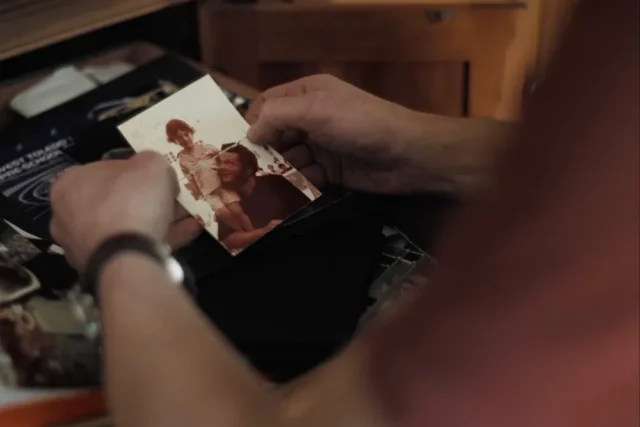
Ventura Durall’s latest documentary Supernatural, premiering in the International Competition of the Thessaloniki Documentary Festival, delves into the complex relationship between science and magic through the lens of a father-son dynamic. A co-production between Spain, France, and Belgium, Supernatural is being sold by Taskovski Films.
The documentary follows Mathu, a doctor who is the total opposite of his father André Malby, a famous spiritual healer. While Mathu leads a disciplined, solitary life, Malby was indulgent and promiscuous. But Mathu’s world begins to fall apart when actress Anna Alarcón, a devoted follower of Malby, claims that his father saved her through psychic means. This forces Mathu to confront his family trauma and question Anna’s beliefs, delving into the conflict between science and mysticism.
Speaking to Business Doc Europe, director Ventura Durall reflects on the journey behind the film and the discoveries he made along the way.
Durall first encountered this extraordinary story through Anna, a close friend with whom he had previously collaborated on two films. “She told me about her family and how [Malby] saved her life through ‘telepathic healing’ when she was about to die from anorexia,” he recalls. “That was four years ago. I’m a rational person, so at that moment, I couldn’t understand what was happening. But I was intrigued and decided to uncover her history.”
As the director delved deeper, he encountered Mathu, Malby’s son, and realised that this was where the heart of the story lay. “I didn’t know anything about Malby before,” Durall admits. “I started researching him and found so many people who were devoted to him, recounting incredible stories about his powers. The first question I asked myself was: am I missing something? Esotericism is a world I had never explored, so I was curious to see what I could find out.”
Researching Malby’s influence meant not only speaking to people but also diving into an extensive media archive. “I had to watch all his broadcasts,” Durall explains. “There’s even a Facebook group with over 3,000 people who claim they were healed by him. He was incredibly popular in the 1980s and 90s and appeared on television almost every week.”
A key element of the film is the stark contrast between Malby and his son, Mathu, a staunchly rational doctor. “That was one of the most intriguing aspects,” Durall agrees. “I had the chance to meet Mathu early on in the process. As the film shows, he moved to the US at 16 and spent 30 years away from his father and family to protect himself. At first, he didn’t want to be part of the project. It took time to convince him, but I made him see that it could be a therapeutic process, a way for him to confront his past.”
Gaining access to Mathu proved to be the biggest challenge, but once he agreed, the project gained momentum. “At first, we only had Ana and Malby’s most devoted followers. For the first year, the focus was very much on them. Then, as Mathu’s story became more and more compelling, we shifted our attention to him.”
Building trust with his subjects was one of the biggest hurdles Durall faced, both technically and emotionally. “As always in documentary filmmaking, the trust you build with your characters is essential,” he says. “I spoke a lot with Ana – she’s very well known in Spain, so it was a delicate decision for her to be at the centre of this film. The same applied to Mathu, but eventually, he opened up.”
The documentary features extensive archival footage of Malby’s television appearances, which was a crucial aspect of the storytelling. “The footage comes from the Spanish broadcaster Televisión Española,” Durall reveals. “We gained access to all the programmes and even acquired transcripts to study the subjects he covered. Malby also recorded his esoteric theories on cassette tapes, which were sold at petrol stations – we feature some of these as well. We spent almost a year cataloguing all this material.”
Despite Malby’s controversial reputation, Durall found no significant public opposition to his work. “The programmes he participated in all shared a similar spiritual, esoteric perspective,” he reveals. “Figures like the singer Miguel Bosé even claimed to have been healed by him. He moved within the cultural scene of the 80s and 90s, so it’s not all that surprising.”
The post-production process was lengthy and transformative. “We joined the training programme dok.incubator and were selected with our first rough cut, in which Ana was still the leading character,” Durall recalls. “Then we realised that the core of the story was really rooted in the conflict between magic and science, and Mathu’s journey was the most powerful aspect. After that, we kept filming extensively to refocus the narrative around him. The final edit took ten months, given the vast amount of footage we had.”
Did making the film change his perspective on magic and science? “What I found is that the film helps to understand the meaning of magical thinking in our society,” Durall reflects. “I came to see the importance of charismatic figures in relation to the placebo effect and suggestion – the ability to activate what some call ‘internal pharmacies’ that supposedly exist within each of us.”





