

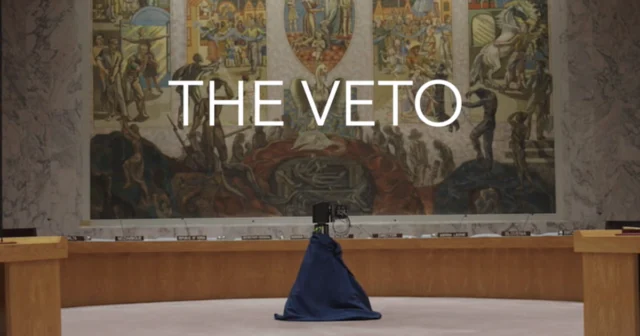
There can be something very grim and unseemly about the use of the “veto” at the United Nations. The five permanent members of the UN Security Council (France, the UK, China, Russia and the US) have the ability to block any resolution that comes before them. Sometimes, when they do so, war crimes and genocide may follow.
In his new film The Veto (world-premiering out of competition at FIFDH Geneva), Tim Slade explores the history of the UN veto, looks at the machinations that go on today inside the chamber, and asks experts if, and how, the veto could be changed.
“I think they realise the incredible issue that veto use presents, and so it was a chance for them to talk about it as transparently as possible,” Slade explains why figures like Prince Zeid Ra’ad Al-Hussein (who represented Jordan at the UN), Larry Johnson, former Assistant Attorney-General for Legal Affairs at the UN, and Kenyan representative, Martin Kimani, alongside other luminaries, were willing to talk on camera. “I think they trusted that I was doing something that was trying to address the problem in as balanced a way as possible.”
Courtesy reigns in the chamber. Representatives talk in a quiet and respectful manner but often they’re often dealing with the most seismic matters imaginable. “What you do do can save a lot of lives. What you don’tdo can get a lot of people killed,” Kimani points out the real-world consequences of decisions taken by diplomats in the vaunted surroundings of the UN.
As the Russian ambassador notes, people stick to fixed positions. Business in the UN often resembles Groundhog Day. The General Assembly will often vote overwhelmingly in one way only to be stymied by the veto.
Interviewees in the film are “extremely impressive good people,” in the words of the director. They are formidably articulate and very passionate about justice and human rights – but are still caught up in a Kafkaesque, system where their influence remains strictly limited.
The Liechtenstein mission advocated on Slade’s behalf for him to be given access to the chamber – and to be allowed to film inside when it was empty. “It was a process to get in but it wasn’t as difficult as I thought because I came with a proposition of looking at this earnestly,” the director recalls.
One of the original sparks for the documentary was Slade’s dismay at Russia and China vetoing the UN resolution just over a decade ago that would have referred the Syrian conflict to the International Criminal Court.
“In the use of that veto, I saw there would likely not be justice for Syrians,” notes Slade (whose 2016 film The Destruction of Memory explored cultural abominations within Syria). “The impact of that veto was so massive…so I have had it [the idea for the film] in my head for a few years.”
In 2022, Russia very predictably vetoed the security council resolution calling on it to stop the invasion of Ukraine. Meanwhile, there have been many vetoes passed by the US regarding Gaza.
All this made the director release that it was a very timely moment to tackle his subject. “I have enormous respect for the diplomats at the United Nations because they are doing a very difficult thing. Unfortunately, the United Nations has an Achilles’ heel built in at the very beginning. This is in part the veto, but also the way in which the permanent members have this superior position…without going too much into history, it would seem that Stalin essentially set that up,” the director reflects.
Slade feels it’s now up to the UN itself to “take charge and push beyond the limitations that are unfortunately built into it…if that doesn’t happen, the functional end of the United Nations could happen very quickly.”
There was a huge jolt to the normal way of doing business at the UN last month when Russia voted with a US-penned resolution on Ukraine that didn’t mention Russian aggression. “I think the United Kingdom, France and the European countries realised the enormity of it.”
The question now is whether the UK and France will use their own veto to act against the US, Russia and China. Old alignments may loosen and even break. It is possible, then, that the film is capturing a system that will soon become obsolete.
The documentary was supported by the Open Society Foundations, the Jubitz Family Foundation and the Foundation For Systemic Change with backing from The Gotham Film & Media Institute.
The film isn’t just a parade of talking heads. Interviews are artfully shot and the archival material is interweaved into the story in an evocative fashion. Slade has a wide range of credits including arts documentaries and dramas. “I came into ‘issue’ subjects after being a filmmaker. I don’t come to it as a journalistic filmmaker,” he says.
“This had to be made fairly quickly. I could see the public broadcaster route would take time…thankfully with these foundations in the United States, they could make decisions quickly. In a way, that just let me make the film without having [to deal with] a lot of bureaucratic processes,” Slade, also the producer and editor, points out. “It was made on a pretty tight budget but it was able to be made quickly.”
The hope now is to bring public broadcasters aboard and to get the film “looked at by civil society.” Slade is hoping the documentary will start a “discussion that isn’t just cynical” about the role of the UN and the Security Council veto.
The film includes footage of international law tutorials at New York University where students from around d the world debate the veto and try to make sense of it. “It is going to have to be in part through young people that this change happens. I think they have more impetus to actually effect change…at the same time, a lot of the people we interviewed see it the same way,” Slade states.
In Geneva this weekend, there will be a discussion accompanying the film at which leading diplomats and human rights campaigners will debate potential reforms to what is widely regarded as “an archaic, unjust and often ineffective system.”
And, yes, Slade is also hoping to show the film at the UN (although he’ll have to “jump through a few hoops” to make this possible). “Obviously, the General Assembly and the member states are the ultimate audience for this…”





