“It’s a little thing, you know, a little story in a little country, but somehow I think that it’s something amazing, because they are facing the illness in a new way,” says director Intxausti of his Basque-based film about living with cancer, Live Till Death.
Business Doc Europe met up with Intxausti (Humanistic, Catalonia) before his pitch to the professional audience at Biarritz.
When Intxausti’s sister was diagnosed with cancer, he desperately wanted to do something. She introduced him to a collective of women she was involved with – The Iñurri (which literally means ‘ant’ in Basque, to symbolise strong but collective effort) – a community-based support association and movement focused on how people experience, talk about, and live with cancer in more open, collective, and empowered ways, rather than as a medical term or clinical organisation.
“She [my sister] told me, no, I am not interested by myself. For me, if you want to do something, you need to check these women. So I started checking what they were doing and I was amazed. I came to realise that the fight of a group of feminist women has the power to change society’s perception of cancer and dismantle its taboo,” says Intxausti.
A feature length doc in six acts, Live Till Death is now almost complete. Each act is focused on a collective practice, bringing insights, protest, hope and connectivity across the different stories: a farewell in life; a humorous monologue that challenges gender stereotypes; the fight for visibility of non-normative bodies; the spirit of sisterhood that defines Iñurri; a response to a questionable hospital practice; and, as an epilogue, the journey towards motherhood after surviving cancer.
“It is very difficult to capture everything that is newly represented through a single woman, you know, it’s difficult to make a film about a collective… but one just didn’t have all the stories, or the diverse stories of the community. So, I decided to separate it into six stories, and each has a different main character, and also a different location and format,” Intxausti explains. “The collective is the unifying factor, and we were careful not to make too many cuts and jumps, with many of the main characters remaining the same throughout.”
It’s important to the collective that there’s humour in there, the director adds, that we see these women just living their lives… one minute receiving bad news, the next discussing a trip to the beach, or going shopping with friends, just living their lives.
“So, you know, always you have some drama, something is so difficult, and then they try to live, with humour, and with love, and with social love. These two aspects of the documentary, during the editing, we realize that there is a drama, then afterwards, in a second, there is a love,” says Intxausti.
From the outset, Inxausti was painfully aware that he was a man making such an intimate film about women. He addresses this via a letter of intent in the film’s dossier:
‘I met with them to explain that I wanted to produce a documentary about their story. I confessed that my only concern was my gender. They told me to start filming and that we would figure out the rest as we went. Together, we also devised a system to ensure the exclusive participation of women in certain recordings. From that moment on, I began to truly understand the impact of the association….Without realising it, in just a few months I had become one of them, one of the Iñurri. My camera became part of the group, and I began filming and writing the script.’
As well as bringing new hope, light, comfort, perspectives and ways of being to many, there is a campaigning aspect to the film, too. There are still parts of the world where the female body can’t be shown, never mind a mastectomised one, where nipples have to be pixelated, where a baby’s crowning head in birth is deemed too disgusting to show. The film hopes to open these conversations in festivals around the world.
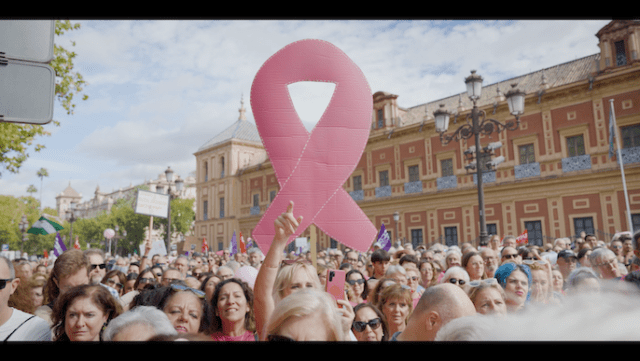
On a more local level, the film exposes the fact that 2000 women in Andalucía were left alone and distressed following ambiguous results during a screening process. They were told it was unclear whether they had cancer or not, and that they would receive a call. None of them did. “It was one of the biggest crises of the health system in Spain last year,” says Intxausti.
In terms of finance, the film is well supported. Crowdfunding within the community, along with a mix of private investors, French TV and French and Basque public grants mean that the team’s goal at FIPADOC are to secure distribution and festival exposure, as well as ink deals with French and Spanish TV outlets.
The film is on track to be completed this year, ready for release early next year. “When I first understood the impact they were having, I promised the Iñurri that we would do everything possible to present the documentary at a major festival,” Intxausti says.
“This is so cathartic, this film,” he signs off.