Angelica Ruffier not only directed IFFR Tiger contender La belle année (sold by Odd Slice Films), she is also the main protagonist. The film begins with Ruffier returning to her father’s house in France after his death in 2021, and finding her own teenage diaries as she clears through her old possessions. Reading through them reminds her of a teenage romantic obsession she once developed for her history teacher, the enigmatic Sylvie Bresson.
The Stockholm-based filmmaker had at first thought of making a short but the project grew in length and complexity.
“When you make a feature, you have to add many more elements…the essential structure of the movie is documentary. I guess it follows the way my life unfolded during the five years I spent making it. I had had an idea of approaching this passionate love I had for this teacher – and then my father died,” Ruffier explains how the ideas about her old teacher and her grieving over the loss of her father became intertwined.
The director’s relationship with her father was difficult. He could be bullying and aggressive. As the film reveals, there came a point when she, her mother and brother, left home and fled to Sweden to get away from him. They pretended they were going on holiday but they never came back.
“When someone difficult dies, what is good with that is that you can choose what you remember,” she strikes a philosophical note about how making the documentary helped her deal with her mixed feelings about her father. “You’re quite free to build a memory of a person. That’s the way you come to terms [with it].”
Her grandfather, who died in 2023, also features prominently. She was very close to him.
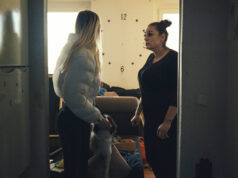
All the scenes that feature multiple characters are “purely documentary.” The moments when she is on her own are reconstructions.
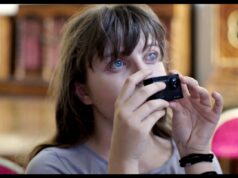
“You have to remember how it felt and what you did – and try to do it in the best way you can in front of someone watching you,” she says of the challenge of “playing” herself.
She adds that she could “never have done it” [appeared on screen] without her editor, Anna Eborn, “because you can’t really see yourself…you have to be with someone else who can see you as a character.”
Her journals, which she kept for five years from the age of 14, allow her to see herself as she was during a turbulent part of her adolescence.
“The really difficult part was to read them now…” she says of the shame she felt when she first looked back over the old notebooks. However, she soon realised that what she had written was, in fact, frank and accurate, a record of a “pure” experience.
“It was well-formulated,” she says of her teenage reflections on her inner life. “I wouldn’t formulate them so well now, I don’t think.”
At around the time she became so fascinated with her teacher, Ruffier had seen a movie catalogue showing silent cinema siren, Louise Brooks, star of Pabst’s Pandora’s Box. She began to regard her teacher as if she was a modern-day Louise Brooks. “I thought ‘my god, that’s her, that’s Sylvie,’” she says of the uncanny resemblance between Brooks and her teacher. “I hadn’t even seen the movie. I saw the movie much later on…so the picture associated with Sylvie brought me to Pabst, which is nice!”
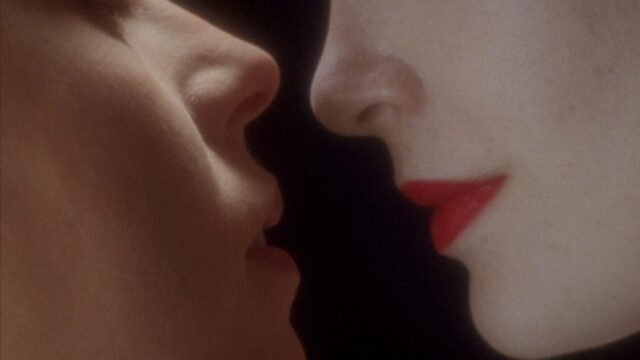
There are several other movie references in the documentary too, including a sequence showing a cinema audience watching Delphine Seyrig in Belgian director Harry Kümel’s cult lesbian vampire feature, Daughters Of Darkness (1971).
“It’s a work that has fascinated me ever since I saw it when I was 16. I thought it was very underground, very strange and very beautiful at the same time. I was a bit ashamed I loved this movie so much.”
Ruffier got in touch with Kümel to request permission to use the clip. The veteran Flemish auteur was intrigued by the “Wagnerian” name of her Icelandic producer, Brynhildur Þórarinsdóttir, and happy for her to use the clip. (His only slight quibble was the cinema where the film is showing is depicted as being only half full).
The director cites Claire Denis and the Dardenne brothers as other filmmakers who inspire her. She also tells Business Doc Europe of her enthusiasm for François Truffaut’s autobiographical films featuring his alter ego, Antoine Doinel.
There are two main strands to La belle année: her fantasies about her old teacher and the events of her everyday existence.
Ruffier approached her teacher directly. “I first wrote to her to confess this love I had for her and then, one year later, I came back to say I am doing a movie about this year – and in this year, you are part of my life. Could you imagine meeting me?”
Bresson was very open. She invited the director for lunch. “We didn’t talk so much about the past. She was very curious about how you make movies. She asked questions about the editing and the timeline of the documentary.”
There is an obvious contrast between Ruffier’s teenage fantasy projections of the teacher and the woman audiences see in the movie – a kindly, grey-haired, bookish figure who, by her own admission, is now living a “mundane” life.
“It was extremely nice, a very dear moment,” the director says of her reunion with the teacher. “And for my team to meet her after they had heard so much about her, that was a brilliant moment.”
This is the director’s first feature after her well-received shorts From Here to There; The Other Way Around (2018) and Stranger (2020). The Swedish release is set for April and will be handled by Folkets Bio. Ruffier doesn’t know what she’ll do next although she has the “embryo” of an idea. She is also determined to continue with the same collaborators.
“What’s really important for me is that I will keep on working with the crew from this film…that’s a certainty!”