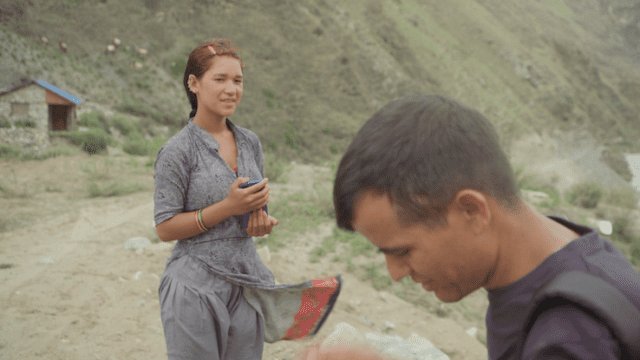
Valley of the Heart (CZ), directed by Theodora Remundová, tells the story of Purna Prasad Devkota between the ages of 24 and 33. He is a young man who has grown up in a Hindu family in a secluded valley deep within Nepal, but he longs for escape, and when his father dies of cancer, he leaves his valley for the first time to settle in the Czech Republic.
“Purna’s story raises a profound, existential question about the meaning and fulfilment of human life in a global context,” Remundová writes in her film notes.
The story, the filmmakers tell us, is a journey not only across space from rural Nepal to modern Europe, it’s also a journey across time, and is a vivid personal reflection on the cultural clashes that define our world today.
The documentary feature, which is currently in production, is being presented as part of the FIPADOC Pro Industry pitches this week at FIPADOC. BDE catches up with producer Jiri Konečny (Endorfilm, Czech Republic) in Biarritz.
Having worked with director Remundová before, Konečny was drawn to the director’s profound empathy and sensitivity towards her protagonists. From past experience, Konečny explains, he was convinced that a film approaching migration could have a universal appeal – even to those who have moved only a few hundred kilometres away from their home.
“The emotions of beginning anew, of estrangement and adaptation, are deeply familiar. I believe that whatever melancholy emerges from this dimension of the story will be balanced by the vitality of the courtship scenes and the cultural collisions that ensue,” he says.
Cinematically, the film takes an observational approach. “We capture visually refined imagery of both the industrial landscapes of modern society and local communities of Nepal. The beauty of the Nepali locations provide a striking visual counterpoint,” the director tells us in her statement.
The editing process will respect the chronological flow of events, whilst “subtly breaking the linear narrative, allowing different environments to intersect in brief reflections.”
We follow Purna’s journey, to a menial job in a bakery in Czech Republic, to a factory where he studies and aspires for more, to the rooms he shares with fellow Nepalese immigrants, and onto the various haunts he begins to discover. We watch as social workers help Purna assimilate, explain how relationships work differently from those in Nepal, especially between men and women. He goes to nightclubs, works the earth of his tiny garden in the town of Žďár in Czech Republic, sends money back home, and we watch his mother smiling into her phone as she chats to him from her tiny village in the Himalayas.
We thus see Purna’s life unfold over nine years. Eventually, the old ways call, and Purna’s family encourage him to find a wife from his own caste in Nepal. A marriage is arranged and we travel back with him to meet and marry his wife. Despite this return to his homeland, the couple decide to make a life back in Czech Republic, where the opportunity for a different life still calls.
The film throws up myriad questions around place, tradition and progress – and where are you really better off? “Aspiration brings frustration and also brings balance in the society. There are also questions of belonging, of nostalgia,” muses Konečny.
“It’s called Valley of the Heart because it’s the thinking of how can we actually move from one place like this with all the traditions, the feelings, to a totally different place? Is it necessary, do we have to do it? How can we survive it?” he continues.
No deadlines have been imposed by Czech TV (Česká Televize), who have supported the project from the start, resulting in a story which follows the protagonist for a significant period of his life (ages 24-33), a rarity in today’s documentary climate. Valley of the Heart is already 85% funded, so producer Konečny looking to cross the finish line in Biarritz. More that, the team is looking for sales and distribution partners who are prepared also to give the story time and space to grow, perhaps to consider a series.
“We are lucky to be selected for FIPADOC, it’s prestigious for us and we are happy about it,” says Konečny. “This is the first time we are showing it, so it will be a big test for us to see how the market will swallow it… I would be happy if we reach for one, two, three, four partners here… still there is a chance for somebody who would like to co-produce it, or support it in the festival distribution stage,” he underlines.