“My mother always tells me, why don’t you get a nose job? No wonder you can’t get a European husband,” jokes Iranian director and author, Afsaneh Salari, who is based in Paris. Herein lies the crux of an obsession that lies deep within the Iranian psyche, and which Afsaneh’s film Tehran, Auto-Immune examines via intimate observations of beauty clinics in a city that records the highest rates of cosmetic surgery.
Pitching to the Fipadoc professional attendees in Biarritz, Afsaneh outlined her motivations for the project.
“Of course, everyone is obsessed with beauty in our society today. Everyone wants to stay young, beautiful, fit, healthy, and in Iran we have a long tradition of wanting to be beautiful. Sixty years ago, our queen came to France to have a nose job to be more presentable as a Queen of Iran. But for the past few years we have had an explosion of beauty surgery, plastic surgery, and body shaping in Iran. And that’s pretty surprising, because Iran is a country where you’re not allowed to show your body, you’re not allowed to show your hair, you’re not allowed to show your curves. Then why this pandemic? This is the question that drove me to make Tehran, Auto-Immune.”
The synopsis outlines how the film performs a biopsy on Iranian middle-class society using two beauty surgeons as conducting threads – one man and one woman, both of whom are among the top ten practitioners in the country.
The male surgeon, humorous and extrovert, is famous for modifying any body part, calling himself the ‘Michelangelo’ of Iran. ‘What I’m able to do is at the crossroads of art and science. I’m able to build Kim Kardashian out of any woman.’
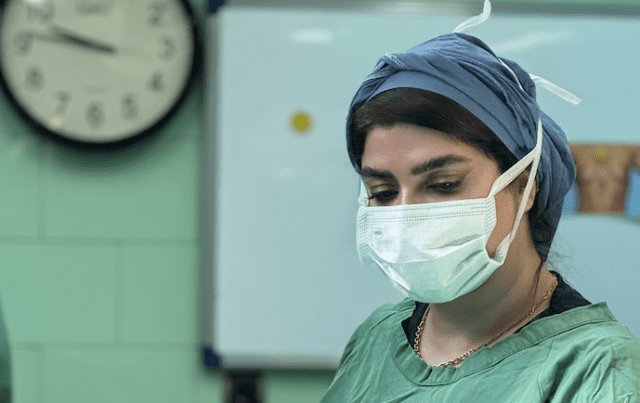
The top female surgeon for nose jobs in Iran has fought for her position amongst the male-dominated beauty industry. She operates mainly for young women and believes that this is how she can empower them by helping them gain self-confidence.
Afsaneh expands on these themes. “In auto-immune diseases, our body does not recognise itself. It identifies itself as an enemy, attacks the healthy tissue and destroys it. This metaphor will help me biopsy the current fabric of the Iranian body, the current fabric of Iranian middle-class society.”
“The two doctors will be our two leading characters, but they’ll also connect us to our sub-characters, the patients who go through different stages of this procedure – consultations, operations, what happens to them afterwards,” the director continues. “But there will also be my voice that will take you further. I will tell you stories of my own upbringing, but also the upbringing of the women of my generation.”
The project description further outlines how Afsaneh is deeply fascinated and intimately connected with the people in her films – how she strives to capture their humanity and, with this project, their vulnerability and deep desire for change. The challenge of this film lies in “its mosaic structure, where the mini-stories of the individuals she encounters weave together to form a compelling narrative journey.” This dynamic develops in the film as we are introduced to wider society outside the clinics in Tehran.
Producer Christian Popp of YAMI 2 Productions (France) commented, “We are co-producing with Sisyfos Film (Sweden) and we’re very happy to have CAT&Docs as a sales agent with us. We are looking for money, obviously, and broadcast support.”