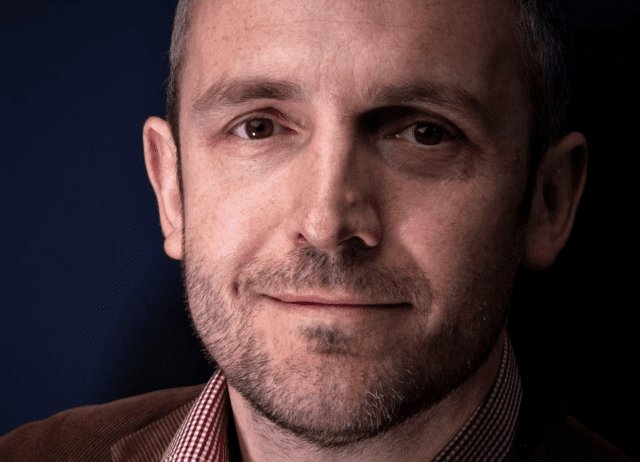
Andy Whittaker likes to cite a famous quote by Albert Camus, ‘one must imagine Sisyphus happy’, when he is describing the qualities needed to survive in a ruthless business like UK film distribution.
The quote is used in one of the films that his company, Dogwoof, released early in its existence, Raman Bahrani’s Man Push Cart (2005). This was a drama about a once successful Pakistani musician who earns a living by selling coffee and doughnuts from a cart he pushes around on the streets of New York. This man was a contemporary equivalent to Sisyphus, the king of the city of Corinth, condemned for his pride to push a gigantic rock up a hill – and then to find it rolling back down to the bottom every time he neared the top.
Distribution entails the same endless repetition. In his darker moments, Whittaker felt that each new film Dogwoof released was like Sisyphus’ rock. He was in a world in which you were always on the verge of success but, somehow, it remained tantalizingly out of reach. The trick was to maintain an entrepreneurial spirit and a ‘can do’, determined approach, whatever the setbacks.
When Whittaker (born in 1967) was growing up on a small dairy farm in Cheshire, the morning routine was punishing. He would rise at 6 a.m. to milk the cows and would then have to walk five miles down country lanes to Betley Junior School in nearby Nantwich. By the time he was twelve, he was driving the family tractor. The farm had around fifty cattle and was supplying the Co-op (by coincidence, later to be Whittaker’s backers when he set up a film distribution company). It wasn’t an especially idyllic childhood. In spite of EU subsidies, money was tight. Whittaker’s parents were working so hard that they didn’t have much time to mollycoddle him.
Life improved a little when he was eight and he was given a bike. That meant he could ride to school. Later, when he won a place at grammar school, he would use the bike to get to the nearest bus stop, two miles away, leave it hidden in the hedge and hope it was still there when the bus dropped him back off again. The idea then that he would one day run a film company would have seemed absurd. He didn’t know anybody in the film business and didn’t pay much attention to movies. However, when his parents were too busy to look after him, he would watch television. The alternative was to play on his own in the farmyard – but that was risky given the dangerous equipment.
‘After I was fed, they [his parents] would be busy working and setting up for the next day,’ Whittaker remembers how, from a very early age, he would find himself in front of such grown-up fare as Granada’s ‘World in Action’, John Pilger documentaries and foreign-language films that would be shown on the BBC, ‘The Bicycle Thieves and things like that’. His TV viewing was providing him with an alternative ‘education’ about a world beyond the family dairy farm. His parents would also occasionally take him to the cinema in Crewe where he would watch Star Wars (1977) and Raiders of the Lost Ark (1981). As he grew older, he soon started going to the cinema (which he describes as ‘the glue of the local community’) on his own or to meet friends.
Whittaker’s specialization as a film distributor has been in documentary and he credits films he saw in his childhood and adolescence, ranging from Ken Loach’s Kes (1969) to Karel Reisz’s Saturday Night and Sunday Morning (1960) with fostering his passion for hard-edged, realist stories.
At grammar school in Newcastle-under-Lyme, Whittaker was on free school dinners. He was a scholarship boy among fellow students who tended to be from much more affluent backgrounds. The school was around an hour away by bus – plus the two miles’ journey by bike to reach the bus stop. One upside to such a long journey was that his parents no longer demanded he milk the cows before he set off. One downside was that, in winter, the sun would have set by the time the bus dropped him off and he would have to cycle home in the dark.
Whittaker dropped out from school at the age of sixteen because he ‘wanted to earn some money and get out’ from his stifling rural background. He landed an apprenticeship at the GEC–Marconi Company in Kidsgrove in Staffordshire, learning about electronics, computer- aided design and hi-tech. He was taught how to build circuit boards and worked on early mainframe computers. ‘I think I’ve done OK [in my career] but around that same time, you had the Bill Gates of the world, working in their garages with similar access . . . but I took a different path.’
Nearby Manchester was a thriving cultural hub. This was the era of Factory Records, New Order and legendary nightclub The Haçienda. Rave culture was in its early days. Independent music labels were springing up. Whittaker would buy hand-pressed, limited edition vinyl records from bands like Magazine and the Buzzcocks.‘That was a huge change in my mindset. You’d be hearing this music and buying these records,’ Whittaker says of when he first realized it was possible to produce and release music independently without relying on faceless big corporations.
If the eighties was a fertile decade for indie music, it was also a time of widespread unemployment and industrial strife. The movie business still seemed a long way away. He didn’t think about film as a career because, as he puts it, ‘apart from Granada TV’, there were no available jobs in film and media – and no pathway into the industry unless you moved to London. If you did move to London, you had to survive – so Whittaker took the job with a big accountancy firm, as part of their new dot.com strategy team. Then he moved sideways into banking after being headhunted by Japanese investment bank Nomura. Then came the internet crash. He took a ‘golden parachute’ in the form of a generous pay-off from his employers and went off to re-think his career, and what he really wanted to do. He set up his then production company Dogwoof in 2003. The name came from a remark made by French writer André Gide to Truman Capote when Capote was complaining about receiving a negative review. ‘The dogs bark but the caravan moves on,’ Gide told Capote, quoting an old Arab proverb. ‘It should have been Dogs Bark but Dogwoof was a fun version of that.’
At the Cannes Film Festival in 2004, Whittaker met script editor Anna Godas (a Spaniard based in Barcelona) at a breakfast. He brought her into Dogwoof as his business partner. At this point, Whittaker sold his house in London and invested all the money into his company. He may have been a newcomer with no track record whatsoever but the sales agents were still keen to meet him. The original vision for the business was for a mix of world cinema drama and documentary with a social impact angle.
Dogwoof was evolving as an adventurous but relatively traditional distributor, handling independent British and foreign-language arthouse fare. However, its profile and business model changed dramatically when it acquired Black Gold(2006), a feature documentary about ethical coffee farming in Africa. ‘Of course we will do this. We loved the film, and it was also available for free,’ Whittaker remembers of a project for which Dogwoof didn’t have to pay any upfront fee.
The film’s directors, Marc J. Francis and Nick Francis, were ingenious and relentless users of social media during its release campaign. This was regarded as a ‘low-cost, low-effort’ release but Whittaker saw an opportunity. Instead of spending £50,000 or more on advertising and press opportunities for big-name actors, they were spending £10,000 or less. The indefatigable Francis brothers were ‘like a machine’, doing interview after interview. Awareness around the documentary grew.
Dogwoof later followed up on the success of Black Gold with Burma VJ (2008), a Danish documentary about the protests against the military regime in Burma, and Franny Armstrong’s eco-themed documentary The Age of Stupid (2009), a drama-documentary decrying climate change.
In 2006,Whittaker had hired Oli Harbottle, who went on to head up distribution and acquisitions. Harbottle had been working at the perennially cash-strapped, London-based independent festival Raindance, and so was used to tight budgets. Like Godas and Whittaker, he had no previous experience in film distribution. This, though, was seen as an asset rather than a hindrance. After his time working in the dot.com start-up world, Whittaker had decided that, ‘If you are inventing the future, you don’t want people from the old world’.
By pioneering a documentary-oriented strategy the company had a near free run. No one else was in the market for these films. In the UK, at least, documentary was still seen as a form best suited to television, not cinema.
An added advantage was that documentary enjoyed a spectacular renaissance. Instead of occasional documentary hits, films like Michael Moore’s Bowling for Columbine (2002) or The March of the Penguins (2005), competing with dramatic features at the box office, a steady stream of new titles found significant audiences.
Whittaker, Godas and Harbottle remain the senior management team at Dogwoof today. In 2018/19, Dogwoof had two of its biggest hits, Three Identical Strangers (2018), which made £572,000 at the UK box office, and Jimmy Chin and Elizabeth Chai Vasarhelyi’s Free Solo (2018), which depicts climber Alex Honnold’s ascent of the sheer El Capitan rock face in California’s Yosemite National Park, and which took £2 million.
It would be trite to suggest Whittaker’s childhood experiences on a remote Cheshire dairy farm provided him with a grounding for the film business. He cites the influence of Mancunian broadcaster and music pioneer Tony Wilson, who used to say: ‘The world is billions of years old. We are on this planet for 50 to 100 years – so just do things. Don’t let barriers get in your way.’ Whittaker shares Wilson’s risk-taking entrepreneurialism and his impatience to test out new business models, however far-fetched they may initially appear.
(This is an edited extract from The British Film Industry in 25 Careers by Geoffrey Macnab, published by Bloomsbury. )