Kandis For Life by Jesper Dalgaard
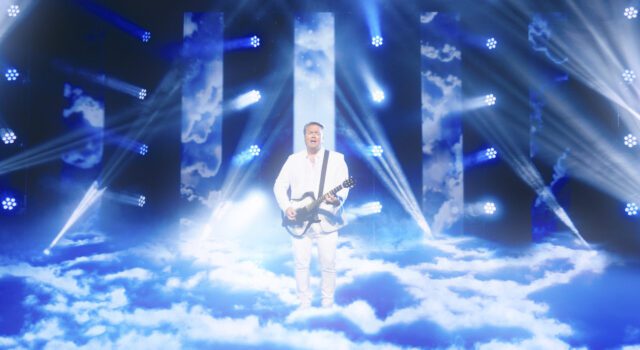
The popular Danish schlager singer Johnny Hansen, of the band Kandis, inspires derision and devotion in equal measure. He is deemed crass among sophisticated city folk while considered a messiah by many in Denmark’s provinces. Jesper Dalgaard’s poignant doc favours the latter constituency, and in the process reveals their rich and at times heartbreaking sense of humanity.
These are people for who have lived their lives with Johnny as a constant presence, whether on the radio (or laterally Spotify) or as audience members. For 30 years his band Kandis has played over 200 concerts per year, many of them within local Danish stadia or clubs, regularly entertaining audiences in excess of 500, at other times considerably more.
We meet René who was contemplating suicide in his car, but when he heard the Johnny-penned ‘Heaven’s Hotel’ on the radio he changed his mind. The older Henning is lachrymose, prone to tears at the drop of a hat, and he can’t really explain why. But he tends the grave of Johnny’s wife, who herself committed suicide 13 years ago, something the singer cannot himself do as he still harbours much grief and resentment. Susan has given up on life, but still writes saucy novels (one assumes about Johnny) which will never be published, and details of which she refuses to divulge.
Other subjects include Kandis fan Strøm who misses his late mother and must decide whether or not to discard her late effects. We also meet three blind brothers in their eighties who shuffle together both inside and outside their domicile like elephants at the circus. While their story is hard to pin down, they perform a particular function in the film, as metaphor for the overarching theme. “They became like a physical symbol, the three of them guiding each other in blindness through darkness,” says director Dalgaard.
The Kandis devotees aren’t so articulate, and much of the time choose to express themselves through the lyrics of Johnny’s songs, many of which were written after his own personal tragedy. They are also the type of people that Dalgaard grew up around, and serve to illustrate a wider point about the value of art, when assessed through the prisms of high and low culture.
The director was raised in the next village to Johnny Hansen. His uncle was a big fan, as was his grandad. His father’s musical tastes were pretty similar, he says, and his mum played the harmonica locally. “I’ve been away from the village for 15 years, maybe longer, so now I’m part of a completely different culture, which you call maybe more highbrow, some sort of elitism.”
“Why I wanted to make this film was also to try to embrace how I’m defined by both worlds,” he continues. “Trying to go back to that childhood culture and understand it from a new perspective. The film is also for me portrait or an exploration of a certain type of man that I grew up around, and how they express their feelings, how they express themselves. And of course it’s related to my father. It is an ongoing development with him and how we connect with each other because we are very different.”
“Where I grew up, you don’t really express your feelings. You find different ways or you suppress them,” Dalgaard clarifies. “Emotional language has different faces. It can look very different, how you express yourself… For these kind of people who don’t have a language for their emotions, they can use these songs as, you know, a way of expressing it or understanding how they feel.”
And then there’s Johnny himself, who has grieved the death of his wife for the past 13 years-plus, a woman whose suicide note referred to the couple’s inability to have ‘deep conversations.’ He always regretted never having prepared an adequate speech for his wedding, we are also told, and instead had to deliver those meaningful words at her funeral.
“He’s some sort of messiah to his fans, so that duality, or that contrast between being stuck in your own emotions and your own feelings and your own development, while still being a saviour for other people, I found really interesting,” says Dalgaard.
Hansen was very co-operative during the production, and “completely understood” that his personal story was core to the film, given how the s
ongs that resulted have shaped the lives, and soothed the pain, of so many people. But after the death of his wife, he and his daughters were subjected to tabloid intrusion and he therefore feared the same after the release of Kandis For Life. But thus far, at least, press interest has mainly focussed on the fan aspect.
“He loves the film. I think he and the entire band are really surprised how it went out. They didn’t expect it to be this way. They didn’t expect it to have this [fan] perspective. We talked about this, but you can never really imagine how a film is gonna turn out,” says Dalgaard. “I think he’s also really surprised in a positive way how much good reviews it got in Denmark, and how well it was received.”
In concluding, Dalgaard returns to the subject of high and low culture, and the ways that Johnny’s songs are perceived. “You know, if you objectively take a Kandis song, a lot of people will say ‘it’s simple, it’s bad, it’s stupid lyrics.’ But from what perspective? When you put it into the context of somebody’s life and as a tool for their emotions and relate it to [them] wanting to commit suicide, but then they change their mind while they sit in the car, then it’s not really a matter of a good song or a bad song anymore. Then it has a completely a new meaning,” Dalgaard ends.