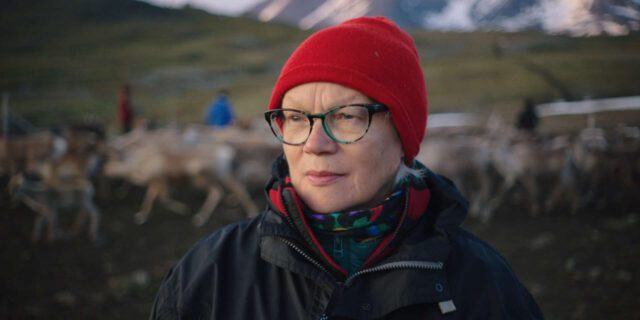
The struggle for the Sámi culture is powerfully and beautifully represented in the large-scale 24 metre-long cinematic-style textile artwork “Historjá” by Britta Marakatt-Labba, with the embroidery depicting motifs from Sámi history. It also acts as a focal point for Thomas Jackson’s impressive documentary which details Britta’s story, at the same underlining the importance of land to the Sámi people and how climate change is the latest battleground for her community.
As Britta movingly says early in the documentary: “I was born into a struggle…because in Sámi culture, we’ve always had to fight – against religious oppression, against the abuses of the state and authorities, against incursions on our territory, our faith and our culture. And now we have another fight we need to take, against climate change. And if we don’t win that one, it will be our last.”
The Sámi people are Finno-Ugric speaking people from the region of Sápmi (formerly known as Lapland), which today takes in large northern parts of Norway, Sweden, Finland and the Murmansk Oblast in Russia. Traditional livelihoods include fur trapping and coastal fishing, but Marakatt-Labba’s family are from a semi-nomadic reindeer herding tradition, and for her the ancient Sámi lands fuel her art as well as her life.
Historjá: Stitches for Sápmi astutely blends the story of the Sámi people (as reflected in Marakatt-Labba’s astonishing embroidered artwork, which made a huge cultural impact when it was shown at Documenta 14 in Kassel in Germany) with beautifully shot vistas of the striking landscapes, while simultaneously detailing campaigns to try and save Sápmi land.
Marakatt-Labba is filmed walking in an area the Sámi call Gaiccacahca, where she and her family come to every July to mark their reindeer calves. “Min eatnamat means that this is our land. There were humans here 4,000 years ago, hunting and living their quiet lives. I have the feeling I am part of this,” she says as she crouches to greet the mountain stream.
She hopes that her son can continue with the family trade of raising reindeer. But “things have become so unreliable. You can’t trust the seasons anymore…” she says. “The reindeer pastures have deteriorated as the climate has changed.”
Nature truly comes alive in this stunningly beautiful story about the Sámi worldview and mythology, with lovely aerial shots juxtaposed with images from her artwork, which tells us about the legends and history Sámi culture whose story has been marked by a struggle against the majority population. The struggle has concerned the right to land and the way of life, but also underlying this are two views of mankind and its relationship to nature.
She adds: “Sámi philosophy is that nature itself speaks to us if we listen carefully. I have a dialogue with nature…but big companies show up and they don’t care about our culture or our faith…they think that it is all nonsense.”
She talks about how she was sent to the nomad school for reindeer-herding Sámi in Karesuando in northernmost Sweden as a child. “It was all so alien…so many rules, when I was used to living a free life at home,” she says, “There were so many abuses in nomad schools – that is where the fight awakened in me.”
Once she had finished her education in Gothenburg in 1981, she joined the protest against the power plant expansion by the Alta River in Norway. “It was a state of war in a way,” she says. The police cut chains the protesters had used to secure themselves and she found herself thrown in a police van. “A policeman said I’d be dropped at border,” she said. “I told him the border didn’t exist for us.”
The film dwells on how the younger generation of Sámi herders find the impact of climate change on the landscape hard (one mentions that he can no longer get advice on some things from older herders because they didn’t have to deal with the changes in the landscape) before showing Marakatt-Labba joining an Extinction Rebellion
protest. This is intercut with footage of older (and similar) protests, with Marakatt-Labba observing: “We need to fight for our future and for our children and grandchildren. You have to keep fighting and believe that a change is possible.”
Sweden, 2022, 89mins
Dir Thomas Jackson
Production TriArt Film, BRT.F
Producers Mattias Nohrborg, Pelle Nilsson
Cinematography Jonas Rudstrom, Hans Olaf Utsi
Editor Kaveh Akaber
Music Erik Havnes
With Britta Marakatt-Labba