It’s a marriage made on two continents and a film put together across multiple time zones. A Marriage: Love In The Time Of The Internet (a world premiere in Hot Docs) is the new documentary by Czech director Kateřina Hager, made in collaboration with Emmy award winning Pakistani director Asad Faruqi.
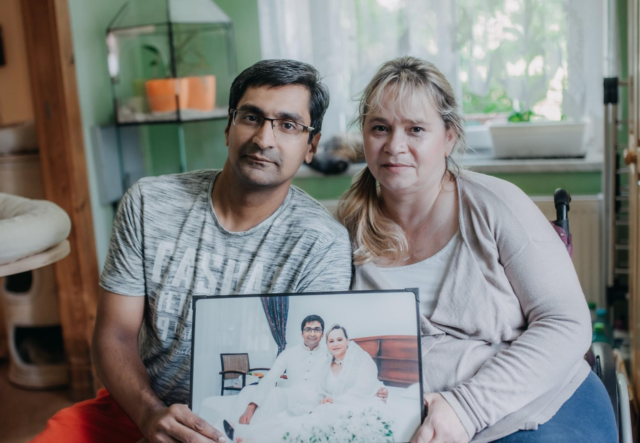
It tells the story of the formidable Zdenka from the Czech Republic, who has been wheelchair bound since a car accident at the age of 23, and of Tabish from Pakistan. They meet playing an online game and eventually fall in love and marry. The Czech authorities won’t accept that theirs is a genuine relationship while Tabish’s family remains deeply suspicious of the relationship. Five years after they’ve exchanged vows, the spouses therefore remain stuck thousands of miles away from each other.
Hager, founder of production company Bohemian Productions, first heard about this very complex online love story in 2017 from Czech author Iva Pekárková,
“I found it quite unbelievable and I wanted to investigate it further,” the director tells Business Doc Europe. At the time, she had just finished her previous documentary Children Online (2017), which explored the dark side of the internet – in particular how kids are groomed in cyberspace. A Marriage continues her exploration of how the internet is changing lives but this time the tone of the film is much more positive.
Zdenka and Tabish fell in love after tending a virtual garden together while playing online game Farmville.
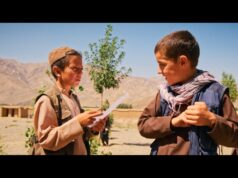
The logistics behind the documentary were daunting. Hager was in Prague, shooting Zdenka. Her co-director Asad Faruqi, whom she enlisted after a meeting at the Sheffield Doc Fest in 2017, was in Karachi, shooting Tabish. “We worked across three time zones. I am based in Prague. Asad is based in New York and Tabish was in Karachi,” the director recalls.
Zdenka and Tabish have strong reasons for participating. Both believed that the film could prove that their love was “authentic” and that they weren’t just trying to get round immigration regulations.
“Tabish was treated for many years as guilty and couldn’t do anything to prove himself innocent,” the director says of how the Pakistani was regarded by the Czech authorities. The couple were facing “a wall of prejudice.” Not only was Tabish regarded as an economic migrant. The authorities were deeply suspicious that he was younger than his wife and that he didn’t seem bothered that she was wheelchair-bound.
“It’s institutional discrimination. I think if he was coming from a different country, not a third world country, the conditions would be very different,” the director says. “They (the Czech authorities) could not imagine that a young, healthy Pakistani could fall in love with an older Czech woman in a wheelchair.”
The authorities also questioned whether real, meaningful relationships could be forged online. It was made next to impossible for the couple to spend time together. They could meet on short holidays in Sri Lanka – and that was it.
“It’s definitely the case that technology changes the way we fall in love and even the way we conceive and maintain relationships,” Hager says of what she has learned from observing the couple. “Although we made our film before the pandemic, this space we are finding ourselves in right now shows that people really can maintain relationships and can find love on the internet. I very much believe that.”
Hager was convinced that Zdenka and Tabish really did love one another. She was curious, though, to see how “this relationship will make its transition from the online phase to in-person reality in the small Czech town where Zdenka is living.”
The documentary was shot in traditional verité style with the two directors spending as much time as possible with their protagonists and trying to be as spontaneous as possible.
The director realised early on that if she tried to tell Zdenka what to do, she would get nowhere. “Honestly, Zdenka is a hard person to direct. She is such a strong character,” Hager says. “I must admit that after a few days of filming with her, I truly almost forgot that she was on a wheelchair. The way she acts, the way she is so strong, it never ever allows you to view her as a victim.”
During shooting, the filmmakers had no idea whether their story would end up with a happy ending – or whether the husband and wife would continue to be forced to live apart. That added to the tension. Nonetheless, the mood during production was always upbeat.
Now, the film is to be launched at Hot Docs with the Czech Premiere following at the One World Film Festival in May. Czech distribution will be handled by The Association of Czech Film Clubs.
On a professional level, the relationship between Hager and her New York-based co-director Faruqi mirrors that of their protagonists in the documentary. “We had to work mostly online…although we worked together for almost four years, we saw each other I would say for a maximum of one hour in person,” Hager says of a collaboration which worked remarkably well in spite of the distance between them. “I find myself having a professional cooperation with someone I barely know in person but there is also a level of trust and understanding!”
A Marriage is one of the ten films selected for the Changing Face of Europe programme at Hot Docs, organised by European Film Promotion.