

Frankie Fenton’s fascination with the pro-nuclear movement began 13 years ago, when he read an article in Wired magazine entitled ‘Uranium Is So Last Century — Enter Thorium, the New Green Nuke.’ The Irish filmmaker was immediately fascinated by the idea that Thorium-based nuclear power could be far less dangerous than its Uranium-based equivalent.
Fenton’s Atomic Hope: Inside The Pro Nuclear Movement (screening in The Changing Face Of Europe Strand at Hot Docs) is very timely. The Ukrainian war is still raging. Climate change is becoming ever more of a threat to the planet. Many countries are desperate to wean themselves off fossil fuels. New sources of clean energy are coveted. Nonetheless, environmental groups remain hugely suspicious about Thorium and about every other form of nuclear power as well. Memories of Hiroshima and Nagasaki, Three Mile Island, Chernobyl and Fukushima continue to cloud the arguments. That is why, even in the middle of an energy crisis, nuclear power stations continue to be summarily shut down.
The filmmaker is plunging into what remains a very heated debate. Early on, though, Fenton realised that he had to make his documentary entertaining as well as informative.
“Originally, I was filming older scientists in front of bookcases. It wasn’t making very good or entertaining documentary,” he remembers. “It wasn’t actually exciting enough to keep one’s attention for 80 minutes.”
Fenton decided to make his documentary “less about the technology and more about the people speaking about the technology.” He wanted to come at the story from a human point of view – to provide colour, context and lively argument as well as scientific theory. He hoped to make a film that the “elderly neighbour down the road” or his local postman could understand and enjoy. There was no point in simply preaching to the converted.
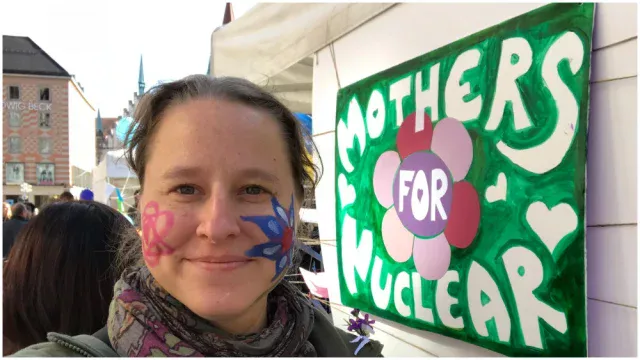
Over the years, Fenton had met many advocates of nuclear energy. They range from scientists in Japan to academics in America and Europe. These experts have encountered considerable hostility. They’ve been shunned at climate change marches and protests. Their arguments tend to fall on deaf ears.
When he first became interested in the pro-nuclear movement himself, Fenton wasn’t yet a filmmaker. He had been working as an edit assistant but had never picked up a camera. He knew he wanted to make a film but wasn’t sure how best to go about it.
Atomic Hope has taken a decade to complete – and Fenton completed another documentary during the same period. It’s Not Yet Dark (2016), narrated by movie star Colin Farrell, was about Irish film director and author Simon Fitzmaurice’s battle against motor-neurone Disease (amyotrophic lateral sclerosis). It won awards at the Galway Festival before going on to show in competition in Sundance.
“That’s really where I was able to cut my teeth and learn to tell stories,” Fenton recalls.
Atomic Hope is produced by Kathryn Kennedy of Kennedy Films. Seed money for the project came through crowd funding site, Kickstarter. After the success of It’s Not Yet Dark, he was also able to secure Screen Ireland funding as well as some equity investment.
“[But] it was certainly a hard sell to try to convince people that this was a story that needed to be told.”
Fenton understands why there is such suspicion of nuclear power but argues that anyone who “is trying to make the world a better place” deserves a platform. The pro-nuclear figures featured in the documentary are generally coming at the debate “from a place of love and heart and caring about the future.”
The documentary has a very striking poster: an image of a rodeo rider on a giant banana with a message on it saying that the piece of fruit is “more radioactive than living near a nuclear plant for one year.”
“Posters are meant to be eye-catching,” Fenton explains the choice of an image which evokes memories of Slim Pickens riding a nuclear bomb in Stanley Kubrick’s satirical comedy Dr Strangelove. “I also think it shows that the people in the film are mavericks.”
On the eve of Hot Docs, the director acknowledged that he expected his film to provoke some heated debate. “It always has felt like walking into a storm, talking about a subject like this. However, the stakes are so high right now. If we’re not talking about it, then nothing is getting done…we have 28 years before we have 10 billion people on the planet. In that time, we are going to triple our energy usage.”
Oil, coal and gas currently accounts for a reported 83% of the world’s energy usage. The challenge is to bring that down to as near to zero as possible. “It doesn’t matter to me if anyone is anti-nuclear or pro-nuclear but I do want people to know that if we are going to lose nuclear power plants early at this crucial time, we need to do it for the right reasons, not [for reasons] based on fear or lack of understanding,” the director declares.
International sales on Atomic Hope are handled by Java Films.





