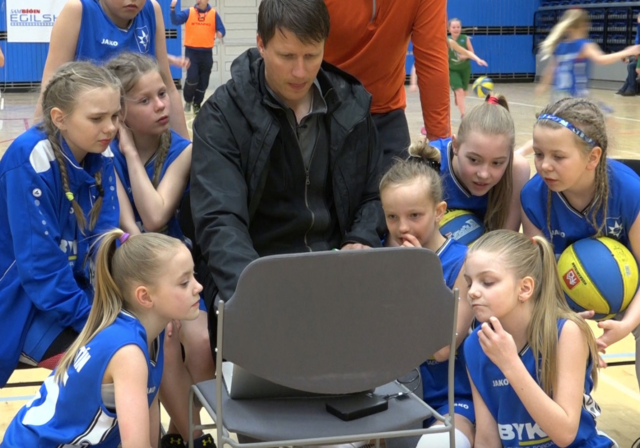
Girl power is alive and kicking in Guðjón Ragnarsson’s Raise the Bar, about an Icelandic all-girl basketball team and their uncompromising coach. But is Iceland ready to embrace, or even acknowledge, the girls’ bid for emancipation, equality and agency? Filmmaker Ragnarsson talks hoop dreams with BDE.
Brynjar Karl Sigurðsson is a force of nature. An Icelandic businessman, former basketball player (both in the US and for the national and Icelandic national team) and dad, he also coaches young girls aged 8-13 in playing the game. But his methods are unconventional, to say the least. He roars at the girls from the sidelines, swears profusely during training and promotes trash-talking on court. At parent meetings he vigorously defends his hardline methods, sometimes tearfully, against mums and dads who think his influence is too great, and methods too extreme.
But the girls love him, because for them his guidance has been transformational, turning them into savvy, confident and immensely capable young women. “The game is a tool for for life itself,” says the coach.
That said, the country’s basketball authorities don’t seem to see it that way, and refuse the team’s application to play against boys. Which of course hardens the resolve both of Brynjar and his young charges, culminating in a brave, unified and articulate (and headline grabbing) act of protest before the film’s conclusion.
Debutant Icelandic docmaker Guðjón Ragnarsson (then at acting school in LA) heard about the coach back in 2015, and when he returned to Iceland he met up with him. “From the first moment I met him I knew that he was a guy who was not for everybody – I got that off the bat,” says Ragnarsson. “I also knew that he was very unique, the way he speaks very direct and honest, and I liked that about him, so I guess we kind of became friends.”
But the director was nevertheless shocked when he attended his first practice. “I wanted to just run in and hug the girls and tell them that everything was going to be all right,” he admits. “To protect the girls, that’s what my heart was telling me but I decided not to…I just watched the whole practice and I just thought, this is so interesting. It was like a car crash you couldn’t look away from. He was very direct with them and they were so little, but then I decided to come the week after for another practice, and this time I had my camera and I started filming.”
Ragnarsson was not yet a fully-fledged docmaker, and around this time he applied for film school in Iceland. He showed the footage he had shot to his tutors, cut it into a short and then presented this to Icelandic Sagafilm who agreed that this would make a great subject for a feature doc, and so the project continued.
The filmmaker is at pains to say that his main focus is the girls and their journey to maturity, and not so much Brynjar, although the coach features very prominently throughout the film. Furthermore, he chose not to tell the ‘dark’ story of the basketball association’s ongoing refusal to acknowledge the all-girl’s team’s right to play against boys’ teams. “The truth is that if there had been any other coach, none of this would have been an issue,” Ragnarsson says.
However, what is unavoidable in the film is how, just as Brynjar looks to remove all the discriminatory obstacles the girls must overcome, the authorities and some parents seem as eager to put them back in their way, leading the director to ask, “Can empowerment go beyond what the culture can tolerate?”
Byrnjar tells how, when his daughter Tanja (also in the team) was born, he started to look at the world through her eyes, and what he saw meant he “couldn’t sleep at night.” And so he set out on his radical campaign of change, to convince the girls of their enormous potential and capabilities, and show them the importance of full-on engagement with the world. He also describes the zen-like transmutation of pain to gain. “The strongest person is not the one who doesn’t feel anxiety,” he tells one of his players, “but the one who feels anxiety and does something about it.”
While one parent (Logi) complains about his girl having to hear bad language, another (Hákon, chisel-faced and resembling a marine) breaks down in tears of gratitude for Byrnjar, who has transformed the man’s daughters from shy wallflowers into confident young women, ready to take on the world.
“They are so dedicated, they are so mature,” agrees Ragnarsson of the girls. “It’s such a big part of my life that I have been with them. They’re like little sisters and I love them. They have changed the paradigm through which I look at kids because they are so forward thinking and so honest and so light, and none of them have any trouble in school. They are just like saints. They do well, they get good grades.”
“They are my role models basically,” he adds. “I’m not saying that just to sound cool. I look up to them and I want my son to grow up around them so he can learn what it is to be a good person.”
The film’s end is shocking insofar as it indicates just how far society (even within one of the progressive Nordic countries) is yet to come in acknowledging the agency and respect that must be accorded to children, in this case female adolescents arriving (very quickly) into full emotional and intellectual maturity.
“One of the big points in the film is that we are underestimating kids,” says Ragnarsson. “That is the main [point], not to say that we can’t yell at them or be harsh with them, it’s just that kids are awesome and their brains are better than ours. So we should both listen to kids and trust them more, and give them a voice, uncorrupted by politics.”
Sales for Raise the Bar are handled by CAT&Docs.