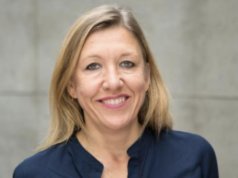
Lisa Gerig has a dual career. The Swiss filmmaker doesn’t just make hard-hitting documentaries. For the last 10 years, she has also been an activist, highlighting the problems facing asylum seekers in Switzerland. In particular, she has focused on the grim situation encountered by those kept in deportation prisons in Zurich.
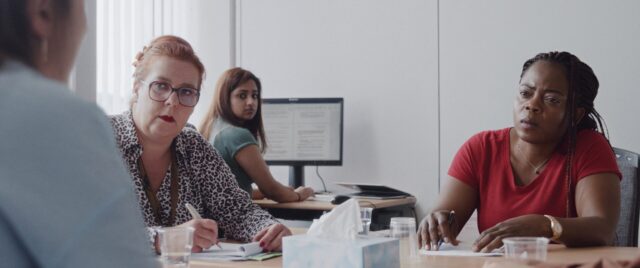
“I was able to build up many friendships with refugees and I heard a lot about the challenge of telling one’s life story in front of the authorities, this moment being so essential for the future of how one’s life develops,” Gerig says of the inspiration behind her new feature documentary The Hearing, which world premiered at CPH:DOX in March. In the film, four asylum seekers re-enact their interviews with the authorities to determine whether they will be allowed to stay in the country.
These conversations are absolutely crucial to their futures. “Everything that happens in the asylum procedure…that is the heart of it,” the director says of the hearings.
Gerig already had relationships with the four asylum seekers who feature in the documentary. “I started with them [when] preparing the project and then I approached the authorities…”
The officials of the Swiss state were initially very wary about the young filmmaker asking them so many questions about their activities. “I think they are very used to be suspicious when someone comes from media or film,” Gerig says of the employees working for the State Secretary of Migration. They didn’t take her seriously. The filmmaker, though, persevered, conducting over 40 research interviews. Gradually, she won their trust. One person after another agreed to help her.
The relationship between the authorities and the asylum seekers is attritional and sometimes openly hostile. The interviewers are trying to make their subjects slip up. They cast doubt on their stories. The asylum seekers are describing often horrific experiences of torture and persecution, but are often treated as if they are making it all up.
“The four people from the authorities in the film are the soft ones, the polite ones…that’s also what the asylum seekers told me. In their [the asylum seekers’] real interviews, it was even harsher and harder. The questions were less polite. The mistrust at the beginning of the day was always there. They had to prove that they were a victim,” the director notes. She praises the officials who were brave enough to “show their faces” in the film. “I met many other employees who said they would talk to me only without cameras.”
The film has the tautness you find in a well-constructed play. The sparsely furnished offices in which the interviews take place add to the brooding atmosphere.
Gerig and her co-editor Ruth Schlaepfer, worked hard to give the documentary a dramatic shape. “To me, it was always important that it was not a film about these four life stories but a film about our system. That helped us to structure it,” the director reflects. “But because the situation is essential for the future of these protagonists, there already was this tension in the room. We didn’t have to look for moments that were intense. Everyone in the room knew it was important.”
Language differences add to the suspense. The asylum seekers don’t always know what the officials are saying – and vice versa. This means they have to wait for the interpreters.
The director won’t say precisely what has happened to her four protagonists. One has now been waiting for over four years for the decision of the courts as to whether she will be given leave to remain. Another received a negative decision and is applying against the decision. Two have been allowed to stay in Switzerland, at least for now.
Gerig hopes her film will encourage the authorities to be more sensitive and humane in the way they deal with the often traumatised asylum seekers. Small matters, for example improving the quality of the translations, could make a big difference.
“I hope that the film will make you think when you go out of the cinema, is it even legitimate to do this selection and what other possibilities could there be,” Gerig says of the questions she wants viewers to ask themselves.
The Hearing may have been made in Switzerland but its director believes the same stories could be told almost anywhere else where there are refugees. “As far as I know, it is a very similar procedure all over…”
Gerig spent almost two years researching the film “without really having money.” Her producers Maurizius Staerkle Drux and Eva Vitija from Ensemble Film soon came aboard. The Hearing was financed by Bundesamt für Kultur, Zürcher Filmstiftung, Kulturfonds Suissimage, Fondation SUISA, Verein Casa nell’Arte, Markant Stiftung, Stiftung Anne-Marie Schindler and Stiftung Corymbo. Outside The Box is the Swiss distributor while Rise and Shine handle world sales.
Gerig sees her filmmaking and her activism as complementing each other. “I don’t really separate them,” she says. The new documentary picks up on themes explored in her earlier short documentary, Zaungespräche, about refugees in a deportation centre in Zurich.
Now, the director is hatching some very different projects. One is about inheritance in Switzerland and the other is about…cleaning.“I like to clean and I have friends who earn money by cleaning. Switzerland is a very clean country…who is cleaning this clean country? There are a lot of different questions in this activity for cleaning that interests me,” she reflects on a project she hopes will shine.