

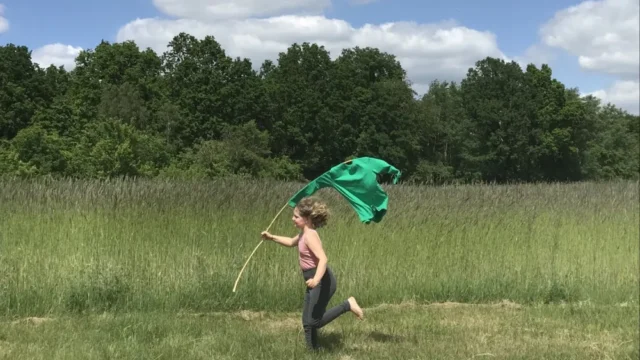
When Jaśmina Wójcik was growing up, she was no fan of the famous 1923 Janusz Korczak children’s novel, King Matt the First. This told the story of a boy suddenly made king after the death of his father. Nonetheless, after the Covid pandemic hit, and she and her family moved out of the city to a place in the country, she realised that her two young daughters, Zoja and Lea, adored the book.
“It was something very inspiring for them. I don’t know why because when I was a little girl, I hated this book I must say! This book is very tough…this book has a lot of war, a lot of betrayal of his [the young king’s] best friends. I didn’t understand why my daughters loved it so much.”
Wójcik s daughters are at the heart of her new feature doc King Matt the First, screening at Hot Docs and handled internationally by Raina Films. This wasn’t the intention at all when she first hatched the idea of a project about the intimate, imaginative life of kids.
“But something unexpected happened…when we moved to the countryside, my daughters spent all day long in the garden and in nature.”
The daughters’ games were strongly influenced by what they had read in Korczak’s novel. The strange sense of isolation felt by the young king in the book chimed with what children across Poland were feeling during lockdown. The girls, though, were very happy playing in the gardens, forests and fields.
“Nature gave them this opportunity to have space,” the director says of the feelings of liberation that Zoja and Lea were experiencing.
One day, Wójcik’s younger daughter came to her and said, “Mummy, you know I am talking to the wind.”
It was at this point, the director and her partner, cinematographer Jakub Wróblewski decided to focus the film on the daughters. (The initial plan had been to make documentary about wider groups of children).
“Of course, it was challenging. We as a family had to make this decision together,” Wójcik remembers the intense discussions about making the film such a close-knit family affair, when Lea was still only six and Zoja was eight.
Wójcik and her co-writer Igor Stokfiszewski asked the daughters to tell them their version of the story of King Matt. These interpretations give the film its storyline.
The director was also eventually joined by an editor, Anna Garncarczyk. “She is a very open person but also very gentle, and very radical as an editor.”
After two years, the daughters grew tired of being filmed. “We stepped back,” Wójcik remembers. But then, as Zoja was growing older and was on the cusp of adolescence, the family held another conversation. “This moment is also very important. Something happened between them, something unique, something new, and [we asked] maybe we could shoot once again. They told us ‘yes.’”
Wójcik was initially wary about what the girls’ friends and schoolmates would make of the documentary. However, Lea and Zoja, now 11 and 13, already think of it as “something from the past” and are very happy for the film, of which they are proud, to be seen widely.
The director is “very engaged in education” as well as filmmaking. Over the last decade, she has been heavily involved in looking at ways of unleashing children’s artistic expression. For her, King Matt is not just a family chronicle or a celebration of her daughters’ love of nature. It is also a movie with a very clear message.
“I really want to show the perspective of children and I really want to give them their voice back – to give them the freedom of talking and playing,” she states. “I think we forget how important it is to be in nature, with mud and sticks, and without adults. It’s kind of a manifesto, this movie. I am very involved in alternative education because our system in Poland, our national [educational] system, is very oppressive.”
Wójcik talks darkly of the way children are forced to sit silently in classrooms. The teacher has all the power. Adults don’t take the kids seriously or regard them as individuals. That’s a state of affairs she wants to change.
And, no, their mother certainly doesn’t want her own daughters being sucked into the vortex of social media either. “They don’t have Facebook or Instagram and they totally understand why…I think it’s pure evil to put Instagram or Facebook in our children’s mobile phones.”
The director’s attitude toward Korczak is now very different from when she was a kid herself. One reason she hadn’t liked King Matt was that it didn’t have a happy ending. “Now, maybe, I am more open-minded. I think maybe because of climate crisis, catastrophe, war and the political situation in our times, we really need these types of stories.”
Korczak doesn’t romanticise childhood – and nor does Wójcik. The documentary may be full of enchanting and wistful scenes of the girls climbing trees, playing with the pet dog and speculating on the meaning of life – but there is cruelty and occasional hints of ‘Lord of the Flies’-like viciousness here too.
In 2022, after Russia launched its full-scale invasion of Ukraine, she noticed changes in the kids’ behaviour. “Evil comes from the adults. War changed children. This was something important for me, that war came and children are different because of it.”
The project was produced by Marta Dużbabel and Agnieszka Rostropowicz and made through Pinot Films ,with support from the Polish Film Institute.
“It was really a long and hard journey. Thanks to my producers, we closed this project. They are lovely people. They also are mothers.”
Wójcik further acknowledges the assistance from HBO’s legendary documentary guru Hanka Kastelicová in making the film accessible to an international audience. “She’s the most wonderful person…”
Thanks to corporate restructuring, HBO wasn’t ultimately able to co-produce the movie but played an important role in its development.
After Hot Docs (where Wójcik won Best Mid-Length Documentary Award in 2019 for her Symphony of the Ursus Factory), King Matt will screen at Millennium Docs Against Gravity. Several other festivals are in the pipeline too.
Wójcik hopes the new picture will reach as many viewers of all ages as possible.
“I think it’s for adults and it is for children as well,” she says of her intended target audience. In the doc, she deliberately doesn’t mention that Korczak (whose real name was Henryk Goldszmit) was eventually murdered along with the children from his orphanage at the Treblinka concentration camp in the summer of 1942. This is the one fact all children in Poland are taught about the author, but she would far rather they read and enjoy his work than learn about the grim circumstances of his death.
“That’s why I didn’t put it in my movie because for me, the most important thing is his legacy, how he perceived children and not this information [about his death],” she insists.





