The British tourist had got his calculations wrong. His plan had been to dive into the hotel swimming pool from a high window. Instead, he landed headfirst on the concrete surrounding the pool. A hotel worker was left to clear up the blood.
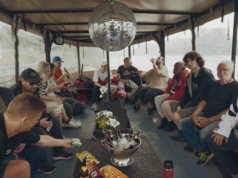
This is one of the more extreme stories shared in Miguel Angel Blanca’s Magaluf Ghost Town (sold by Taskovski Films), a recent premiere at Hot Docs. The film, like most of its director’s work, is a hybrid, blending documentary with fictional elements. It shows Mallorca tourist town Magaluf in its full Sodom and Gomorrah glory. This is where British tourists, who leave all their inhibitions at passport control, come to get drunk, have sex on the beach and throw up – and where they might well be seen at dawn, passed out on the sidewalk. It’s also where people like Tere and her much younger flatmate, Cheickne from Mali, have to live and work.
“The first time I went to Magaluf was in 2015/ 2016,” the Spanish director tells Business Doc Europe. “I went for curiosity…all the Spanish TV channels were talking about Magaluf – the extreme parties, the madness. I needed to know if all this was true.”
The director discovered that filmmakers weren’t at all popular there. “When you arrive in Magaluf with a camera, the people want to kill you because the tabloid press has done a lot of damage with fake news about extreme holidays.” It was therefore an uphill struggle for Bianca to convince people that he wasn’t there to stitch them up.
Right from the outset, Bianca decided to work with local inhabitants rather than tourists. “We did a lot of auditions to find charismatic people with interesting stories.”
The chain-smoking, constantly snacking Tere is one of these: an outspoken Andalusian woman who came to Magaluf when she was very young. She has worked everywhere and knows the town inside out. Her partner Francisco (who looked a little like Antonio Banderas) has died, leaving her no money. That is why she lets out a room to Cheickne. They make an engagingly odd couple.
Bianca’s technique is to “build a little plot and scenes” with his characters but these are generally based on their actual lives or on real events.
The town itself has a dream-like, phantasmagoric quality. Weird events happen in Magaluf all the time. “Trying to figure out if the film is fiction or documentary is not the point,” the director states.
There are extreme contrasts between the wealth of town planners and high-end holidaymakers, designing and renting huge, luxurious villas, and the local workers staying in cramped apartments.
Bianca acknowledges his admiration for the work of subversive, surrealistic filmmakers like Ulrich Seidl and David Lynch, whose work influences his own. “I like the films and the stories where there are concrete and closed universes with their own rules,” he suggests, citing Twin Peaks as a perfect example. He adds that he admires the very deadpan humour in Seidl’s documentaries. “I like to go with the spectator to uncomfortable places. For me, that’s the most important [thing].”
As for the tourists themselves, the director understands why they are often held in such low esteem. He talks of the “love/hate relationship” the Spaniards have with these hordes of foreign visitors. “I think you can see it in the documentary. We need the tourists but we hate them because they destroy your streets.” In Magaluf Ghost Town, they’re portrayed as if they’re the equivalent of zombies or vampires in horror pictures.
Bianca isn’t just a filmmaker. He is the founder of indie pop Spanish band Manos De Topo, for whom he plays guitar. “Music creation helps me work as [part of] a team,” he suggests, likening the process of song-writing to the production process. “When you compose a song with your band, the song is building slowly thanks to all the members of the group – the bass, the guitar, the drums. All the members of the group have a responsibility.”
On a location or a film set, Bianca works in the same way as with his fellow band members. He looks for everybody to collaborate and improvise “to create the film together.”
“I like to make movies as if we were a music band in a practice room in a garage. I don’t like the idea of auteurs where only one person is the genius in the team,” he continues.
Bianca makes his films through Barcelona-based production company, Boogaloo. “My producers always believe in the projects…they like impossible challenges.” They stuck with Magaluf Ghost Town. “It has been very difficult to finance this project,” the director acknowledges. “In Spain, Magaluf is kind of a taboo and nobody wants to put money in this kind of project.”
In the end, the film was backed by broadcasters Movistar +, IB3, France Télévisions and RTS, with the support of ICEC, CNC and Procirep.
As for that gruesome scene in which Tere cleans up the remains of the British tourist whose high dive into the pool went wrong, the director acknowledges that the blood is fake. “The story is true but we needed mise-en-scéne,” he says of the recreation.
If possible, Bianca would very much like to show the film in Mallorca, post-pandemic.
“I am sure the tourists will love the movie. For me, it is a love letter to Magaluf, this film,” he says. “If I was a tourist and I saw this movie, the first thing I would do is go to Magaluf and find out if all this magic is real!”