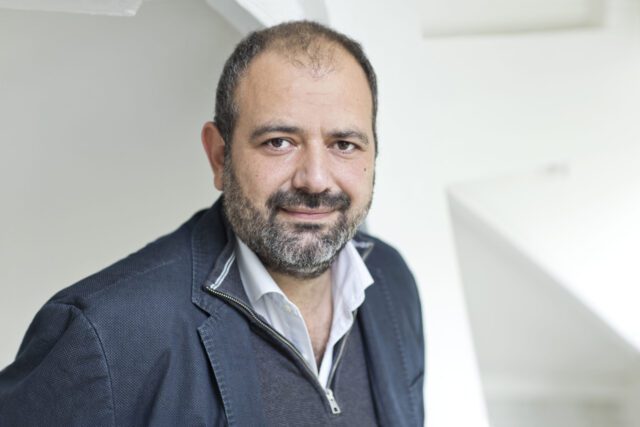
Orwa Nyrabia, IDFA Creative Director (Picture: Caroline Westdijk)
“Returning to cinemas, in my view, is an act of resistance,” Orwa Nyrabia tells BDE ahead of an IDFA that may be presented with a greater degree of sobriety in 2021, but with no less ambition and vigour. “The challenge is that we all come together and share the responsibility, prove together that a film festival can be a serious collective experience, and be safe and healthy, at the same time. That said, being ‘healthy’ is not only a matter of not catching a virus, but also a mental, cultural, political, and philosophical question, and even more so during a pandemic.”
First things first, IDFA 2021 is going ahead as planned. Cinemas are open and industry events such as Forum, Docs For Sale and IDFAcademy will see no disruption, other than that caused by participants taking excess care and getting a week of early nights courtesy of early closure of bars and restaurants across Amsterdam.
All of which is a shot in the arm, if you’ll forgive the pun, for a doc industry that has been by and large targeting IDFA as its point of re-entry to meaningful face-to-face engagement with fellow docmakers, funders, sales personnel et al, and with the new works they are screening, pitching or preparing.
The festival is restructured in 2021, with an aim both to ‘defy’ and ‘manage’ expectations, and includes the new Envision Competition program of 15 exploratory and risk-taking films ‘of the highest caliber.’ Nyrabia explains the changes.
“If you’re watching a film in the International Competition, you should expect a film that is excellent, that relies on the great traditions of film dramaturgy and creates a unique experience within those conventions. For example, a chronologically edited observational film that transports you to its world and makes you think and imagine, or a surprising interrogation of archival footage combined with great voice over,” he says.
“Envision, on the other hand, is our line-up with films that do not fit into the categorization easily, films where the filmmaker tried to invent their own answer to the question, the fundamental question, ‘what is cinema?’ So, I hope this improves the festival by managing the viewer’s expectations, making them start watching each film with openness, with the right state of mind. The new structure should help the audience, and industry members, navigate the program better, and widen the spectrum of films that IDFA can present to the world. Make IDFA’s core even more open to diverse artistic expressions.”
And emotions, he might add. What the past 18 months have proved, and you don’t have to be part of the doc world to understand this, is that the world is a place teeming with emotion, brought about by worry, frustration, tragedy, recovery, relief and trust in fundamental relationships. And as we have sought out cultural or artistic stimulation and/or pleasure, what has transported us furthest has been that which has affected us emotionally. Is this a criterion that Nyrabia specifically applies when it comes to programming?
“I would say so, yes,” he answers. “To be honest, I don’t really think in terms of criteria. Some films make my life better, make me better, fill me with ideas and emotions, with intrigue, they light up my imagination… So, I keep searching for them. I have my own strict training on watching films with a certain level of submission. I start from trusting the filmmaker. I start with the hope that the filmmaker will carry me there, wherever it is that they want to take me, in their own way and style. Personally, I am very sceptical of any film that tries to tell me what the truth is, or to ‘educate’ me, or those that are the same film I’ve seen many times but within a different context…I prefer a film that earns my trust by a genuine sense of sincerity. Sincerity is a key to singularity.”
“So, ‘emotional’ is a key part of being sincere and not didactic, truthful but hopefully not sentimentalist, or propagandist for that matter. Emotional but sincere, not manipulative,” he adds, before offering a rejoinder. “But in any case, I do not take my own opinions as absolutes. Parts of IDFA’s program are also about showcasing the trends and currents in documentary filmmaking today, whether I personally like them or not!”
Yes, when pushed, Nyrabia can isolate films from the 2021 program for special mention, but he doesn’t like to do so as “it beats the purpose of the job to answer this question – [the selection] is a kaleidoscope that is defined only by the eye of the beholder,” so we’ll put his reluctant response to one side. That said, he expresses how, “personally, I cried for an hour watching Bellocchio’s beautiful Marx Can Wait (Masters). It is a film that will live with me for the rest of my days, and I do not really know why.”
The 2021 program is eclectic and wide-ranging and is drawn from all corners of the globe, and delivers on Nyrabia’s unapologetic promise of greater geo-diversity when he took over the festival in 2018.
“I believe the most important change here is the fact that the selectors of IDFA come from all over the planet now,” he explains of the selection and his co-workers who helped shape it.
“Capable programmers with all the breadth of sensitivities one can hope for. This is, to me, the true translation of being representative of the world and not only of its leading markets. I do not hope for a program that strives to show representation in a manufactured manner. When we share the decision-making power with great partners around the world, we become truly representative.”
“Prejudice is not a film term; it is a much larger issue,” he adds. “Realizing that privilege creates bubbles of self-righteousness, of missing the difference between ‘different’ and ‘wrong’, especially when we work in a competitive film industry that is ruled by, for example, one annual awards season in one country, or any such static measures of success.”
“No new ideas here…to create change, to progress, we need to challenge society,” he continues. “While to make money, it is more efficient to just give the audience what the audience know they want. In art, we are defined by the position we take in the space between these two opposing aims. There are many possible positions between the two, the world is nuanced.”
When Nyrabia took over as Creative Director IDFA in 2018, he stopped producing, although he has looked to complete works that were started prior to then. How then does his experience at the coal face of doc production inform his role at IDFA? He answers at length.
“Having this experience makes me keen on bridging a gap that some festival professionals might not see as clearly. It is comparable to the gap between filmmakers/artists and distributors, critics, and scholars,” he comments. “First, I never think of a film as another one in a pile of thousands. A certain commodification emerges when you are in position of power over thousands, a certain cynicism, to be clear. New technology makes this factor bigger: there are many more films being made than before, and today professionals watch these films via screener links. No matter how experienced one is, this practice lowers the perceived value of each film, mechanically and inevitably, when compared to pre-screening a film in a cinema for example.”
“Add to that the fact that in the wider film industry, documentary is still less appreciated or valued, compared to big fiction budgets and names. Adapting to this reality is a challenge that is not taken seriously often enough, in my opinion. Then, experience also translates in how one ‘reads’ a film from the viewpoint of the creative process, and not only from the viewpoint of the average audience member.”
“A festival is a mediator between filmmakers and the audience, not merely an agent of the audience checking the films on offer according to preset interests and previous success stories. We take risks to make new trends and introduce new possibilities. We do not just ride a wave after it’s proven successful. If filmmakers want to change reality, then festivals can be their partners in that, not merely the guardians of a status quo,” Nyrabia concludes.