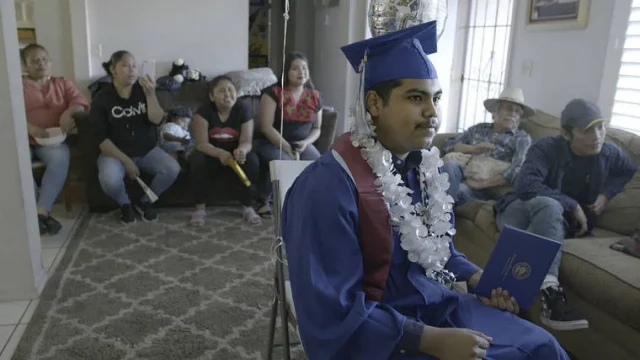
What David Simon did for Baltimore in The Wire and what Fred Wiseman has done with institutions all over the US in his films, Peter Nicks is doing for Oakland, California.
The Hulu documentary Homeroom (a European premiere at IDFA) is the third in his trilogy set in the city, following on from The Waiting Room (2012), set in a hospital waiting room and asking “what it is like to be uninsured in America,” and The Force (2017), looking at the inner workings of the city police department as it tries to reform.
This time, the focus is on the students at Oakland High School during the 2019-2020 academic year.
“The intention of the trilogy is to articulate a grand narrative of one American city. Oakland is one of the most diverse cities in America and so reflects all the opportunities and challenges for a diverse young nation,” Nicks states.
The director acknowledges that he never knows how his films will end. In the case of Homeroom, he simply couldn’t have predicted that the school year would be so badly affected by Covid. Nor did he know at the start how involved the students would become in the protests around the killing of George Floyd amid the huge and increasing resonance of Black Lives Matter.
“You can articulate the broad intention but once the film begins…” Nicks pauses. He uses a phrase, “the whim of the universe,” to describe his inability to chart in advance where his films will take him.
However, the three films are all interrelated. In Homeroom, the starting point was trying to work out “what it was like to be a young kid of colour in Oakland, California.”
The school’s intake is mostly black, Hispanic and refugee kids. One early challenge was identifying the story’s protagonists. “It’s so difficult to navigate life in a world when you’re trying to capture it in real time through a camera….trying also on the fly to figure out who you are going to follow, who has got a story to tell. You’re often casting as you are producing.”
One of the main characters in Homeroom is Denilson Garibo, the smart and very articulate student representative on the school board. Nicks was also looking for familiar archetypes from high school movies – the jock, the stoner, the popular kid, the loner etc.
“We were also very interested in exploring the emotional lives of young kids of colour today,” the director notes.
Student activists like Denilson had already spent several years trying to get the police department out of their school, “to reallocate funding for a dedicated police force on campus to services like mental health,” as Nicks explains.
“In the wake of everything they lost with Covid, having graduation stripped away, senior party, senior prom, acting in the school play [removed], things they had dreamed about since they were at kindergarten, in the wake of all that loss, they were able to find their voice and do that remarkable thing,” the director applauds the actions the students took to get the police off campus.
In the documentary, Nicks and his team show how dependent the kids are on their cell phones. “Kids, even a lot of adults, are very used to transparency in their lives. It is something this generation has grown up with,” Nicks reflects on how open the students were into sharing the content on their phones.
Nicks grew up watching John Hughes movies like The Breakfast Club, Ferris Bueller’s Day Off and Pretty In Pink. These all took the perspective of white suburban kids. They may have been “deeply authentic explorations” of the emotional lives of these kids but, Nicks notes, any students of colour were invariably grossly misrepresented. That’s a wrong his own high school movie seeks to redress.
In Homeroom, he also wanted to show how and why young people were struggling with their mental health. Social media sometimes exacerbated their unhappiness – but it was also a crucial tool when it came to their political activism.
Homeroom was executive produced by the director’s friend Ryan Coogler, the Black Panther and Creed director whom he has known since before Coogler made his debut feature Fruitvale Station (2013), which was shot in Oakland.
Coogler had seen The Waiting Room and immediately made contact with its director. Oscar Grant, the subject of Fruitvale Station, was born and later died at Highland Hospital, where Nicks had made his documentary. There was an immediate connection between the two filmmakers.
“Every case is different. Every young person who loses their life at the hands of the police is a different story but I think what Ryan did with Fruitvale Station was tell Oscar’s story and zoom in,” Nicks observes.
Coogler’s career subsequently “rocketed.” Now, Nicks is working with Coogler on non-fiction films. Homeroom is their first collaboration. The kids he shows in documentary come from precisely the same background as Oscar Grant. They are also trying to navigate the school system and build a life in a system which is tilted against them.
“Ryan for the most part was a colleague and a spiritual advisor [on Homeroom]. He wasn’t involved directly in the making of the film but so much of the film reflects the values of the stories he tells.”
Will Nicks suffer filmmaking withdrawal symptoms if he stops making films in Oakland? He is taking a “little break” but doesn’t discount the possibility that he could spend yet more of his career probing further in Oakland, either making more movies or helping others to do so.
“Local stories that resonate nationally and internationally I think are incredibly important – and offer a perspective and view that often we don’t see,” he reflects. “I am almost inclined to try to find storytellers and filmmakers from Oakland and help them tell the story of their own community…”