

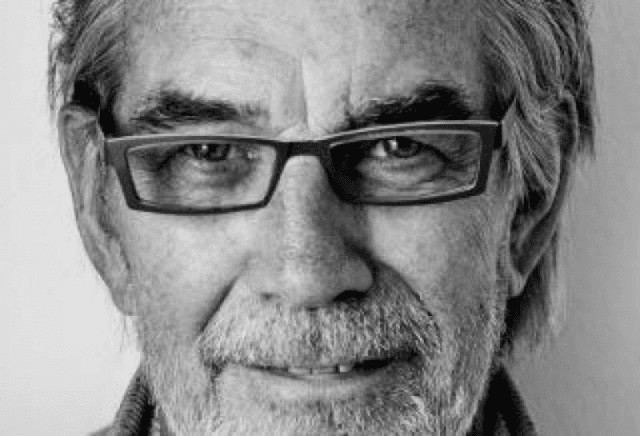
When student filmmaker Ling Lee turned up for an interview for the documentary course at the UK’s National Film and Television School, she was startled to see the course tutor Dick Fontaine with his feet up on the table.
“I hadn’t heard anything about him. I think none of us knew anything about him. We were wondering ‘who was he?’” Lee remembers. “Next to him was a big bowl of fruit and so it looked colourful and friendly, not an office environment.”
Fontaine welcomed Lee with a “big smile” and helped her relax during the interview. “That’s the thing he encouraged us to do at the film school, just to be ourselves but be bold. Getting our potential out of us as filmmakers, he was really good at that.”
The Head of Documentary was a far more distinguished figure than he was letting on. Fontaine (whose 1982 film I Heard It Through The Grapevine, featuring author James Baldwin, had a special screening at IDFA this week, with two more scheduled for November 16 and 17) was a near legendary figure in the UK doc world. He had been one of the first to film The Beatles. He made a series of very well received films about big name jazz, cultural and political figures and he was a founding producer of pioneering, hard-hitting TV documentary series World in Action.
Fontaine died last month. “It was the most sudden news because we wanted to celebrate Dick Fontaine. We planned to invite him and have him with us – but then he passed away,” observes IDFA director Orwa Nyrabia. “It [the screening of I Heard It Through The Grapevine] became much more like a posthumous tribute, a way of raising our hat to him.”
Meanwhile, several of Fontaine’s former students at the NFTS have been in Amsterdam this week. They have been fulsome in their praise of their old mentor. Belgian documentary producer-director Kristof Bilsen, in the same year as Lee at the Film School, talks of Fontaine’s “political playfulness….there was definitely the idea of finding your own voice as a filmmaker, but I really found a political consciousness doing the course. What I mean by that is the whole sense of the Civil Rights movement in the US, of course James Baldwin’s work.”
When Bilsen was making a film in the Republic of Congo, his old tutor got in touch and urged him to read the work of academic Edward Said and to pick up on Said’s critique of Western imperialism. “But it was never in a way it felt like pushing an agenda.”
Bilsen falls into an imitation of the English filmmaker who had a “voice like a wise crow” and would encourage his students to push their projects and to “turn them upside down.”
Former students invariably stayed in touch with Fontaine. He was doggedly loyal to them too, turning up at their screenings, giving them feedback on their new projects, talking them up to potential supporters and sometimes calling them out of the blue, just to see how they were getting on.
Fontaine used to invite his students round to his flat near Shepherd’s Bush. They’d stay late into the night, drinking copious amounts, eating Swedish meatballs, playing jazz and dancing.
Lee and Bilsen were part of a collective, Kitchen Sink, that sprang directly from their experiences with Fontaine. “He was like a father figure,” Lee suggests.
Fontaine would show some of his own films to the students, among them the Baldwin movie and various of his jazz pictures.
“Teaching for me is learning from my students,” Fontaine liked to declare. He was part of the cinema verité tradition and shared his knowledge about how to achieve intimacy with your subjects through “deep listening, deep observation.” He supported his students in their political beliefs but, at the same time, emphasised artistry. He didn’t want soap box movies or agit prop.
“He had a sense of empathetic listening and observing,” Bilsen notes of the storytelling style Fontaine favoured. This didn’t mean he was neutral. “Of course, when you decide to show the contradictions of life and the dilemmas of politics as well, it makes the world so much richer.”
At times, Fontaine could be very critical. He was certainly never bland. “If he didn’t say much, you would think ‘ ok there is something he doesn’t agree with,’ and then if he really felt triggered, he would really shout. He had got a big character,” says Bilsen.
Lee visited him in late September, not long before his death. “He just said ‘how wonderful Ling to see you.’ It was very emotional.” Even then, Fontaine still had the familiar “fire” in him and wouldn’t hold back on his opinions. She is now a teacher herself as well as a filmmaker, as is Bilsen, and both say they are inspired in how they deal with their students by his example. “I feel he is passing this character on through me to them,” she says.
One key lesson from Fontaine was always to encourage passion. Craft will only take you so far. “If you don’t care about it, don’t make the film” was one of his maxims. Another was to show humility. Like Colin Young, founding director of NFTS and a close ally of Fontaine, he would tell students “not to be the arrogant ego-driven director who pushes an agenda.”
“You have to look and listen empathetically at the world. Only then will the film open up,” is how Bilsen sums up his philosophy. The Belgian filmmaker saw Fontaine at a screening of I Heard It Through The Grapevine held at the Barbican in London in September just a few weeks before his death. He was in frail health but still gave a typically lively Q&A.
“As a human being and an artist, I feel I’ve learned from him and now I am really passing it on to [the students],” Lee notes of Fontaine. “He encouraged us to say whatever we think. We could be really extreme. He didn’t think anything was stupid.”





