

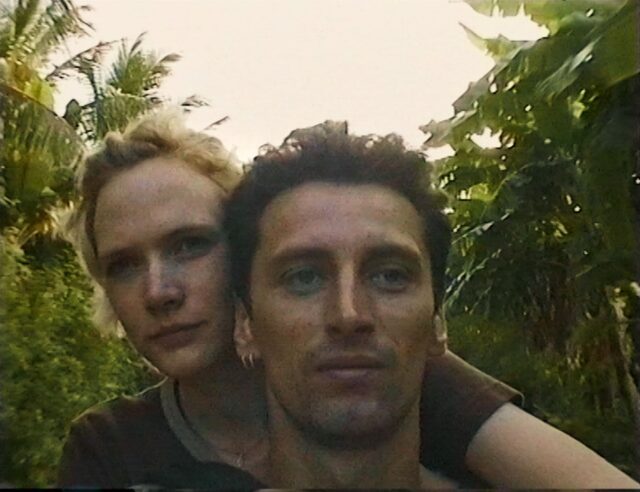
Love-22-Love has been over 30 years in the making. “I’ve been filming since 1992 when I bought my first camera,” visual artist Jeroen Kooijmans says of the origins of his first documentary feature (a world premiere in IDFA’s Envision Competition, and which will be distributed in the Netherlands by Periscoop).
1992 was also when he was in class at art school with Elspeth Diederix, the love of his life and the muse behind the film.
A decade ago, after being injured in a bad accident, falling from a ladder while installing a solo exhibition in a museum, Kooijmans decided to move out of his “very big studio” to somewhere smaller where he could move around more easily. “I thought, OK, I have to throw away a lot of stuff.” He had 3000 hours of tape and was contemplating getting rid of all of it. “But then I found this treasure. Basically, I found my wife as a very young girl. I really wanted to find some light and love in my dark point of view…so then I decided to make a film about love.”
Kooijmans spent three and a half years “just going through the material.”
This may be a love story but anyone expecting a soft-centred romance is in for a harsh surprise. The film is as much about its director’s battles with depression as it is a tribute to Elspeth. During his search for love, he realized that “you can’t truly love someone if you don’t love yourself.”
“I had never made a feature film and so I didn’t know how to make this story interesting,” he remembers.
Producer Bruno Felix of Submarine told him he “had to tell the whole story, not only the love part…otherwise, you have no drama.”
The film opens in striking but harrowing fashion with close-up footage of its director/protagonist in a New York psychiatric hospital in 2002 after enduring a psychotic episode.
“I was totally confused in that time. I really wondered what was going on in my head, but I also had this thing that I had to talk, that I really needed to try to get out of my own head. I tried writing letters to myself. I tried talking. All these things helped.”
Kooijmans describes himself as someone with two sides. “I am this optimistic person normally, but when I am depressed I am also this pessimistic person. I was trying to be positive and, as a pessimistic person, trying to write to my positive side. From my positive self, I write to my pessimistic self to cheer him up and tell him it’s gonna be ok.”
These letters feature prominently in the documentary. So does 9/11. Kooijmans was in New York when the twin towers fell, and his depression was at its worst in the aftermath of the tragedy.
Kooijmans and Elspeth have lived together for 33 years but that doesn’t mean he tells her everything. Both are prominent artists in the Netherlands but they rarely collaborate directly. “We help each other in our art practice but have our own image language and mentality about creating art.”
“In the first three and a half years when I was starting this project, basically I wanted to make a portrait of her. I wanted to make a love letter for her as a surprise. I also didn’t want to tell her because I was afraid she wouldn’t like it and would censor a lot of footage.”
Knowing this, Kooijmans at first kept the film secret from his partner. When he finally told her about the project and said he was making a documentary portrait of her, she responded: “It’s really very nice and very interesting but I think it is a portrait of yourself.”
He allowed her to cut material she didn’t like. She saw many versions of the film and she always gave him constructive feedback.
Now, Kooijmans is planning a book using some of the same material – and he’s again giving her power of veto. As he puts it, she’s the love of his life and he doesn’t want to risk their relationship.
“I’m always a bit like married to art and married to my wife. I love them both – but my wife is a person and art is a destiny,” he says a little cryptically.
The film ends as strangely as it begins, but more humorously. The artist is shown bolt naked, dancing around his studio, carrying a Monstera Deliciosa plant, as David Bowie’s Five Years reverberates on the soundtrack.
“It’s always a bad idea to explain stuff,” he responds when asked about this coda. “But let’s say, for me, I wanted to go into the future, like five years ahead, to stand on the horizon and look back. So I made myself five years older. I am, of course, the main character, but I am also the director…I could see in the end that this was actually a very vulnerable but interesting shot of this guy dancing with his demons.” Early on, there’s a sequence from long ago, when they were young, of Elspeth dancing. Now it was his turn.
Love-22-Love will go on its festival journey after IDFA. It’s expected to be released next September, which will mark the 25th anniversary of 9/11.
“It [the film] will live in the cinema world, but I am based a bit more in the art world. There, I have all sorts of connections,” Kooijmans says. He is thinking of how the material from the film can be developed into an installation.
Yes, he has shown the documentary to his family. His daughters therefore know everything about his “inner world.”
“It was very hard to tell them this story – but I also felt I was making this film for them. My oldest daughter [now 19] was, at one point, my assistant, so she already knows everything. Then we decided to show the younger ones, who are 13 and 15, the film. I was super nervous…but they loved it. They laughed quite a lot. The younger one said she was really scared at some moments, and that she had some questions but that she would ask them later because she doesn’t know yet how to ask them.”
The director admits that for many years he was deeply ashamed about his depressive episodes – and tried to keep them secret. “But I hope very much that it [the film] will help others not to feel ashamed and that it will help to normalise this whole disability. It’s the same as asthma or any other disability. There is no reason to ashamed…and I think it is very healthy to talk about it.”
A version of this article was first published in SEE NL, a collaboration between Eye Filmmuseum and NFF.





