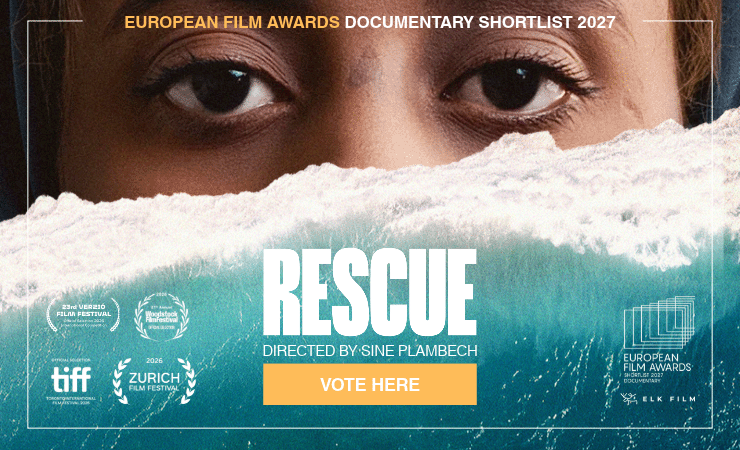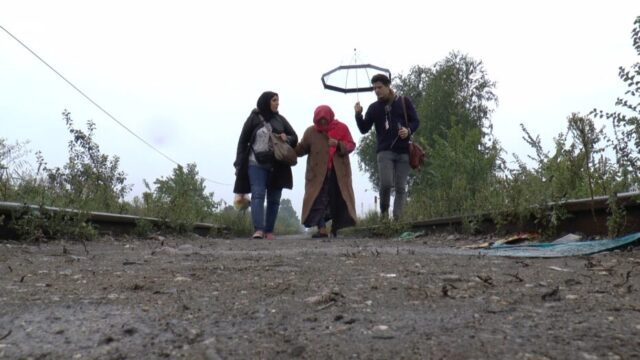
Khaled Jarrar’s documentary (a world premiere in IDFA’s Envision competition) is a refugee story with a difference. The Palestinian artist and director joined a family fleeing the Syrian war on their nightmarish trip across Europe. He wasn’t a news reporter, exploiting their predicament for headlines. He was their friend, looking on at events with their eyes, sharing their hunger, cold and humiliation as well as their fury.
Jarrar dedicates the film to his grandmother. “I grew up [in] the first Intifada when we had this curfew. My mum used to send me to stay with my grandmother in the village because it was safer there,” he remembers. The grandmother would always tell him stories about her own experiences of displacement when the “Zionists” invaded and she was forced to leave her home.
It’s now seven years since Jarrar travelled with the refugee family. His journey with them started in Greece in September 2015. The elderly matriarch Nadira, to whom he was very close, died before the film was completed.
“I didn’t know when I was working on this film at the beginning that my grandmother’s story had such an impact on me. But when I was with the refugees, those images awakened something inside of me which I couldn’t understand…this intergenerational trauma of displacement between me and my grandmother and Nadira and her daughter and her kids,” he says of the strong sense of identification he felt with the refugees. “It was as if I was there making images about my own inherited trauma of displacement.”
Nadira was a woman in her 70s who had been forced to leave her home twice, first in Palestine and then in Syria.
During the journey, Jarrar had tried to film as much as he could. He talks about “forgetting” to go to sleep for four nights because he was so obsessed with recording what he was seeing. “In terms of shooting, I was so obsessed to shoot everything – every moment, every second, even when people were so, so exhausted, asleep in tents or on buses.”
There were many occasions when his batteries died. Sometimes, he would bribe border guards a few Euros to be allowed to recharge his cameras or (when the camera wasn’t working) his iPhone.
There were many gruelling experiences along the way, for example sleeping in tents with water dripping onto their camp beds in a camp in Hungary. He had a computer and hard drive so he was able to store and protect the material he had shot.
When Jarrar began editing the film, Western producers quickly realised that he had shot some very powerful footage. “I got an offer from a producer in Germany for a lot of money,” Jarrar remembers. “But everybody was looking at my images as strong images without [considering] the personal story of all these people inside this frame.”
The director therefore turned the producer down. “I felt wrong. I didn’t feel good…I felt insulted,” he says about what he felt the producer wanted from him. He was determined not to make yet another current affairs documentary looking in at the experiences of the refugees. “I have the right as a filmmaker and as the son of a displaced person to be able to talk about my own story,” he says of his decision to take a much more reflective approach toward his material.
One question Jarrar kept on asking himself was why he had made the journey with the refugees. “Why had I put myself at this risk? What is inside me? What is the motivation?”
The images of the journey kept on “chasing” him in his dreams. “Those images were so heavy, like a chronic pain over my shoulders.” He felt an immense sadness that Nadira died before he could complete the project.
There were times when Jarrar considered extending the film and exploring what had happened to the refugee family in Germany in the seven years since he shot their journey. In the end, he decided to deal with this part of the story in short captions at the end of the documentary.
“Now, as a filmmaker, as an artist, sitting here behind my desk, looking at my images that I shot seven years ago, I found there was somebody else there who is missing. That is Khaled,” the director speaks of himself in the third person.
Jarrar talks about trying “to heal myself from all this trauma of displacement and all the harsh reality I encountered in my childhood. I am trying to survive in this life by doing creative work, like art or songs or stories.”
The artists thinks again and again of his grandmother before she was displaced, when she was able to spend her evenings after work sitting on her balcony, drinking tea, smelling the jasmine flowers and watching the sunset over the sea. “That was her beauty, that was what stuck inside her mind…as Palestinians, we are living in a place where the collective narrative is eating all of those personal stories.”
Those personal stories and “pure poetic moments,” he insists, are precisely what is needed if they are to have any chance of normal lives.