

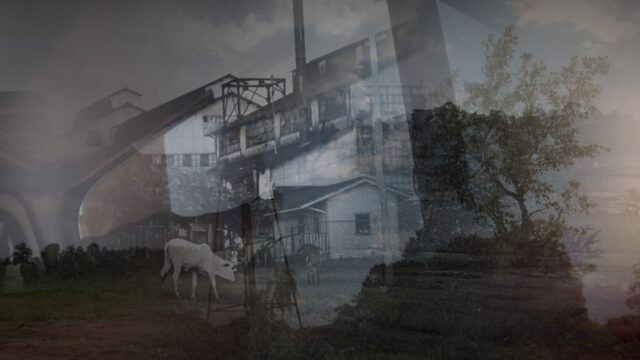
Six years ago, Susana de Sousa Dias (IDFA’s Guest of Honour in 2025) was invited by the French artistic collective Suspended Spaces to work on their project, Fordlândia. That’s when she first started to research the story of the so-called “ghost town” left behind when Henry Ford’s rubber factory in the Brazilian Amazon closed down. This was the subject of her 2019 short, Fordlândia Malaise.
“I didn’t know Fordlândia, and so I started to research. It’s the company town founded in 1928 by Ford. When I went there with Suspended Spaces, I didn’t know I would be doing a film,” de Sousa Dias tells Business Doc Europe.
In the event, de Sousa Dias became so fascinated by the place that she has now made two documentaries in the town – and another one on the way. The second film, Fordlândia Panacea, world premiered last week in IDFA’s Envision.
The director noticed people often said there was nothing in Fordlândia before Ford turned up, and that it had been “a place with nobody living there before.” That turned out to be completely untrue. In 2021, indigenous artefacts were discovered in the town, buried right beneath the Ford factory.
“I decided to make this second film at this moment. When I saw these artefacts, I thought it was a sort of answer to the first film.”
One of her aims was to show there was a rich history in Fordlândia long before the Ford company arrived – and that there’s a history after they left too.
“The first time I went there, I didn’t know anyone. I really wanted to meet people and to understand how they lived and co-existed with this memory of Ford…I wanted to hear their story told by themselves,” she says.
On that first visit to Fordlândia, the moment she stepped off the boat, she went immediately to the church. “I thought the priest must know everybody.” She wanted to meet older residents, especially women, who could still remember the days of the Ford factory.
“I talked with lots of people who are not in the film, but they will be in another film that I am planning,” she confirms her plans to continue filming in the community.
Sound editing is layered and subtle. “The soundscape is very important for me, even it is with silences – although of course, in cinema, a silence is not a silence,” she says, pointing out that in her 2010 documentary 48, about political prisoners in Portugal, there are 16 different kinds of silences. “It’s very important because we are dealing with something that is there, and is not only carried by images and words. Sound has a meaning. It is very important to hear the sounds of the place, the sounds of the insects, the sounds of the animals, the sounds of the atmosphere. This is part of Fordlândia – and part of a very vibrating world that was almost destroyed by all these capitalistic forces.”
The eco-system in the region is altering rapidly because of climate change. New birds are coming to Fordlândia in search of food. Some things, though, stay the same. In the film we also see footage of the celebrations on September 7th, the “liberation” day when Brazil celebrates independence from Portugal. Strangely, much of the iconography, including cheerleaders and marching bands, comes from the US.
De Sousa Dios was using a drone for the first time, capturing spectacular high angle shots. However, she soon decided to adapt the shooting style so it wouldn’t seem as if she was filming from above, as a god-like figure looking down on the community. She looked for different ways to use the drone, bringing it far closer to eye level.
The director is aware that as a Portuguese artist and filmmaker, she is an outsider in this community. “Actually, I have a history of colonial violence within my own family,” she notes. Her great-grandfather was a Portuguese officer involved in repressing revolts by Brazilian indigenous and enslaved people. He married an indigenous woman partly because he wanted to take her land.
“I have both sides: anti-colonial and colonial; republic and monarchic,” she observes of her own family.
The prolific director is already at work on another new project, Total Station, dealing with colonialism and filmed in Angola, which was a Portuguese colony until the mid 1970s. “I am filming there and of course I am thinking ‘do I have the right to film there?’” she questions her own role as a Portuguese storyteller.
“But this is part of the history of my own country, the horrible history, and we have to deal with it. Nowadays, there is a kind of whitewashing. The Portuguese people think they were the ‘good colonisers.’ That’s a kind of myth that is still going on – but they perpetrated terrible massacres in the former colonies.”
After the Angola film, she will return to Fordlândia. “We cannot go there just to extract a story,” she explains why she has become so deeply involved in workshops and community initiatives.
“For me, it’s important to think about what Henry Ford did and what were the consequences.” She sees this as a story with an obvious universal resonance – yet another tale of colonial exploitation and neglect.
Ask what it is like to spend time in Fordlândia and the director says she “feels the obliterated past…you feel this vibration.”
Many have died in Fordlândia, among them North Americans themselves. “The administrator had four kids and all of them died there. If you are going to the cemeteries, there are American names as well. They died from diseases.”
When you look on the internet, it offers a familiar narrative about Fordlândia as the haunted utopia that Henry Ford left behind. De Sousa Dias believes this is a crudely reductive vision of a place that has a far more complex history. “It was neither a Utopian project and nor is it a ghost town,” the director insists.
Through her work in the town, she has already assembled a big archive of interviews, recordings and film footage – and she plans to donate all this to the community.





