To disclose a not-so-secret secret, we critics watch many of our reviewed movies at home, rather than in cinemas. Don’t get me wrong: I adore the cinema, and I spend a lot of my time there. But deadlines and general logistics often make it impractical, if not impossible, to watch all the films we need to cover on the big screen.
And honestly, many documentaries don’t really need that bigger screen. While it’s always better to watch films with others – especially those with social topics, like most documentaries – stylistically, your average documentary is intended for the small screen. As TV is usually their primary medium, where they will find both their funding and their largest audience, that’s what their aesthetics are aiming for.
However, the producers of Victor Kossakovsky’s latest documentary Trillion refused to provide a screener copy. And although this messed up my schedule a bit, and means you are getting this review a little later than planned, as I had to wait for the world premiere screening at Amsterdam’s fairy tale Tuschinski Theatre – I have to admit they were right.
Kossakovsky’s Trillion is a documentary to be seen – to be experienced – in a movie theatre. Indeed, I don’t think it makes much sense to watch it any other way. On the small screen, I can’t imagine much of its impact remaining. Just as, although you can perfectly listen to a podcast through your phone speakers, it makes no sense to listen to Bach’s Matthäuspassionthat way. You’ll get some of the information, but none of the experience.
So, thank you, you defiant producers.
Very broadly speaking, TV thrives on dialogue, plot, medium and close shots, and fast editing. Trillion has none of these.
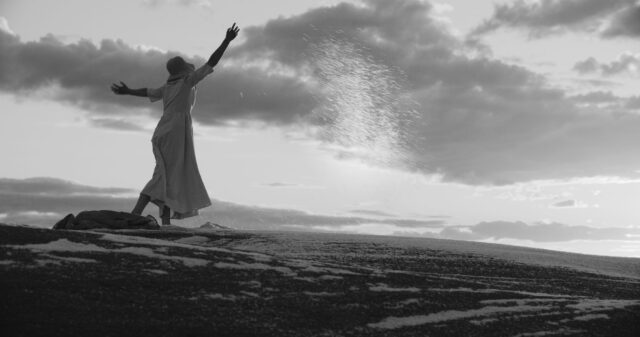
Trillion is a slow-paced, black-and-white mood piece with no dialogues at all, no plot to speak of, and long, repetitive takes. The setting is a rocky isle, or perhaps a peninsula, with no signs of human habitation and hardly even any grass, on which a person wearing a white dress and a sunhat, the face never clearly visible, walks barefoot, carrying large bags towards the coastline. There, the bags are emptied, one handful at a time, and small white particles float through the air, carried by the wind, landing on the dark rocks, slowly covering them like snow. Then the person walks the long stretch back again, to fetch the next bag. And the next. And the next – I quickly lost count.
The simplest way to describe this experience, I think, is as audiovisual ‘music’, something to let yourself be carried along by. Indeed, the music used, composed by Nastasia Khrushcheva, is very strong – sometimes subtle, sometimes forceful – and the film’s sound design is extraordinary. (And the fact there is a foley artist mentioned in the end credits signals that the sound wasn’t only recorded on site to reach its current level of perfection.)
When the waves crashed onto the rocks, the floor of the Tuschinski trembled – these kinds of rumbling bass tones you will not get at home. Nor will the expansive vistas convey the same awe-inspiring sublimity of nature on a small screen. In some shots, you might not even notice the tiny struggling figure, carefully placing her feet on the rocks, within the enormity of the landscape.
The black-and-white imagery is gorgeous, some of the best I’ve seen in recent years – and definitely more detailed than what your home cinema can display, no matter how good your set-up. The nuance is incredible, especially when combined with such stark contrasts. It creates a symphony of textures: of the rocks, which darken as they get wet, seeming like stranded whales; of the water; of the white dress fluttering in the strong winds; of the jute bags, which look like seals resting on the rocks. The effect is highly immersive.
But there is an even more important reason to watch the film on a big screen. Trillion is not a story, but an experience. And a cinema is the place to have these kinds of experiences. Both for the reverence they inspire, and for the concentration they encourage. As the opera house is for opera, and a church is for service, the cinema is a temple to its art form.
Now, the way the film is set up, and the way it progresses suggests you are not intended to know much more before you go in. As with a musical performance, the experience is both communal and highly personal – I can’t tell you what you will feel. So you could stop reading here.
However, although I consider it a minor spoiler, there is one thing that I didn’t recognise – maybe because I’m a city person – and would have liked to have known beforehand. Which is, that the small, very lightweight elements, which almost look like water particles when carried by the wind in slow motion, and which at one point are shown in beautiful microscopic close-ups, are fish scales. An enormous, almost unimaginable amount of fish scales, being carried by this person to the sea, to be eventually swept up by the wind and the water.
And now, for a slightly bigger spoiler (so again, you could stop reading here), that scale-dispensing person is the artist going by the name of K49814 – they wish to remain anonymous. And as an emotional Kossakovsky said about this gesture of returning the fish scales, after the film’s world premiere at IDFA: “It’s a way of saying sorry to the ocean.”
I can’t say I was as touched by this gesture as Kossakovsky was, or even that I got its message. But I’m in awe of how it has been recorded. For me, this intended offering to nature is, above all, an ode to Cinema – undoubtedly belonging on the big screen.
Norway/United States, 2025, 80 minutes
Director Victor Kossakovsky
Production Sant & Usant, Louverture Films
Producers Anita Rehoff Larsen, Joslyn Barnes, Tone Grøttjord-Glenne
International sales Anonymous Content
Cinematography Egil Håskjold Larsen
Editing Victor Kossakovsky, Ainara Vera
Sound design Alexander Dudarev
Sound Alexander Dudarev
Music Nastasia Khrushcheva
With K49814