

Belgian director Sien Versteyhe had already been contemplating making a film about sexual violence when, by chance, she met a therapist at a wedding. They started talking.
The therapist worked in a care centre for victims of sexual violence. That discussion was eventually to lead to the director’s new feature documentary The Sessions (a world premiere earlier this week in IDFA’s Luminous section and produced by Wouter Sap for Lionheart Productions with VRT support).
“You can get therapy and you can also talk to the police…” Versteyhe says of the care centre. She spent many days there, meeting victims who had gone there for help. She eventually encountered one young woman who had been sexually assaulted by someone close to her – and who agreed to be filmed during the therapy sessions.
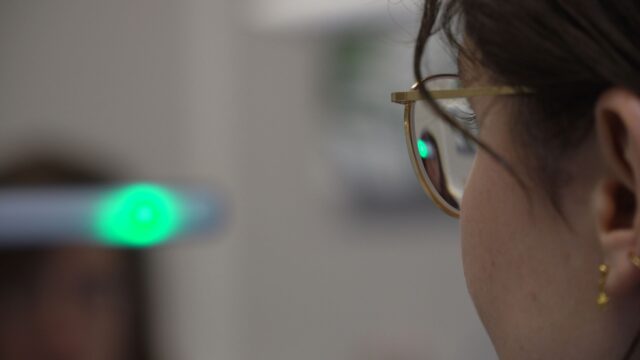
This was a courageous and unusual decision. Although the woman is the main protagonist in The Sessions, we don’t see her face. Instead, she is filmed from behind as she talks to her therapist. Versteyhe was in the room on her own, without any other crew, filming and doing the sound.
“At first, I thought maybe I would work with three people but after a couple of sessions with her, I really found out that the sessions were so deeply emotional that they had to have more time [devoted to them]. I thought it was important that it was just her. I talked to her and she said, ok, yes, that’s also good.”
The director agreed immediately not to reveal her subject’s face. She was also determined to tell the story at feature length. “I felt that it needed time to show what the impact is.”
Versteyhe felt this was an important project to tackle now. “I had the feeling that we are talking more and more about sexual violence but that we are talking about it in the wrong way. I still feel that. In the stories we see or hear, the perpetrator is almost always the man in the bushes, the monster, and the survivor is always weak. We’re not getting any further than the image of a weak victim in a shower…that’s not the reality.”
The woman in the documentary may be vulnerable and traumatised but she is not weak. As the film reveals, she is doing everything she can to put her life back together. She undergoes sessions using an Eye Movement Desensitisation and Reprocessing (EMDR) light. The idea here is that a patient thinking about a traumatic event will look at this light. “It preoccupies the brain and takes away a little of the emotion. You re-process the trauma,” the director explains.
Versteyhe’s shooting style is deliberately discreet. She was filming in a confined space. “But it’s quite intense to be there, both emotionally but also doing the camera.”
After the sessions, she and the woman would walk home together. That gave them the opportunity to relax and process what had just been discussed.
The woman is a criminology student. “She knows how it works and who she has to call, but even then it is very difficult to navigate,” Versteyhe says of a criminal justice system which often seems slanted against the victim of sexual violence. “It’s a very difficult system and it is very hard for her. I also found that very interesting, that other people don’t know where to go. Hopefully, they find their way to the care centres – and find some help.”
The government provides funding for up to 20 therapy sessions for victims. The director filmed several of her subject’s sessions over a period of many months. This meant she had plenty of material, around 40 hours, to draw on. She also shot the woman during her daily life, but eventually decided to leave most of this footage out, and instead to focus on the sessions themselves. Versteyhe did some of the initial assembly work herself before bringing in veteran editor, Dieter Diependaele.
The woman’s assailant is someone she knows well and once liked. “Her story is a very typical story in Belgium. 90% of the perpetrators are people known to their victims,” the director cites one disturbing statistic. “I felt like I had to show something different.”
The man initially admitted his guilt – but soon backtracked. When the woman tried to press charges against him, she had no success. It was her word against his. In the documentary, we hear how, when she was out walking in Ghent with her boyfriend and was about to buy an ice cream, she suddenly saw him and was overcome with feelings of panic and distress.
“I wanted it to tell a small story from the [perspective] of the victim herself, and I hope a lot of people can recognise the story,” Versteyhe reflects.
The filmmakers are now planning an impact campaign. Versteyhe is already talking to NGOs and influencers, “people who would help me reach the right people to watch my film.”
There are plans to show the film in the therapy centre and Versteyhe is hoping the documentary will change attitudes, “even if it’s very small, something in somebody’s mind, or also potentially something bigger, like policy changes for victims when they press charges.”
Versteyhe waited until the film was almost finished before showing it to her subject. “She was happy. She said it was a good summary of what happened…and she didn’t think there was that story in it.”
Does the director now consider her subject a friend? She parries the question. “We have a special relationship, I think, because I have heard and seen a lot of moments together with her where normally she would have been alone…As a filmmaker, it’s always like that, I think – you see people at moments that they are normally not seen in.”





