In New Zealand, ‘The Soldier’—a figure who has fought and died in endless wars—recounts his journey from childhood to the battlefield, haunted by Amir, a ghostly reflection of himself. As he confronts the truth of his identity, he seeks to escape his eternal cycle of war and resurrection.
This is the intriguing premise of one of the docs showcased at this year’s IDFA Forum, co-produced by Serbia’s Set Sail Films, Croatia’s Sekvenca, and Germany’s inselfilm production. BDE spoke to producer Friedemann Hottenbacher to dig deep into this ambitious project.
The Eternal Soldier follows the story of the titular tragic figure who has fought and died in every war since the dawn of time, only to be resurrected again and again. As soldiers perform a Haka around his coffin, he begins to recount his tale, starting with his seemingly ordinary childhood. After a head injury during training, he experiences haunting dreams and phantom memories that intensify when a new war erupts. Obsessed with hunting down the ghostly Amir, he eventually discovers that Amir is a reflection of himself. As the cycle of violence continues, The Soldier must confront his destiny and seek a way to break free.
Director Aleksandar Nikolic is a Belgrade-born, London-based director and editor with a career spanning film and television since 2003. He has directed two feature docs, including The Serbian Lawyer and Guidance Through the Black Hole, which premiered at Sarajevo Film Festival in 2017. Known for his use of archival material, his films explore human paradoxes, political narratives, and the unstable nature of truth. Alongside directing, he edits high-profile TV docs for the BBC, PBS, and Channel 4.
The Eternal Soldier is a long-gestating project. “We’ve strategically positioned the project as a distinctive fusion of artistic vision and commercial viability,” reveals Hottenbacher. “We welcomed Kevin Sim, an esteemed creative executive and BAFTA-winning, UK-based director-producer, to the project. Sim has made several important films about soldiers and war—most notably, Four Hours in My Lai. When he came on board, he not only helped us shape the narrative, but also imbued it with the authority derived from the rich literary tradition of poetry that explored similar subject matter in a different form. It is then that the film really started to assume its current form of an epic poem. […] Narrated in English, the film will feature a distinguished voice portraying the role of ‘The Eternal Soldier’, aligning with the director’s vision.”
Hottenbacher and his team bill their work as “an unprecedented fusion of documentary realism and imaginative storytelling,” capable of “transporting audiences into a realm where authentic soldier footage intersects with a fantastical narrative inspired by timeless literature.”
Loosely based on the poem ‘A Strange Meeting’ by Wilfred Owen, the film’s protagonists are dead soldiers, but they are not entirely products of imagination. “Our narrative device is to use a real telephone conversation between two opposing commanders in Chechnya as a central scene in the film and then to imagine their prior and subsequent lives, extending their stories all the way into eternity where they finally realise that they are in fact two sides of the same coin,” Hottenbacher continues.
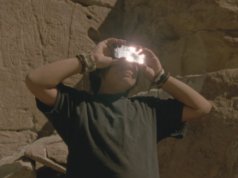
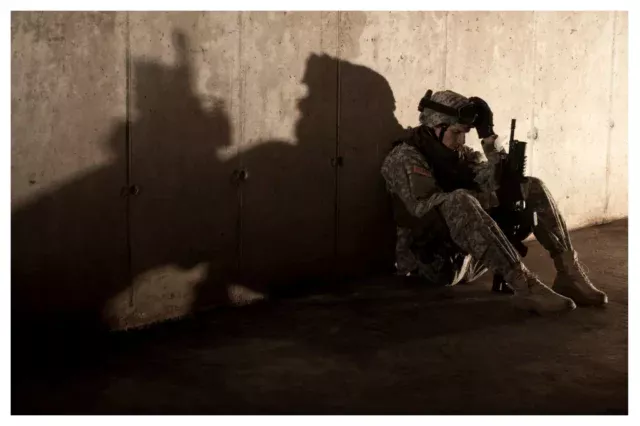
“The story, told in voice-over, is obviously fictional,” he adds. “However, every frame in the film is made up of authentic, documentary footage, often filmed by the soldiers themselves. A tearful father presents his son with the US flag as the son goes off to war; a wife tells their child how proud she is of her husband who is protecting their country; a funny British soldier recreates an episode of MTV Cribs in a remote outpost in Afghanistan; a Ukrainian soldier nonchalantly drinks coffee and smokes in between firing his machine gun; an Armenian soldier hides from sniper fire that is getting closer and closer; a trembling veteran admits his war crimes.”
“This archive is some of the most dramatic and emotional material ever recorded. However, it is through the juxtaposition of this highly authentic drama with the storytelling reminiscent of a Greek tragedy that the film escapes the particularities of our recent wars and encourages the audience to reflect on some of the biggest questions that have ever faced humanity.”
In his director’s notes, Nikolic defines his work “a labour of love and pain.” “Love because I was desperate to tell this story, and pain because I didn’t know how. How do I make a film about one of the most incomprehensible phenomena in human history: our addiction to war? How do I capture the tragedy without falling into fatalism and how do I embrace hope without appearing naive? Above all, how do I rise above everyday politics to capture something truly universal?”
Zooming in on his personal connection with the film’s themes, he discloses: “On the day that my twin brother and I were born, our grandmother was at a commemoration ceremony for almost 3,000 Serbian civilians massacred by German soldiers in 1941. She was there because amongst the dead were her two brothers, killed when they were 12 and 14. When she heard that my brother and I were born on the same date that her brothers died, she was immediately convinced that we were their reincarnations. It is something that she believed to the day that she died.”
“Taking this moment of family trauma as a starting point, I then came up with the concept of The Eternal Soldier,” Nikolic continues. “What we have now is a cut which is still very much a work in progress, but which conveys the intention of the film as well as our artistic approach. We think that now is the perfect time to engage with a commissioning editor who can help us shape the final film.”
Budgeted at €534,760, The Eternal Soldier is slated for a release in April 2026.