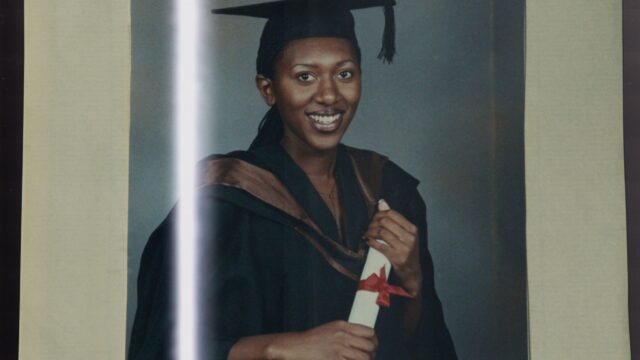
The fascinating subject of well-educated Kenyans making money writing essays for Western undergraduates and doctoral students is investigated with a distinctly personal touch by sociologist Patricia Kingori, the youngest female black professor in the 925-year history of the University of Oxford, herself born in Kenya. Kingori focussed her doctoral research on the ethical challenges experienced by frontline workers.
The notion of these Western students going online and paying somebody to do their work – perhaps even delivering an essay overnight because a deadline is looming – is a deeply unethical one. Yet while most people may think of this as old-fashioned cheating, for many Kenyans, who need to make money whilst utilising their good education, the practice might better be termed “academic writing.”
After hearing of a worldwide network of well-educated Kenyans who write essays for Western students, director Eloïse King follows Kingori as she travels to Nairobi to seek out these behind-the-scenes academic writers and get them to offer their perspective. “When I heard about the fake essays I wanted to know how it came about,” she says. “You have got to pay attention to the fakes!”
There are other places around the world where outsourcing takes place, but Kenya is very much the hot spot. Often the on-line profile pictures of these writers-for-hire are of a white face, in an attempt to give the impression the work is written in the West. But very often these Kenyan workers receive a mere $1 an hour to deliver an essay, paid via a middle-man. That said, figures will vary, depending on whether it is a simple piece or an entire PHD thesis. It is estimated some 50,000 Kenyans are members of this army of “shadow scholars.”
Kingori interviews a series of young Kenyan essay writers, all well-educated but often unable to find work that tallies with their academic achievements. For example, Mercy is an exhausted single mother of an eight-year-old child, who explains how she has spent the night finishing two essays on different subjects. Her input will never be revealed, but instead an ‘influencer’ who has just graduated might talk on their social media about how hard they personally have worked to deliver the essay.
Kingori also discusses this ‘contract cheating’ with Tricia Bertram Gallant, Director of UC San Diego Academic Integrity Office who mentions research from 2018 claiming that 37 million students worldwide have engaged in contract cheating. “These numbers are mind-blowing,” she says, “We want to graduate ethical students.”
She also meets Dr Thomas Lancaster, an expert in academic integrity, computer science and higher education, who has written extensively about the subject over recent years, and who also discusses the increasing power of Artificial Intelligence when it comes to essay writing. In an article he writes how such ‘contract cheating’ can be facilitated using online auction sites.
Patricia Kingori makes for a powerful guide into this ethically uncomfortable world, often upset and moved by the personal stories of these intelligent young Kenyans, and at the core asks the question “who is the shadow – the student or the writer.” Both are shadowy, but the clear difference is that the student is essentially cheating, while the Kenyan writer retains a sense of pride in the work they have delivered.
Straight-forward in tone and structure, the film could well have been tighter, but the underlying story is an important one. It would be easy to get lost in statistics and be justifiably angered about the system being abused, but The Shadow Scholars is at its best when it reveals the real-life stories of the warm and intelligent young Kenyans doing their best to make a difference and also make some money. And, as Kingori asks, if the world’s elite can pay for degrees they didn’t earn, and educated Kenyans cannot find jobs outside this industry, then what is the real value of education?
UK, 2024, 98mins
Dir/scr: Eloïse King
Production: White Teeth Films, Lammas Park
International sales: Dogwoof
Producers: Anna Smith Tenser, Bona Orakwue, Tabs Breese
Cinematography: Eloïse King, Jermaine Edwards, Justin Ervin, Joel Honeywell, Jonas Mortensen, Anna Patarakina
Editors: Cinzia Baldessari, Julian Quantrill, Maya Daisy Hawke
Music: Keir Vine, Nyokabi Kariuki