

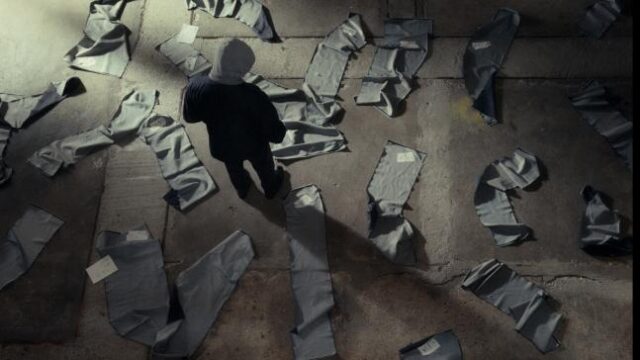
There can be few films in IDFA this year as disturbing as The Lost Souls Of Syria, a world premiere in the festival’s Frontlight section. Directed by Stéphane Malterre and Garance Le Caisne, the film tells the story of the thousands of people tortured and killed by the Assad regime in Syria and of the agonising battle for justice fought by their relatives and friends.
The film’s witnesses include ‘Caesar,’ seen on camera wearing a mask, a former military photographer who fled to the west in 2014, smuggling horrific images of Assad’s many victims which he himself had recorded.
The film has its origins in the book ‘Operation Caesar,’ that Garance Le Caisne wrote about the atrocities committed in Assad’s jails. Stéphane Malterre had read the book. He had also made earlier films on similar subjects, for example The Father, The Son and The Holy Jihad which screened in IDFA in 2016.
As the filmmakers tell Business Doc Europe, working together came very naturally. “He asked me if I would like to work with him. I was very pleased,” Le Caisne confirms.
“In 2016, when I approached Garance to do something about the Syrian death machine, what was the problem for us was that the fog of war and the rise of Isis had completely overshadowed the role of the Syrian regime in killing and destroying his own people,” Malterre remembers of how Assad’s atrocities seemed almost to have slipped out of consciousness. The co-directors shared a determination to remind the public what had been happening in Syria.
“If you look at the Syrian crisis, if ten people are dying, eight are dying because of the regime – because of shelling and forced disappearance, because of the system which was grabbing and trapping so many people and putting them in detention centres, and starving and torturing them,” Malterre notes.
When they were in Syria, both could see what was going on. They knew, as Le Caisne puts it, that there had been “a large number of disappearances…but you don’t see torture, you don’t see forced disappearance,” she says of the way the Syrian media studiously avoided the subject. “We wanted to dig deeper.”
The film includes footage of President Assad being confronted over the killings by Michael Isikoff, a leading US investigative journalist. With astonishing effrontery, Assad simply denies he was responsible.
“Why not deny? It is what he has been doing for the last 10 years and it works. He is still in power and so why not?” asks Le Caisne, “He [Assad] has such a big feeling of impunity.”
The international community has largely failed to intervene. Assad has therefore been able to ignore the evidence against him. “Even so, in his answers, there is a very important segment. He is saying it is possible that there is crime but that it is not the system. I think he is trying to protect himself,” the director suggests of the way Assad is attempting to distance him from skullduggery committed under his watch.
It’s the familiar ‘rogue elements’ defence in which a dictator blames his misdeeds on somebody else.
As for the whistleblower Caesar, the directors were impressed by his frankness. He talked very openly about his job chronicling the torture and the slaughter.
“It was a very long process to convince him to do this. Garance introduced me to Caesar. She had known him for a very long time and had a strong relationship with him. [But] I was just discovering the guy. It was difficult for me. Usually when I make a film and I meet the character, the first thing I am trying to do is understand who he is on a personal level. What are his motivations? What are his feelings? What’s in his mind? Where does he come from…all those things are very important, but with Caesar, very quickly I understood very quickly that there was no possibility to go on this path,” says Malterre.
Caesar remains in hiding. He is shy anyway and has to be furtive in order to survive. He wasn’t going to give much away about himself. “But he was willing to talk about his job [for the regime], what he was doing.”
Malterre jokes that Caesar was like the man “in the iron mask” in the famous Dumas novel. “I was feeling in a way that Caesar is a prisoner of his truth,” the director suggests of his subject. The mask had a symbolic as well as a practical purpose. It wasn’t just concealing his identity but was also underlining his loneliness and isolation. “He is a prisoner also,” Le Caisne says.
This is a documentary with both cinema verité and film noir elements. It has lots of shots of people talking in rooms, but they’re framed in moody and often oblique fashion. “When we started working, I told Garance that I wanted to make a film with a cinematic language and so we definitely need to find ongoing stories. Then, we will follow the different steps of the stories….in film noir, you have two things. One part is the investigative quest for truth. On the other side is the dilemmas, loneliness and suffering of the characters.”
The directors both point out that the war is not over. “When somebody disappears, the pain will last forever unless you find the bodies,” Le Caisne suggests.
The exhibition of the photos of the dead can’t help but seem grim in the extreme. Early on, Malterre had thought he wouldn’t show any of the pictures. Eventually, during editing, he decided he needed to use these images.
And, yes, being exposed to such horror took its toll on the filmmakers. Malettere suggests that the work itself provided him with “a kind of psychological armour.” He concentrated on the practical challenges at hand and tried not to confront the horror which, otherwise, would have overwhelmed him.
“I have a very nice psychologist. She used to work with refugees and victims of political violence and torture,” Le Caisne says. “I went through different stages. At first, I was not shocked by the photos but was I was shocked by the testimony of survivors. After, I was shocked by the images.”
She forced herself to look at the pictures, even when they disgusted her. By doing so, she felt she was expressing her sympathy and humanity toward the lost souls. “When he [a victim] has been killed, his body was thrown in a mass grave. Who looked at him? Maybe his family didn’t recognise him in the photos. Maybe nobody gave him a sympathetic look…so I came back to the guy and I took some time to look at him…it’s a goal of this movie to bring these disappeared people back to our world, to make them alive again and to be able to bury them in a decent way…”
Sold internationally by The Party Film Sales, the film will be released in France by Sophie Dulac Distribution.





