

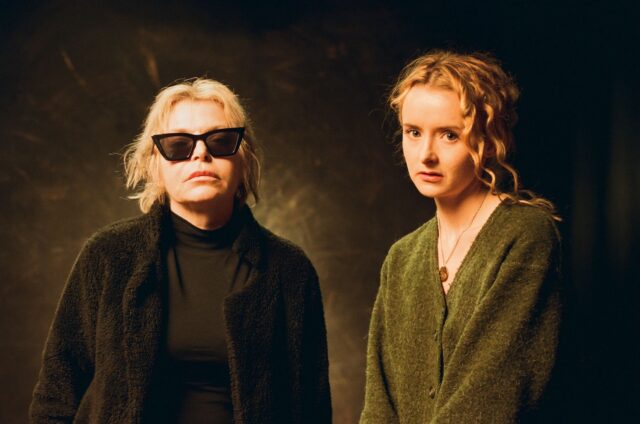
Love may be at the heart of Myrid Carten’s feature documentary debut A Want In Her, but it comes at a price. When the director answered a call to return from London to help find her mother who had gone missing somewhere in Ireland, her response to the crisis was immediate, but so was her reflex to pick up her camera to record the process.
Myrid’s mother Nuala is a waiflike character who was once a successful social worker but who suffered a mental breakdown after the death of her mother. In looks, she resembles Michelle Pfeiffer and she has a fierce intelligence, as well as a deep well of cultural knowledge. Her favourite film is the Ealing classic Kind Hearts and Coronets.
But Nuala suffers severe bouts of acute alcoholism which can render her both comatose and incomprehensible. She admits to a doctor to drinking 18 bottles of cider per day, although we’re not told what size of bottle she is consuming. She has also been sectioned three times and once believed she was the dead Republican hunger striker Bobby Sands.
She loves her daughter Myrid deeply, and that love is reciprocated – unconditionally. In one very affecting scene Myrid lip syncs her mother’s words in interview, only to stop and genuinely take in what her mother is saying. While Nuala is one of ten children, Myrid is an only child. And as such she has had to take on the role of surrogate parent to Nuala, as well to her two feuding uncles, Kevin and Danny, the latter of whom also suffers severe mental health problems.
Throughout the film, Myrid films the process of locating her mother, overseeing a slow and uncertain rehabilitation and managing the family’s ever-escalating dynamics, including the death of one of her uncles. What’s more, she is left in no doubt that she is alone in looking after her mother, as the strain is too great for her remaining uncle.
We also see that Myrid has been obsessed by the camera since she was a child, but even the role-plays that she performed as an adolescent with her friends have acutely observed familial discord at their root.
It is a film both grim and engaging, at times very funny but at other times claustrophobic and with a continual sense of impending doom, which is captured by a camera that ghosts across ceilings and down walls, and an immersive soundscape that will have you looking over your shoulder, such is its intensity.
“I didn’t hold back on anything really,” the director tells Business Doc Europe. Yes, she felt a deep sense of responsibility towards her family, but she felt equally deep responsibility for the integrity of the film she was making.
“The more I start outsourcing and projecting and mind-reading what other people want, the less responsibility I take for my own work,” Carten (Myrid) tells BDE. “I have to stand over it and I have to take responsibility for it…I think there’s a big trend in documentary at the minute where everybody wants everything to be a collaboration. But if it’s not like my ma is going to make this film on her own. It was me who was driving it, and that means that, yeah, I’m responsible then for the outcome.”
Nor is Carten intentionally seeking to experience catharsis with the film, even if the process of making it proved to be a very emotional one. “I’m not making art and films as therapy – therapists are very well paid for a reason!” she says in her production notes. “I’m making a film because I want to communicate something, and I think the space between the film and the audience creates something more than the sum of its parts. But for me, the one therapeutic reflection that I’ve observed is that having a camera always makes me feel like I have a purpose in a situation of crisis.”
“I have agency here,” she continues. “I think it was useful in that it allowed me to ask questions that otherwise I might have been too afraid or defenseless to ask, or would entangle me in the dynamic. Also, I feel it allowed my mother to feel like I was taking her seriously and that she had a voice and that her experience mattered. So it did create a different dynamic for us that wasn’t so much about co-dependency, but about being present and witnessing something for each other.”
Not that she isn’t tough on her mum at times. She films Nuala senselessly drunk on a city-centre bench without intervening, and later upbraids her mother for accepting how the diagnosis of mental illness can be used to justify the way she behaves. It was a conversation that the director deeply regretted, she admits. “I went home that day and I cried and went back and apologized to her because – and for me this is one of my own issues [that] I’ve had to overcome – of this sense of self-righteousness and this sense of not accepting her powerlessness over her illness and getting very frustrated with her.”
Carten doesn’t feature her father in the film, just his voice on occasion. He was a mental health social worker and so she was familiar with the “slippery” business of mental health diagnosis from an early age. Her father suffered a stroke five years ago and the director decided to keep him out of frame.
“I love my family. I think they’re quality on screen, and I’m so grateful that I have this footage of my Uncle Danny and people that have passed away,” Carten reflects on her finished film. “I think, for me, it’s created a sense of meaning and purpose out of something that was a bit of a mess. And it helps to remind me sometimes of moments where I have had grace, and there’s been grace enough in my life that there has been strength. But it also really helped me to see the mistakes that I made and I’ve been able to do things differently as a result. [Such as] with the bench scene. I don’t think I made the right call that day for sure.”
The “inner strength” that Carten inherited from her mother is conversely that which enables her not to be “consumed” by her, she suggests. Those strengths manifest themselves more in her sense of humour and her ability to “write a good funding application.”
“Some people have said, oh, you must have this great fear that you’re going to become your mother, and – there for the grace of God, go I – I kind of know that I’m not an alcoholic. I’ve had my own issues and I can see how anybody can have a breakdown for sure,” she says.
“But I have done a lot of soul searching and I kind of trust it. It doesn’t have to always repeat itself. These cycles don’t always have to repeat themselves,” she signs off.
A Want In Her is produced by Tadhg O’Sullivan and Roisín Geraghty for Inland Films, and Kat Mansoor for Snowstorm Productions (UK), in co-production with Eline van Wees (The Netherlands).





